From Hospital Success to Hopeful Beginnings: Geofinity Expands OptERP into IVF Solution
The journey toward parenthood can be deeply personal, emotionally demanding, and medically complex.
For fertility clinics, that journey is also operationally complex.
A single IVF cycle can involve consultations, investigations, hormonal monitoring, medication schedules, procedures, laboratory processes, embryology records, embryo tracking, billing, documentation, follow-ups, and continuous communication with patients.
When these activities are managed across paper files, spreadsheets, disconnected applications, phone calls, and manual registers, the result can be fragmented information and unnecessary administrative work.
This is where digital IVF clinic management becomes increasingly important.
Geofinity, through OptERP-Healthcare, is expanding its healthcare management capabilities into the IVF and fertility-care ecosystem with a dedicated IVF Management System designed to connect clinical, laboratory, administrative, patient, and financial workflows.
IVF requires precision in the laboratory, coordination in the clinic, and empathy throughout the patient journey. Digital systems can help connect all three.
IVF is Becoming a Digital Healthcare Challenge
Infertility is not a niche healthcare issue.
The World Health Organization estimates that approximately 1 in 6 people of reproductive age experience infertility at some point in their lives. WHO's 2025 global infertility guideline also emphasizes the need to improve the availability, accessibility, quality, and affordability of fertility care.
For fertility providers, this creates an increasingly important operational challenge.
More patients seeking fertility services means more:
• consultations,
• diagnostic records,
• laboratory investigations,
• treatment plans,
• medication schedules,
• cycle monitoring,
• procedures,
• embryo records,
• follow-up appointments,
• financial transactions,
• and patient communications.
The complexity increases further when a clinic handles multiple treatment cycles simultaneously.
This makes the IVF clinic more than a conventional outpatient environment.
It is a multi-stage clinical and laboratory ecosystem.
Why IVF Needs a Modern Management System?
IVF involves a sequence of interconnected decisions and activities.
A typical digital workflow can be represented as:
Patient Registration
↓
Initial Consultation
↓
Infertility Assessment
↓
Treatment Planning
↓
Cycle Initiation
↓
Medication & Hormonal Monitoring
↓
Ovum Pickup
↓
Fertilization
↓
Embryology
↓
Embryo Selection/Tracking
↓
Embryo Transfer
↓
Pregnancy Testing & Follow-up
Every stage generates information.
The challenge is ensuring that the right information reaches the right person at the right time.
A modern IVF management system therefore needs to do more than store patient records.
It should help coordinate the entire IVF workflow.
The Problem With Fragmented IVF Workflows
Many healthcare organizations still operate with a combination of:
• paper records,
• spreadsheets,
• standalone laboratory systems,
• accounting software,
• appointment systems,
• messaging applications,
• and separate patient databases.
Each tool may solve an individual problem.
The problem is the gap between them.
| Fragmented Workflow | Integrated IVF Workflow |
| Multiple patient records | Centralized patient profile |
| Manual scheduling | Structured cycle scheduling |
| Paper-based documentation | Digital clinical records |
| Separate lab information | Connected embryology workflow |
| Manual reminders | Automated notifications |
| Separate billing | Integrated financial workflow |
| Difficult reporting | Centralized analytics |
| Repeated data entry | Shared information |
| Manual tracking | Structured cycle monitoring |
The goal of an IVF management platform is therefore not simply to "computerize paperwork."
It is to connect the patient journey.
Why Nepal Needs Digital IVF Management?
Nepal's broader healthcare system is already moving toward digital transformation.
The Ministry of Health and Population has been developing a national digital health ecosystem focused on electronic health records, interoperability, health information exchange, and standardized digital systems. Its EHR initiative envisions electronic records containing information such as prescriptions, test reports, medical history, diagnoses, procedures, allergies, and other relevant patient information.
Nepal has also established SIL-Nepal, a health interoperability laboratory focused on standards, testing, training, and interoperability across digital health systems.
The country has also been working toward standards such as HL7 FHIR, which is designed to support structured exchange of healthcare information between systems.
Recent EMR implementations supported by WHO further demonstrate the direction of travel. In 2025, EMR systems were handed over to hospitals including APF Hospital and G.P. Koirala National Center for Respiratory Diseases, with phased implementation and alignment with Nepal's broader digital-health strategy.
This creates an important opportunity for specialized healthcare platforms.
IVF should not exist as a disconnected digital island.
It should be capable of participating in the broader digital healthcare ecosystem.
OptERP-Healthcare: A Complete IVF Cycle Management Solution
OptERP-Healthcare by Geofinity has already made a significant impact in hospital and clinical care management. Now, Geofinity is taking its expertise into the IVF sector, providing a comprehensive, integrated solution that covers every stage of the IVF process. Here’s how OptERP’s IVF management system works:
IVF is one of the most complex medical journeys, demanding absolute precision in the lab and immense empathy in the clinic. Too often, clinics rely on fragmented systems that create administrative burdens and increase the risk of error.
OptERP-Healthcare changes that. We provide a single, integrated platform that seamlessly connects clinical workflows, embryology lab data, and patient communications.
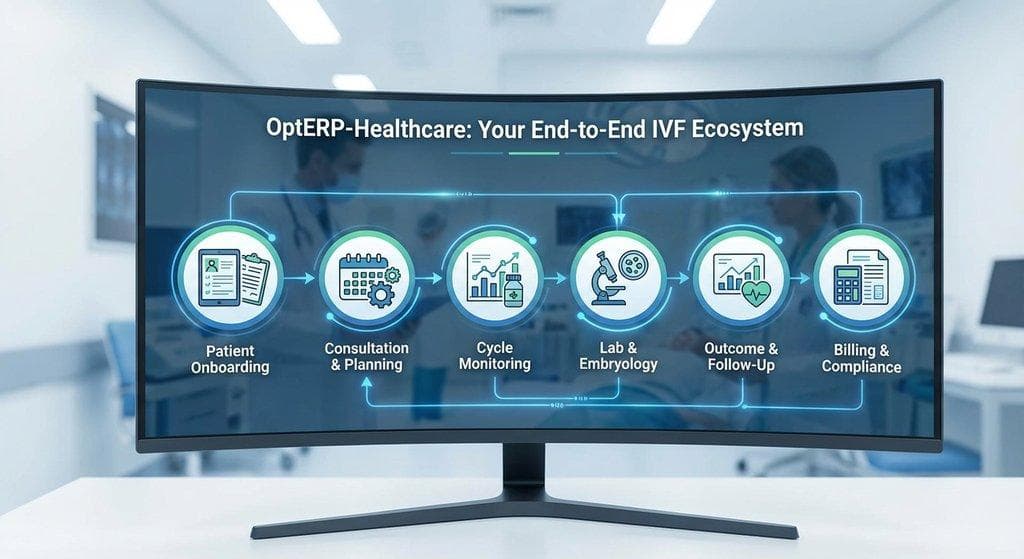
Your End-to-End IVF Management Ecosystem
1. Streamlined Patient Onboarding
The Feature: Digital registration and centralized patient profiles.
Patient information can be organized into a structured digital profile rather than being distributed across paper files and disconnected records.
The Benefit:
A centralized profile can help reduce:
• repetitive data entry,
• misplaced information,
• duplicate records,
• unnecessary paperwork,
• and delays in accessing patient information.
More importantly, it gives authorized clinical staff a consistent view of the patient's journey.
The patient experience begins before the first treatment procedure.
It begins at registration.
2. Intelligent Treatment Planning
IVF treatment requires coordination between reproductive specialists, nurses, laboratory professionals, administrative teams, and patients.
The Benefit:
OptERP-Healthcare's structured workflow approach can help organize:
• treatment plans,
• appointments,
• cycle schedules,
• procedures,
• clinical tasks,
• and follow-up activities.
Why This Matters?
When treatment information is scattered, important activities can depend too heavily on manual coordination.
A structured workflow creates greater visibility.
| Traditional Approach | Digital Approach |
| Manual appointment tracking | Structured scheduling |
| Paper treatment plans | Digital treatment workflows |
| Phone-based coordinations | Centralized task visibility |
| Repeated follow-up | Automated reminders |
| Difficult cycle overview | Cycle-based dashboards |
3. Proactive IVF Cycle Monitoring
An IVF cycle is time-sensitive.
Medication schedules, monitoring appointments, hormone tests, procedures, and laboratory activities must happen according to the clinical plan established by the care team.
OptERP's IVF workflow can help clinics track important cycle milestones and scheduled activities.
Potential Workflow:
Cycle Started
↓
Medication Schedule
↓
Hormonal Monitoring
↓
Clinical Assessment
↓
Ovum Pickup
↓
Fertilization
↓
Embryology
↓
Embryo Development
↓
Transfer
↓
Follow-up
Digital monitoring does not replace clinical judgment.
Instead, it provides a structured environment in which clinical teams can see where each cycle is within the workflow.
The objective is not to automate medical judgment. It is to make the information required for that judgment easier to access and manage.
4. Seamless Laboratory & Embryology Integration
The IVF laboratory is one of the most data-intensive parts of the fertility-care process.
Embryology teams may need to maintain information associated with:
• oocytes,
• sperm,
• fertilization,
• embryo development,
• embryo grading,
• laboratory procedures,
• cryopreservation,
• storage,
• and transfer.
This creates a strong case for connecting clinical and laboratory information.
OptERP's Approach:
OptERP-Healthcare is designed to bridge the clinical and laboratory sides of IVF workflows through structured embryo and cycle information.
Instead of reproductive specialists relying on disconnected communication channels to obtain laboratory updates, the platform can provide a shared digital workflow.
The Goal:
Clinic + Laboratory + Patient
should operate around the same treatment record.
This can improve visibility and reduce unnecessary administrative communication.
5. Embryo Tracking and Traceability
Embryo-related information requires particularly careful management.
A fertility management system should therefore support clear identification and traceability throughout the relevant laboratory workflow.
Important information can include:
• cycle identification,
• patient identification,
• laboratory events,
• embryo development information,
• grading information,
• storage information,
• and transfer-related records.
The exact clinical and laboratory protocols should remain under the control of qualified fertility and embryology professionals.
The software's role is to provide the digital infrastructure for recording, retrieving, and organizing that information.
6. Empowering Patients Through a Digital Portal
IVF can be emotionally overwhelming.
Patients may have repeated questions about:
• appointments,
• medications,
• test results,
• cycle progress,
• procedures,
• payments,
• and upcoming steps.
A secure patient portal can reduce unnecessary dependence on phone calls and fragmented communication.
OptERP's patient-facing capabilities can support access to relevant information and automated communications according to the clinic's workflow.
A Better Patient Experience
Instead of:
Patient → Phone call → Reception → Nurse → Doctor → Response
a digital workflow can enable:
Patient → Secure Portal → Authorized Information
This does not eliminate human communication.
It makes that communication more efficient.
7. Automated Results and Notifications
Timely communication is especially important during fertility treatment.
A digital IVF platform can support automated communication for events such as:
• appointment reminders,
• scheduled procedures,
• follow-up instructions,
• available results,
• payment notifications,
• and other clinic-defined communications.
Automation should always be configurable and subject to the clinic's clinical policies.
The objective is not to replace healthcare professionals.
It is to reduce repetitive administrative work.
8. Integrated Billing and Financial Management
IVF treatment involves multiple financial components.
Depending on the clinic and treatment plan, these can include:
• consultation fees,
• diagnostic tests,
• medications,
• procedures,
• laboratory services,
• embryo-related services,
• storage,
• follow-up,
• and other treatment-related charges.
Managing these separately from clinical records can create administrative friction.
OptERP-Healthcare's integrated ERP approach can connect:
Patient → Treatment → Services → Billing → Payment → Reporting
This provides clinic administrators with a clearer picture of operational and financial performance.
9. Reporting and IVF Analytics
A modern IVF management platform should not only record data.
It should help clinics understand it.
Potential reporting areas include:
| Analytics Area | Example Insight |
| Patient volume | Number of fertility patients |
| Cycle volume | IVF cycles by period |
| Treatment stages | Patients at different cycles stages |
| Laboratory activity | Embryology workload |
| Appointment data | Utilization and scheduling |
| Revenue | Treatment-related financial performance |
| Outstanding payments | Receivables |
| Operational performance | Bottlenecks and delays |
| Patient communication | Notification and engagement activity |
However, clinical success metrics must be interpreted carefully.
A digital platform can help capture and report clinical outcomes, but it should not imply that software itself causes higher pregnancy or live-birth rates.
Clinical outcomes depend on factors including patient characteristics, diagnosis, age, treatment protocols, laboratory quality, clinician expertise, and many other variables.

From Data Storage to Clinical Intelligence
The next generation of IVF systems will increasingly move beyond simple record keeping.
Once structured data exists, clinics can potentially use it for:
➞ Operational Analytics
Where are treatment bottlenecks occurring?
➞ Capacity Planning
How much laboratory and clinical capacity is required?
➞ Patient Flow Analysis
Where are patients experiencing delays?
➞ Outcome Reporting
How are treatment outcomes changing over time?
➞ Quality Management
Are processes being followed consistently?
➞ Research
Can appropriately governed, de-identified data support clinical research?
This is where digitalization becomes more than an administrative project.
It becomes a data infrastructure project.
Interoperability: The Next Big Requirement
A fertility clinic rarely operates in isolation.
It may interact with:
• diagnostic laboratories,
• hospitals,
• pharmacies,
• imaging systems,
• insurance systems,
• national health systems,
• payment systems,
• and other healthcare applications.
This is why interoperability matters.
Nepal's Ministry of Health and Population is actively working on digital-health interoperability and standards, including FHIR and related health-information exchange approaches.
A future-ready IVF management system should therefore be designed around:
Structured Data + APIs + Standards + Security + Interoperability
rather than becoming another isolated database.
IVF Data Is Highly Sensitive
Fertility information is among the most sensitive categories of health information.
An IVF system may contain:
• reproductive history,
• infertility diagnosis,
• hormonal information,
• genetic information,
• semen analysis,
• pregnancy information,
• embryo information,
• treatment outcomes,
• financial records,
• and personal identification data.
That means security cannot be an afterthought.
A responsible IVF management platform should consider:
• Role-Based Access: Different users should access only the information required for their responsibilities.
• Audit Trails: Important actions should be traceable.
• Encryption: Sensitive information should be protected during transmission and storage.
• Authentication: Strong identity and access controls should be implemented.
• Backup and Recovery: Critical clinical information needs resilient backup mechanisms.
• Data Governance: Clinics should clearly define how patient data is collected, accessed, retained, shared, and deleted.
Nepal's reproductive-health legislation recognizes confidentiality around reproductive-health services and information, reinforcing the importance of privacy in this domain.
IVF Digital Transformation Must Be Patient-Centered
Technology can make a clinic more efficient.
But IVF is ultimately about people.
Patients may experience:
• anxiety,
• uncertainty,
• repeated procedures,
• financial pressure,
• emotional stress,
• and long treatment journeys.
Therefore, the best IVF software should not be designed only around administrators.
It should be designed around the patient journey.
A Patient-Centered IVF System Should Make It Easier To:
• understand the treatment journey,
• know upcoming appointments,
• access relevant information,
• communicate with the clinic,
• receive timely updates,
• review records securely,
• understand billing,
• and maintain continuity across treatment cycles.
Technology should reduce complexity rather than add another layer of it.
A Better IVF Workflow With OptERP
The value of an integrated system becomes clearer when the complete journey is considered.
Before Treatment
Registration → Patient Profile → Consultation → Investigation → Treatment Plan
During Treatment
Cycle Initiation → Medication → Monitoring → Appointments → Procedures
Laboratory
Ovum Pickup → Fertilization → Embryology → Embryo Tracking → Storage/Transfer
After Treatment
Transfer → Follow-up → Results → Pregnancy Monitoring → Reporting
Administration
Billing → Payments → Claims → Inventory → Financial Reporting
Instead of managing these as separate systems:
OptERP-Healthcare brings them into a connected healthcare-management environment.
What Makes an IVF Management System Different from a General Hospital ERP?
A general hospital ERP handles broad healthcare operations.
An IVF management system needs additional workflow depth.
| General Hospital ERP | IVF Management System |
| Patient registration | Fertility-specific patient profile |
| OPD management | Fertility consultation workflow |
| Appointment scheduling | Cycle-based scheduling |
| Clinical records | Fertility treatment records |
| Laboratory management | Embryology workflow |
| Billing | IVF treatment packages and services |
| Reporting | Cycle and fertility analytics |
| Patient portal | Fertility journey communication |
| Inventory | Medication and laboratory supplies |
| General clinical workflow | IVF-specific milestones and traceability |
This specialization is important.
IVF is not simply another outpatient department.
Its workflow requires coordination between reproductive medicine, nursing, laboratory science, administration, and patients.
Why Integration Matters More Than Individual Features?
A clinic does not necessarily need dozens of disconnected software tools.
The real value comes from how those tools work together.
Consider a patient beginning an IVF cycle.
The same event may affect:
• the doctor,
• nursing team,
• laboratory,
• appointment desk,
• pharmacy/inventory,
• billing department,
• and patient portal.
If every department uses a separate system, information must constantly move between them.
With an integrated platform:
One clinical event → Multiple connected workflows
That is the real value of an ERP-based approach.
The Future of IVF Management in Nepal
Nepal's healthcare sector is moving toward greater digitalization.
The Ministry of Health and Population is developing the Nepal Digital Health Blueprint, while national initiatives around EHRs, Health IDs, interoperability, and digital health standards are also progressing.
This creates an opportunity for specialized systems such as IVF platforms to become part of a larger digital-health ecosystem.
Future fertility platforms could increasingly connect:
IVF Clinic
↕
Hospital EMR
↕
Laboratory Information System
↕
Pharmacy
↕
Patient Portal
↕
National/Shared Health Records
↕
Analytics & Research
The long-term goal should be a healthcare ecosystem in which information can move securely and meaningfully between authorized systems.
AI and the Future of IVF Software
Artificial intelligence will likely become another layer of fertility technology.
Potential applications could include:
• operational forecasting,
• appointment optimization,
• patient communication,
• clinical documentation assistance,
• data-quality monitoring,
• laboratory analytics,
• research support,
• and decision-support tools.
But AI should be introduced carefully.
It should support clinicians rather than replace clinical judgment.
For fertility care especially, AI-generated recommendations need strong validation, governance, transparency, and human oversight.
The foundation must come first:
Clean Data → Structured Workflows → Interoperability → Analytics → AI
Without reliable data, sophisticated AI simply produces sophisticated uncertainty.
Get more knowledge on: AI in Electronic Health Records
Building Trust Into IVF Technology
The most important metric for an IVF system should not simply be:
How many features does it have?
It should be:
Can clinicians trust the information?
A trustworthy system should provide:
• accurate patient identification,
• clear audit trails,
• reliable data,
• appropriate access controls,
• transparent workflows,
• backup and recovery,
• interoperability,
• and clear responsibility for clinical decisions.
In fertility care, where records can contain extremely sensitive reproductive and embryology information, trust is part of the product.
OptERP's Opportunity in Fertility Care
The expansion of OptERP-Healthcare into IVF represents a natural extension of Geofinity's healthcare technology work.
The opportunity is not simply to create another hospital software module.
It is to create a specialized digital infrastructure for fertility clinics.
The broader vision can be summarized as:
One platform. One connected patient journey. Multiple coordinated healthcare workflows.
From registration to treatment planning.
From cycle monitoring to embryology.
From patient communication to billing.
From operational data to analytics.
The goal is to make the complex IVF journey easier to manage for the people delivering care and easier to navigate for the people receiving it.
What IVF Clinics Should Look for in Digital Management Software?
Before selecting an IVF management system, clinics should evaluate more than the user interface.
✔ Clinical Workflow
• Can the system support the full IVF cycle?
• Can workflows be customized?
• Can different treatment protocols be configured?
✔ Laboratory
• Can embryology data be integrated?
• Can embryo information be tracked?
• Can laboratory workflows be connected with clinical workflows?
✔ Patient Experience
• Is there a patient portal?
• Are automated notifications supported?
• Can patients securely access relevant information?
✔ Data
• Are records centralized?
• Are audit trails available?
• Can data be exported securely?
✔ Interoperability
• Does the platform support APIs?
• Can it integrate with laboratory and hospital systems?
• Can it support recognized healthcare interoperability standards?
✔ Security
• Is role-based access available?
• Is sensitive data protected?
• Are backups and recovery procedures available?
✔ Analytics
• Can clinics monitor operational performance?
• Can treatment-cycle information be reported?
• Can management generate customized reports?
✔ Scalability
• Can the system support multiple branches?
• Can it scale with patient and cycle volume?
• Can new modules be added later?
A Practical Digital IVF Architecture
A mature IVF management ecosystem can be viewed as several connected layers:
| Layer | Function |
| Patient Layer | Registration, portal, communication |
| Clinical Layer | Consultation, diagnosis, treatment planning |
| Cycle Layer | IVF protocols, monitoring, appointments |
| Laboratory Layer | Fertilization, embryology, embryo records |
| Administrative Layer | Scheduling, billing, inventory |
| Analytics Layer | Reports, KPIs, operational insights |
| Integration Layer | APIs, HL7/FHIR, external systems |
| Security Layer | Authentication, authorization, audit, backup |
This architecture makes one thing clear:
An IVF management system is much more than an appointment application.
It is a specialized healthcare information platform.
From Hospital Success to Hopeful Beginnings
The future of fertility care will not be defined by technology alone.
Clinical expertise remains at the center.
But technology can create the infrastructure that allows that expertise to operate more efficiently.
For patients, this can mean a more organized and transparent treatment journey.
For clinicians, it can mean better access to information.
For embryologists, it can mean more structured laboratory workflows.
For administrators, it can mean greater operational visibility.
For clinic leadership, it can mean better data for decision-making.
And for the healthcare ecosystem, it can mean a stronger foundation for interoperability and digital transformation.
This is the opportunity behind OptERP-Healthcare's expansion into IVF management.
Conclusion: Technology Supporting the Journey to Parenthood
IVF is one of the most complex journeys in modern reproductive medicine.
It requires:
Precision.
Coordination.
Traceability.
Data.
Communication.
And above all:
Empathy.
A modern IVF management system cannot guarantee a successful pregnancy—and no responsible healthcare technology should make that promise.
What it can do is help clinics create a more organized, connected, secure, and data-driven environment in which healthcare professionals can focus on what matters most: caring for patients.
With OptERP-Healthcare’s IVF Management System, Geofinity is extending its healthcare technology experience from broader hospital and clinical management into the specialized world of fertility care.
The vision is not simply to digitize IVF.
It is to connect the entire IVF journey.
From hospital success to hopeful beginnings, the next chapter of healthcare technology is about making complex care more connected, more human, and easier to manage.
Frequently Asked Questions (FAQs):
Q. What is an IVF Management System?
An IVF Management System is specialized healthcare software designed to manage fertility-clinic workflows such as patient registration, consultations, treatment planning, cycle monitoring, appointments, laboratory and embryology information, patient communication, billing, reporting, and analytics.
Q. Why do IVF clinics need specialized software?
IVF involves multiple clinical and laboratory stages that must be coordinated precisely. Specialized software can connect these workflows and reduce dependence on paper records, spreadsheets, disconnected applications, and manual communication.
Q. What should an IVF management system include?
Important capabilities can include patient management, treatment and cycle management, appointment scheduling, laboratory/embryology workflows, embryo tracking, patient portals, notifications, billing, inventory, reporting, analytics, security, and interoperability.
Q. Can IVF software improve IVF success rates?
Software should not be marketed as directly increasing pregnancy or live-birth rates. Its value is in improving workflow organization, data quality, coordination, documentation, monitoring, and operational efficiency. Clinical outcomes depend on many medical, biological, laboratory, and patient-specific factors.
Q. Can an IVF management system integrate with an EMR?
Yes, if the system is designed with appropriate APIs and interoperability standards. Nepal's digital-health ecosystem is increasingly emphasizing interoperability and standards such as HL7 FHIR.
Q. Why is embryo tracking important?
Embryology workflows involve highly sensitive information that needs accurate identification, documentation, and traceability. Digital systems can provide structured records and auditability for authorized users.
Q. Is IVF patient data sensitive?
Yes. Fertility records can contain highly sensitive reproductive, medical, laboratory, genetic, and financial information. IVF platforms therefore need strong access controls, security, auditability, and data-governance practices.
Q. Can patients access their IVF information online?
A fertility clinic can provide patients with a secure portal through which authorized information, appointments, notifications, results, and other clinic-defined information can be made available.
Q. Can OptERP manage other hospital operations alongside IVF?
OptERP-Healthcare is positioned as a broader healthcare-management platform, with the IVF solution extending its capabilities into specialized fertility workflows. The exact modules and integrations available should be evaluated according to each clinic's requirements.
Q. Why is interoperability important for IVF clinics in Nepal?
Fertility clinics may need to exchange information with hospitals, laboratories, pharmacies, diagnostic systems, and broader healthcare platforms. Interoperability helps prevent isolated data silos and supports a more connected digital-health ecosystem.
Q. What is the future of IVF management software?
The future is likely to involve increasingly connected clinical and laboratory systems, patient portals, analytics, interoperability, automation, and carefully governed AI-supported workflows.
Q. Is digital transformation becoming more important in Nepal's healthcare sector?
Yes. Nepal's Ministry of Health and Population is actively working on EHRs, interoperability, Health ID development, and a national Digital Health Blueprint, while healthcare facilities are increasingly implementing electronic medical-record systems.
Final Takeaway
The future of IVF is not only about advanced laboratory technology.
It is also about how effectively information moves through the fertility-care journey.
A connected IVF management platform can bring together:
Patients + Doctors + Nurses + Embryologists + Laboratories + Administrators + Finance
into one coordinated digital ecosystem.
That is the opportunity for OptERP-Healthcare.
Better-connected workflows.
Better-organized information.
Better patient experiences.
More efficient clinic operations.
And ultimately, technology can help fertility professionals spend less time managing fragmented information—and more time caring for the people behind it.
Get knowledge on: OptERP Healthcare