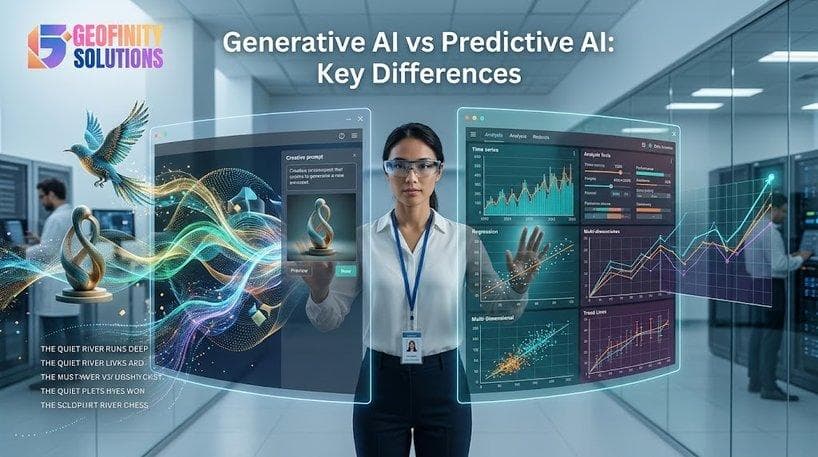
Generative AI vs Predictive AI: What's the Difference?
Artificial intelligence (AI) is changing how businesses analyze information, automate tasks, make decisions, and serve customers. From AI assistants that draft content to systems that forecast sales and identify customers at risk of leaving, organizations are using different AI approaches to solve different problems.
Two important approaches are generative AI and predictive AI. Although both can use machine learning and large amounts of data, they are designed to accomplish different tasks.
Generative AI creates new content, such as text, images, code, audio, and other outputs. Predictive AI uses existing data to estimate what is likely to happen, classify an outcome, or assign a probability to a future event.
Understanding generative AI vs predictive AI helps businesses choose the right technology for their goals. A company that wants to automate customer support conversations may benefit from generative AI, while a business trying to forecast inventory demand may need predictive AI. In some cases, combining both approaches can deliver greater value.
This guide explains how generative and predictive AI work, their key differences, practical business applications, benefits, limitations, and how to choose the right approach for your organization.
What Is Generative AI?
Generative AI is a type of artificial intelligence that creates new content based on instructions, context, or input data. It can produce written text, images, computer code, audio, video, summaries, and other forms of digital content.
Unlike a system designed only to classify information or calculate a forecast, generative AI produces an output that can be used as a draft, explanation, design, or starting point for further work.
Examples of generative AI applications include:
- Writing product descriptions and marketing content.
- Summarizing lengthy documents and reports.
- Generating software code and explaining technical errors.
- Creating images and visual concepts.
- Answering questions about company documents.
- Drafting customer service responses.
- Translating content into different languages.
How Does Generative AI Work?
Generative AI models learn statistical patterns and relationships from training data. When a user provides a prompt, the model uses what it has learned, along with the available context, to generate a response.
For example, a business owner might enter the following instruction:
“Write a professional email informing a customer that their order will be delivered tomorrow.”
A generative AI tool can produce a complete email draft. The user can then review the wording, correct any details, and send it.
Different generative models use different architectures. Large language models commonly use transformer-based architectures to process and generate language, while image-generation systems may use diffusion models or other generative techniques.
The model does not need to retrieve a previously written email to produce the draft. It generates new content based on learned patterns and the information supplied to it.
Common Types of Generative AI
| Type | What it generates | Example use |
|---|---|---|
| Text generation | Articles, emails, summaries | Marketing and business communication |
| Image generation | Illustrations, concepts, visual assets | Creative design and advertising |
| Code generation | Code snippets and explanations | Software development |
| Audio generation | Speech, audio, and sound | Voice applications and media |
| Video generation | Video clips and visual sequences | Training and promotional content |
Generative AI is especially useful when the desired result is new content that people can review, refine, or use.
However, its output is not automatically accurate. A response can sound convincing while containing incorrect information, so important facts should be verified before the output is used.
What Is Predictive AI?
Predictive AI uses historical data and statistical or machine learning methods to estimate likely outcomes. It helps organizations identify patterns, forecast future events, classify cases, and make decisions based on data.
Rather than creating a marketing email or an illustration, predictive AI might estimate next month's sales, identify a transaction that could be fraudulent, or calculate which products are likely to run out of stock.
Common applications include:
- Sales and revenue forecasting.
- Inventory and demand planning.
- Customer churn prediction.
- Fraud detection and risk scoring.
- Predictive maintenance for equipment.
- Delivery time estimation.
- Customer segmentation and lead scoring.
How Does Predictive AI Work?
Predictive AI models are trained or configured using historical examples. The model learns relationships between relevant inputs and known outcomes, then applies those patterns to new data.
Imagine a retailer with two years of sales records. The dataset includes product categories, prices, promotions, seasonal patterns, and quantities sold.
A predictive model can use these records to estimate future demand for each product. The retailer can use the forecast to plan purchasing and reduce the risk of having too much or too little stock.
The basic process often follows these steps:
- Collect data: Gather relevant historical records, such as sales, customer activity, or machine sensor readings.
- Prepare data: Correct errors, handle missing values, and organize the information.
- Train and validate the model: Learn patterns and evaluate performance against data that was not used to fit the model.
- Generate predictions: Estimate outcomes for new cases or future periods.
- Monitor performance: Compare predictions with actual outcomes and update the model when necessary.
Predictive AI can use methods such as regression, decision trees, random forests, gradient-boosting models, and time-series forecasting. The most appropriate method depends on the problem, available data, and required level of accuracy.
Common Types of Predictive AI Tasks
| Task | Example output | Business application |
|---|---|---|
| Regression | Estimated sales of NPR 12 lakh | Revenue forecasting |
| Classification | High or low churn risk | Customer retention |
| Probability scoring | 80% estimated likelihood of late payment | Credit and collection planning |
| Time-series forecasting | Expected weekly demand | Inventory planning |
| Anomaly detection | Unusual transaction flagged for review | Fraud monitoring |
These examples illustrate different analytical tasks; not every one requires the same model architecture or produces a prediction with the same degree of certainty.
Predictive AI is most useful when an organization needs a forecast, score, classification, or estimate to support a decision.
Generative AI vs. Predictive AI: Key Differences
The most important difference is the purpose of the output. Generative AI creates content, while predictive AI estimates outcomes using patterns in data.
Both can use machine learning, and some models involve prediction internally. The distinction is about the task the system is designed to perform, rather than whether prediction occurs anywhere in the process.
Comparison Table
| Comparison factor | Generative AI | Predictive AI |
|---|---|---|
| Primary purpose | Create new content | Estimate likely outcomes |
| Typical output | Text, images, code, summaries, audio | Forecasts, probabilities, scores, classifications |
| Common input | Prompts, documents, images, contextual information | Historical records and relevant input variables |
| Typical data | Often large and diverse training datasets | Relevant historical data with suitable outcome information |
| Common techniques | Transformers, diffusion models, other generative architectures | Regression, decision trees, gradient boosting, time-series methods |
| Evaluation | Factual accuracy, relevance, usefulness, safety, and quality | Accuracy against actual outcomes, calibration, and task-specific metrics |
| Common business use | Drafting content and answering questions | Demand forecasting and risk assessment |
| Main risk | Incorrect or fabricated content | Incorrect forecasts, bias, and poor generalization |
| Human oversight | Review generated content and verify important claims | Validate predictions and assess the consequences of decisions |
| Example question | “Write a product description for this item.” | “How many units are likely to sell next month?” |
The comparison is a practical guide, not an absolute rule. Some generative systems use structured data, and predictive systems can use unstructured inputs. Both approaches depend on the quality of their data and implementation.
Example: An E-Commerce Business
Consider an online retailer selling electronics and accessories.
Generative AI
Task: Create content
The retailer asks AI to write product descriptions, draft promotional emails, and summarize customer feedback.
Output: New content for staff to review and use.
Predictive AI
Task: Estimate future outcomes
The retailer analyzes historical sales, promotions, and seasonal demand to forecast which products may sell quickly.
Output: Demand forecasts to support purchasing and stock planning.
Both systems can help the same retailer, but they solve different problems. Generative AI supports content creation, while predictive AI supports planning decisions.
How Generative AI and Predictive AI Work Differently?
Understanding the underlying approach helps explain why these technologies are not interchangeable.
✦ Data Requirements
Generative AI models are often trained on broad collections of text, images, code, or other content. Businesses can use existing models and provide relevant context without training an entirely new model from scratch.
Predictive AI usually depends on data that is relevant to a specific business question. For example, forecasting customer churn requires historical customer information and, ideally, reliable records of which customers actually left.
A business without consistent sales history may struggle to build a useful demand forecasting model. A business with limited data can still use an existing generative AI tool to draft an email or summarize a document, although the output still needs review.
✦ Model Design and Training
Generative AI includes models designed to learn the structure of data and generate new examples. Large language models, for instance, generate text by estimating likely next tokens in context. Image-generation models use other methods to create visual outputs.
Predictive AI uses models selected for tasks such as estimating a numerical value or assigning a category. These models can range from relatively simple statistical techniques to complex neural networks.
Neither approach is automatically more sophisticated or more accurate. A small regression model may be the best solution for a business forecasting task, while a generative model may be more suitable for summarizing complex documents.
✦ How Outputs Are Evaluated
Generative AI is often evaluated using criteria such as:
- Whether the response addresses the user's request.
- Whether factual claims are correct.
- Whether the content is clear and relevant.
- Whether the output follows required format and safety rules.
- Whether users find the result useful.
Predictive AI is typically evaluated against known outcomes using metrics appropriate to the task.
For example, a sales forecast can be compared with actual sales using error measurements. A fraud classifier may be assessed using precision, recall, false-positive rates, and the cost of missed fraud.
A model that performs well on historical data may still perform poorly when customer behavior, market conditions, or business operations change. Both types of AI require ongoing evaluation, but the testing methods differ.
✦ Explainability and Reliability
Some predictive models, such as simple decision trees or regression models, can make it relatively easy to inspect how input variables relate to an output. More complex predictive models can also be difficult to interpret.
Generative AI outputs can be harder to trace to individual training examples, and the model may generate unsupported details. When a generative system answers questions using company documents or other trusted sources, retrieval-based techniques can help ground responses in relevant information, but they do not eliminate every error.
For either approach, businesses should identify what could go wrong, measure performance, and define when human review is necessary.
Business Applications of Generative AI vs. Predictive AI
The practical value of each approach becomes clearer when viewed through common business functions.
✦ Marketing and Content Creation
Generative AI applications:
- Drafting blog posts, social media captions, and email campaigns.
- Producing initial versions of advertisements.
- Generating product descriptions.
- Adapting content for different audiences.
- Summarizing customer reviews and campaign feedback.
Predictive AI applications:
- Forecasting campaign performance.
- Estimating customer conversion probability.
- Identifying audiences with a higher likelihood of responding.
- Predicting customer churn.
- Comparing expected results across campaign scenarios.
For example, a marketing team could use predictive AI to identify customer segments that are more likely to purchase a product. Generative AI could then help draft campaign messages for those segments.
The predictive result should not be treated as a guarantee of future behavior, and the generated content should be reviewed before publication.
✦ Sales and Customer Relationship Management (CRM)
Generative AI can summarize sales calls, draft follow-up emails, create proposal outlines, and help sales staff locate information in approved company documents.
Predictive AI can estimate which leads are more likely to convert, forecast sales opportunities, or identify customers who may not renew a service.
Together, the two approaches can help sales teams prioritize their work and communicate more efficiently.
✦ Finance and Accounting
In finance, predictive AI can support cash-flow forecasting, anomaly detection, payment-risk assessment, and expense analysis.
Generative AI can help explain financial reports in plain language, summarize invoices or policy documents, and draft narratives for management reports.
However, a generated explanation should not replace validated calculations or the review of an authorized finance professional. Financial figures should come from reliable records and properly configured accounting systems.
✦ Inventory and Supply Chain Management
Predictive AI is useful for forecasting product demand, estimating replenishment needs, and identifying possible supply disruptions based on available data.
Generative AI can summarize purchasing reports, draft supplier communications, and explain inventory trends to staff.
For example, a predictive model may estimate that demand for a product will rise next month. Generative AI could then draft a purchase-planning summary explaining the forecast and highlighting the items that need attention.
The forecast should be checked against supplier lead times, current stock, planned promotions, and other relevant business information.
✦ Human Resources
Generative AI can assist with job description drafts, onboarding materials, training content, and answers to routine policy questions based on approved documents.
Predictive AI can support workforce planning by estimating staffing needs or identifying patterns in employee turnover.
Employment-related predictions require particular care. Historical data may reflect past unfairness, and a risk score should not be treated as an objective judgment about an individual. Organizations should consider privacy, fairness, explainability, and human oversight.
✦ Software Development and IT Operations
Generative AI can assist developers by drafting code, explaining errors, producing test cases, and documenting software. The generated code must still be reviewed and tested.
Predictive AI can estimate equipment failures, identify unusual operational patterns, and forecast resource demand. In software operations, anomaly detection can flag unusual system behavior, while forecasting can help teams plan infrastructure capacity.
For example, a predictive model may flag a server's unusual resource usage. A generative AI assistant could summarize the alert, gather relevant logs, and draft a troubleshooting checklist for an engineer to review.
These applications show that generative and predictive AI can complement each other rather than compete directly.
Can Generative AI and Predictive AI Work Together?
Yes. In many business workflows, the strongest approach is to combine predictive AI's ability to estimate outcomes with generative AI's ability to turn information into useful content.
Predictive AI can identify a trend, classify a case, or flag an issue. Generative AI can then explain the result, draft a recommendation, or help a person decide what to do next.
This combined approach is also recognized in guidance from major cloud providers, which describe using generative and predictive capabilities together for broader business tasks.
Example 1: Demand Forecasting and Purchasing
A retailer wants to avoid running out of popular products.
- Predictive AI analyzes historical sales, seasonality, current stock, and other relevant factors to estimate demand.
- The business applies inventory rules, supplier lead times, and budget constraints to determine replenishment needs.
- Generative AI drafts a summary of the forecast and a proposed purchasing list.
- The purchasing manager reviews the recommendations and approves the order.
The predictive model estimates demand; the generative model helps communicate and organize the information.
Example 2: Customer Retention
A subscription business wants to reduce customer cancellations.
- Predictive AI identifies accounts with elevated cancellation risk.
- The business reviews the factors contributing to that risk and determines which customers need attention.
- Generative AI drafts tailored outreach messages based on approved customer information.
- A customer service representative reviews and sends the messages.
This workflow can help teams prioritize outreach while keeping humans involved in customer decisions and communication.
Example 3: Financial Reporting
A finance team wants to prepare monthly management reports more efficiently.
- Validated accounting data is used to calculate revenue, expenses, and other financial measures.
- Predictive AI forecasts selected future financial trends.
- Generative AI drafts a plain-language summary of the historical results and forecast.
- Finance staff verify the figures, assumptions, and wording before sharing the report.
The generated narrative should never substitute for accurate accounting records or independent verification of financial calculations.
Example 4: Customer Support
A company receives a large volume of customer enquiries.
- Predictive or other classification models identify the topic, urgency, or likely category of each enquiry.
- A support workflow routes the enquiry to the appropriate team.
- Generative AI drafts a response using approved support documentation.
- A human reviews sensitive or unusual cases, and the response is sent according to the company's rules.
This combination can reduce repetitive work while preserving appropriate oversight.
A Simple Combined AI Workflow

The combined system still needs reliable data, appropriate permissions, clear responsibilities, and monitoring. Connecting two AI systems does not automatically make their outputs accurate or their recommendations appropriate.
Benefits and Limitations of Each Approach
Neither generative AI nor predictive AI is the right choice for every problem. Understanding the strengths and limitations of each helps businesses avoid investing in technology that does not solve their actual needs.
Benefits of Generative AI
- Faster content production: Helps produce drafts, summaries, and other materials.
- Natural-language interaction: Lets users ask questions or give instructions in everyday language.
- Support for knowledge work: Helps employees work with documents, code, and other information.
- Flexible applications: Can support different tasks through prompts and contextual information.
- Improved accessibility of information: Can translate technical material into more understandable language.
Limitations of Generative AI
- Incorrect information: Generated responses may contain fabricated or inaccurate details.
- Privacy risks: Sensitive information can be exposed if tools and data-handling policies are not properly configured.
- Variable output quality: Responses may differ in relevance, consistency, and completeness.
- Review requirements: Important outputs need fact-checking and approval.
- Operational costs: Usage, integration, access controls, and monitoring can create ongoing expenses.
Benefits of Predictive AI
- Data-driven planning: Supports demand forecasting and resource allocation.
- Early warning signals: Can flag likely risks or unusual patterns.
- Consistent evaluation: Predictions can be measured against actual outcomes.
- Operational efficiency: Helps prioritize cases and focus attention on important exceptions.
- Decision support: Provides estimates that can inform purchasing, staffing, and financial planning.
Limitations of Predictive AI
- Dependence on historical data: Incomplete or inconsistent records can reduce reliability.
- Changing conditions: A model can become less accurate when customer behavior or market conditions shift.
- Bias and fairness concerns: Historical patterns may reflect existing inequalities.
- False positives and false negatives: A model may flag a normal event as risky or fail to identify a genuine problem.
- Implementation and maintenance: Data preparation, validation, monitoring, and model updates require resources.
The important consideration is not whether one type of AI is universally better. It is whether the technology can deliver a measurable improvement for the specific task, with acceptable risks and operating costs.
How to Choose the Right AI for Your Business?
Before investing in AI, define the business problem and the output you need. The following framework can help narrow the options.
Find a suitable AI starting point
Choose the options that best describe your business need. This is a starting guide, not a technical assessment.
1. What outcome do you need most?
□ Create content, summaries, images, or draft responses
□ Forecast demand, sales, risks, or likely outcomes
□ Make predictions and generate explanations or recommendations
2. How ready is your business data?
□ Limited or inconsistent historical records
□ Some usable data, but it needs preparation
□ Reliable, organized data with known outcomes
3. How consequential is the output?
□ Low risk, such as internal drafts or brainstorming
□ Moderate risk, such as business planning or customer communication
□ High risk, such as financial, employment, healthcare, or safety decisions
Suggested starting point
Generative AI
Start with a narrowly defined content or knowledge-work task. Use approved information, check output quality, and measure time saved.
Define review and approval rules before using outputs in customer communications or important business decisions.
Build my AI adoption plan
A Practical Selection Checklist
Before choosing a solution, ask:
- What specific problem are we trying to solve?
- Do we need generated content, a numerical estimate, a classification, or a combination?
- Do we have suitable data and permission to use it?
- How will we measure whether the system works?
- Who will verify outputs and handle errors?
- What will implementation, usage, integration, and maintenance cost?
- How will we protect confidential information and manage access?
Start With a Small, Measurable Pilot
Businesses do not need to deploy AI across every department at once. A focused pilot is often a more practical way to evaluate its value.
For example, a company might start by using generative AI to draft internal reports or by testing a predictive model on one product category's demand history.
Define the current process, the expected improvement, and the success metrics before launching the pilot. Measure the results against a baseline, then decide whether to expand, modify, or stop the project.
This approach helps organizations evaluate real business value instead of adopting AI simply because the technology is popular.
Frequently Asked Questions (FAQ's):
Q. What is the main difference between generative AI and predictive AI?
Generative AI creates new content, such as text, images, code, and summaries. Predictive AI analyzes data to estimate future outcomes, classify cases, or calculate probabilities. The right approach depends on whether a business needs content or a data-driven prediction.
Q. Is ChatGPT generative AI or predictive AI?
ChatGPT is a generative AI system. It generates responses based on the prompt and context. Although language models use next-token prediction as part of text generation, ChatGPT's primary purpose is to generate content rather than forecast a specific business outcome.
Q. Can predictive AI generate content?
Predictive AI is generally designed to produce forecasts, scores, or classifications rather than new content. A business can combine predictive AI with generative AI to turn predictions into written explanations, reports, or recommendations.
Q. Which is better for business: generative AI or predictive AI?
Neither is universally better. Generative AI is useful for drafting content, summarizing documents, and assisting with knowledge work. Predictive AI is useful for forecasting sales, estimating demand, identifying risks, and supporting data-driven decisions.
Q. What are examples of generative AI in business?
Common examples include AI-generated marketing drafts, product descriptions, customer service responses, software code, document summaries, and internal knowledge assistants. Human review remains important when the output contains factual or sensitive information.
Q. What are examples of predictive AI in business?
Predictive AI can forecast product demand, estimate customer churn, identify suspicious transactions, predict equipment failures, score sales leads, and estimate future revenue. Its usefulness depends on the quality of the data and how well the model performs on new cases.
Q. Does generative AI require more data than predictive AI?
Not always in the same way. Training large generative models can require extensive and diverse datasets, but businesses can use existing models without training them from scratch. Predictive AI often requires relevant historical records for the specific problem being solved. Actual data requirements depend on the model and application.
Q. Can a business use generative AI and predictive AI together?
Yes. A business can use predictive AI to estimate demand or identify high-risk customers, then use generative AI to draft a report, explain the findings, or prepare a communication. The predictions and generated content should both be checked for accuracy and suitability.
Q. Is predictive AI the same as predictive analytics?
They are closely related but not identical. Predictive analytics is the broader practice of using data, statistical methods, and models to estimate future outcomes. Predictive AI generally refers to AI and machine learning approaches used to make those predictions.
Q. Is generative AI always accurate?
No. Generative AI can produce incorrect facts, misleading explanations, or invented details. Businesses should verify important claims against reliable sources, restrict access to sensitive information, and require appropriate review before using outputs in consequential situations.
Q. Does predictive AI guarantee accurate forecasts?
No. Predictive AI estimates outcomes based on available data and learned patterns. Unexpected events, changing conditions, data quality problems, and model limitations can affect accuracy. Predictions should be evaluated against actual outcomes and monitored over time.
Q. Which AI is more suitable for small businesses?
Generative AI can be a convenient starting point for small businesses that want to draft content, summarize documents, or support routine communication. Predictive AI may be more appropriate when the business has useful historical data and a clear forecasting or classification problem. The best choice depends on the desired result, not the size of the company alone.
Q. Can generative AI replace human decision-making?
Generative AI can assist with research, drafting, and analysis, but it should not automatically replace human judgment. Business decisions involving finances, employment, healthcare, legal matters, or safety require suitable verification, accountability, and oversight.
Q. How should a business measure the success of an AI project?
Define measurable goals before implementation. Generative AI projects can be assessed through review time, factual accuracy, quality, and employee productivity. Predictive AI projects can be assessed using appropriate forecast errors, classification metrics, and business outcomes. Both should be evaluated against a baseline and monitored after deployment.
Conclusion
Understanding Generative AI vs. Predictive AI helps businesses choose technologies that solve specific problems rather than adopting AI without a clear objective.
Generative AI is designed to create content and assist with tasks such as writing, summarization, coding, and conversational support. Predictive AI uses historical data and learned patterns to forecast demand, estimate risk, identify trends, and support business decisions.
For many organizations, the greatest opportunity is not choosing one over the other. It is combining their strengths where appropriate: using predictive AI to identify what may happen and generative AI to help explain the results or prepare the next action.
Before investing, define the business problem, assess data readiness, select meaningful performance metrics, and establish appropriate human oversight. A focused pilot with measurable outcomes is a practical way to determine whether AI can deliver real value.
Explore AI Solutions for Your Business With Geofinity
Geofinity Pvt. Ltd. helps businesses explore technology solutions aligned with their operational needs and digital goals. If your organization is considering AI-powered applications, workflow automation, or business software integration, start by identifying the processes where better information and automation could make a measurable difference.
📍 Baluwatar 4, Kathmandu, Nepal
📞 +977 9802372660
Contact Geofinity to discuss your business technology requirements.