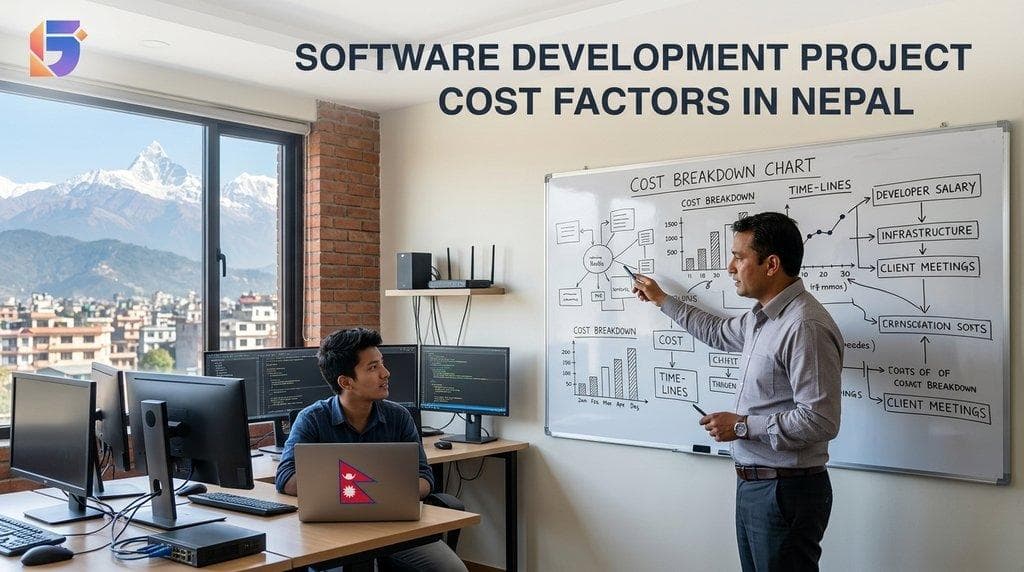
Software Development Project Cost Factors in Nepal
Businesses across Nepal are increasingly investing in digital solutions to improve operations, reach customers, automate workflows, and compete in a technology-driven market. From custom business management systems and e-commerce websites to mobile applications and enterprise software, organizations need solutions that match their specific goals.
However, one of the first questions business owners ask is: How much does software development cost in Nepal?
There is no single price that applies to every project. A simple business website, a customer-facing mobile app, and a complex enterprise resource planning (ERP) system require different levels of planning, design, development, testing, and ongoing support.
Understanding the software development project cost factors in Nepal helps businesses plan realistic budgets, evaluate proposals, and avoid unexpected expenses. Instead of focusing only on the initial quotation, businesses should consider the complete cost of developing, launching, maintaining, and improving their software.
This guide explains the main factors that affect software development costs in Nepal, how to plan a practical budget, and what to consider before choosing a software development partner.
What Determines Software Development Costs in Nepal?
The cost of developing software depends on the amount of work required to turn a business requirement into a reliable, usable product. This includes planning, design, coding, testing, deployment, documentation, and maintenance.
A basic internal application may require only a few essential features. A comprehensive business platform may need multiple user roles, automated workflows, third-party integrations, advanced reporting, and robust security.
Published Nepal-based pricing guides show a broad range of estimates, from a few lakh rupees for relatively small applications to tens of lakhs or more for complex business platforms. These are indicative market estimates, not standardized prices or guaranteed quotations.
Several variables determine where a project falls within that range:
- The type and complexity of the software.
- The number of features and modules.
- The technologies and architecture required.
- The experience and size of the development team.
- The number of integrations and external services.
- Security, performance, and scalability requirements.
- The project timeline and delivery expectations.
- Testing, deployment, support, and maintenance requirements.
The most reliable way to estimate software development costs is to define the required features and expected outcomes before requesting a quotation.
Major Software Development Project Cost Factors in Nepal
★ Project Scope and Complexity
Project scope is one of the most significant software development project cost factors in Nepal. It defines what the software must do, which users it serves, and which business processes it supports.
For example, a basic inventory application might allow staff to add products, record stock movements, and generate simple reports. A more advanced system may include multiple warehouses, barcode scanning, purchase orders, supplier management, automated alerts, and accounting integration.
Each additional workflow introduces development, testing, and maintenance requirements.
Consider these examples:
| Project scope | Typical functionality | Relative cost |
|---|---|---|
| Basic application | Forms, records, simple reports | Low |
| Standard business application | Multiple features, dashboards, user roles | Medium |
| Advanced platform | Complex workflows, integrations, automation | High |
| Enterprise system | Multiple departments, advanced permissions, extensive integrations | Very high |
These categories are comparative rather than fixed pricing tiers. Actual costs depend on the implementation details.
How to manage this cost: Separate essential features from optional improvements. Define what must be available at launch and what can be introduced in later releases.
★ Type of Software Being Developed
Different software products require different development approaches, technologies, and skill sets. As a result, the type of application directly affects the budget.
▸ Business Websites and Web Applications
Business websites generally focus on presenting information, generating leads, or providing content management. Web applications can involve user accounts, dashboards, business rules, databases, and interactive workflows.
Cost drivers: custom design, backend functionality, integrations, and content management.
▸ Mobile Applications
Mobile apps may require Android and iOS support, notifications, location services, offline functionality, device permissions, and app-store deployment.
Cost drivers: native versus cross-platform development, device compatibility, and backend services.
▸ ERP and Business Management Systems
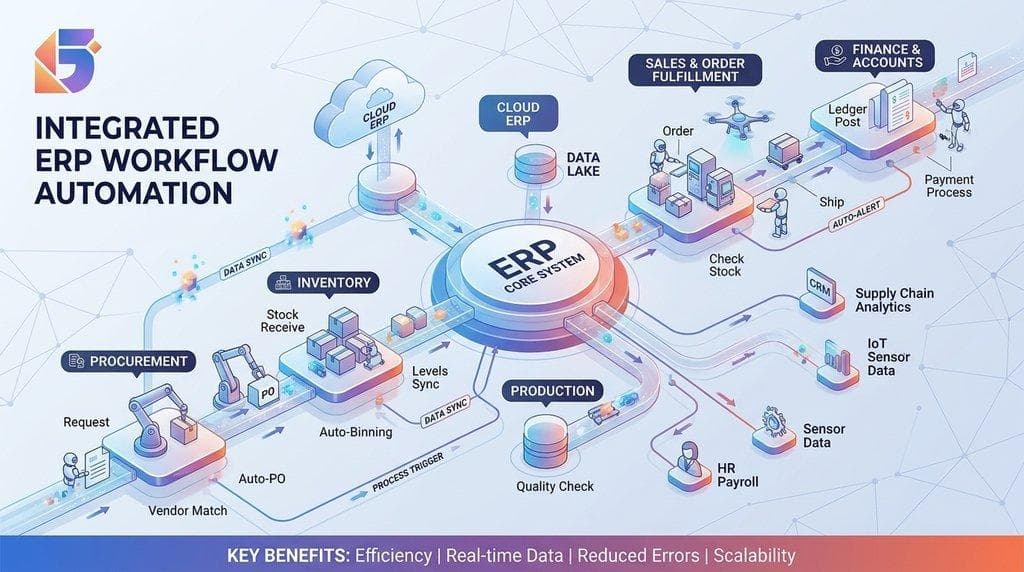
Enterprise resource planning (ERP) software connects functions such as finance, inventory, procurement, human resources, and sales.
Cost drivers: module count, business rules, data migration, permissions, and cross-department workflows.
▸ SaaS Platforms
Software as a Service (SaaS) products often support multiple customers, subscription plans, account management, billing, and ongoing releases.
Cost drivers: multi-tenant architecture, subscription management, infrastructure, and scalability.
A small website and a multi-module ERP system should not be evaluated using the same pricing expectations. Nepal-based providers publish different estimates depending on product type and project scope.
★ Number of Features and Modules
Every feature requires some combination of design, development, validation, and documentation. The more functionality a project includes, the more effort it generally requires.
Common features that influence project costs include:
- User registration and authentication.
- Role-based access control.
- Admin dashboards and reporting.
- Search, filtering, and data exports.
- Payment processing.
- Notifications through email or SMS.
- Booking, scheduling, or approval workflows.
- Analytics and automated reporting.
- AI-powered recommendations or assistants.
For example, adding a simple contact form to a website is relatively straightforward. Adding a complete customer portal with account management, document uploads, payment history, and automated notifications is a considerably larger task.
Budgeting tip: Request an itemized feature list. This makes it easier to identify which functions are responsible for the largest portion of the estimated cost.
★ UI/UX Design Requirements
User interface (UI) and user experience (UX) design influence both development cost and the product's long-term usability.
A project using a standard interface may require less design work than a platform with custom dashboards, interactive charts, complex forms, and multiple user journeys.
Design costs may include:
- User research and requirements workshops.
- Wireframes and interactive prototypes.
- Visual design systems and reusable components.
- Responsive layouts for different screen sizes.
- Accessibility considerations.
- Usability testing and design revisions.
For example, a customer-facing mobile banking application needs careful attention to clarity, accessibility, error prevention, and trust. A small internal tool may have more modest design requirements.
Investing in good UX can also reduce training requirements and help users complete tasks with fewer errors.
★ Technology Stack and Software Architecture
The technology stack refers to the programming languages, frameworks, databases, and infrastructure used to build an application.
Common technologies include Laravel, Django, React, Node.js, Flutter, React Native, PostgreSQL, and MySQL. The appropriate choice depends on project requirements, existing systems, team expertise, and future maintenance needs.
Technology-related cost factors include:
- Availability of experienced developers.
- Complexity of the application architecture.
- Compatibility with existing systems.
- Performance and scalability requirements.
- Licensing and subscription fees.
- Long-term maintenance and upgrade requirements.
Choosing a popular framework does not automatically make a project inexpensive. A well-structured application with a suitable technology stack is often easier to maintain than an unnecessarily complicated solution.
Businesses should prioritize technical suitability and long-term support over choosing a technology solely because it appears cheaper at the beginning.
★ Development Team Size and Experience
Software projects involve more than writing code. Depending on the project's scale, the team may include business analysts, project managers, UI/UX designers, frontend developers, backend developers, mobile developers, QA testers, and DevOps engineers.
A small project may be handled by a compact team. A larger enterprise platform may require several specialists working in parallel.
| Team role | Main responsibility | Cost influence |
|---|---|---|
| Business analyst | Requirements and workflows | Reduces ambiguity and rework |
| UI/UX designer | Interface and user journeys | Affects usability and design effort |
| Frontend developer | User-facing functionality | Depends on screen and interaction complexity |
| Backend developer | APIs, databases, and business logic | Depends on architecture and integrations |
| QA engineer | Testing and defect detection | Depends on test coverage and complexity |
| Project manager | Planning and coordination | Depends on project scale and delivery model |
| DevOps engineer | Deployment and infrastructure | Depends on hosting and operational needs |
A higher quotation does not necessarily indicate a better team, and a lower quotation does not automatically indicate poor quality. The important question is whether the proposed team has the experience and capacity to deliver the agreed scope.
★ Third-Party Integrations
Integrations connect the software to external platforms, services, devices, or existing business systems.
For businesses in Nepal, potential integrations include:
- Payment providers such as eSewa and Khalti, subject to their available integration options.
- SMS and email notification services.
- Accounting and inventory systems.
- Maps and location services.
- Customer relationship management (CRM) tools.
- Government or regulatory systems, where approved access is available.
- External APIs and identity providers.
An integration can involve API access, authentication, data mapping, error handling, testing, and coordination with the external provider. Some services also charge setup fees, subscription fees, or transaction fees.
For instance, a simple notification integration may be relatively straightforward. Connecting an ERP system with multiple accounting, payment, inventory, and reporting systems can introduce substantial additional work.
Before development begins, list every external system the software must connect to and confirm whether API access, documentation, and test environments are available.
★ Data Migration and Existing Systems
Businesses replacing spreadsheets, legacy software, or manual records often need to transfer existing data into the new application.
Data migration may involve:
- Cleaning duplicate or incomplete records.
- Converting files into compatible formats.
- Mapping old fields to the new database.
- Preserving relationships between records.
- Validating migrated information.
- Testing the migration before launch.
Suppose a distributor has years of product, customer, supplier, and sales records stored in spreadsheets. Moving this information into a new inventory system requires more than uploading files; the data must be accurate, consistent, and usable.
If data is poorly structured, migration can become a significant source of unexpected work.
How to manage this cost: Review existing data early and include migration, validation, and backup requirements in the project scope.
★ Security and Compliance Requirements
Security is an essential part of software development, especially when an application handles personal information, financial records, healthcare data, or confidential business documents.
Security-related work may include:
- Secure authentication and password management.
- Multi-factor authentication.
- Role-based permissions.
- Encryption where appropriate.
- Secure API design.
- Logging and monitoring.
- Vulnerability assessments and security testing.
- Backup and recovery procedures.
Businesses should also identify applicable legal, regulatory, and contractual requirements before development. These depend on the industry, the type of data processed, and how the software will be used.
For example, an application managing sensitive customer records may require stronger access controls, audit trails, and security testing than a simple public-facing informational website.
Security work should be included in the initial budget instead of treated as an optional feature to add after launch.
★ Scalability and Performance
An application designed for a small internal team has different infrastructure and performance needs from a platform serving thousands of customers.
Scalability requirements can influence:
- Database design and optimization.
- Server and cloud architecture.
- Caching and background processing.
- Load balancing.
- Monitoring and alerting.
- Automated deployment and recovery.
- Performance testing.
Not every project needs complex cloud infrastructure from day one. Overengineering a small application can increase development and operational expenses without delivering meaningful value.
However, if rapid growth is expected, the initial architecture should support a sensible path to expansion.
The goal is to build for realistic business needs today while avoiding expensive architectural limitations tomorrow.
★ Project Timeline and Delivery Deadlines
The time available to complete a project can affect the cost.
A realistic schedule allows the team to plan, build, test, gather feedback, and address problems. An aggressive deadline may require additional developers, parallel work, overtime, or reduced flexibility.
Rushing can also create technical debt: shortcuts that make the application harder or more expensive to maintain later.
Businesses should distinguish between a genuine business deadline and a preferred launch date. If the launch date is fixed, the team can often prioritize essential features for the first release and move lower-priority features to a later phase.
★ Testing and Quality Assurance
Testing confirms that the software behaves as expected and helps identify defects before users encounter them.
Depending on the project, testing may cover:
- Functional testing.
- Browser and device compatibility.
- API and integration testing.
- Performance testing.
- Security testing.
- User acceptance testing.
- Regression testing after updates.
The required effort increases when the application contains complex workflows, sensitive data, many integrations, or multiple user roles.
Reducing testing may lower the initial quotation, but defects discovered after deployment can lead to downtime, customer dissatisfaction, data problems, and additional repair costs.
A professional quotation should explain what testing is included and how defects will be handled before and after launch.
★ Maintenance and Post-Launch Support
Software development costs do not end when the application goes live.
After deployment, software may require bug fixes, security patches, operating system or framework updates, server monitoring, backups, performance improvements, and new features.
Ongoing expenses can include:
- Technical support and troubleshooting.
- Hosting and cloud infrastructure.
- Domain and certificate renewals, where applicable.
- Third-party API and subscription fees.
- Database maintenance and monitoring.
- Staff training and documentation.
- Feature enhancements and future releases.
Nepal-focused cost guides identify hosting, maintenance, and third-party services as expenses that businesses should consider separately from the initial development quote.
Ask the development company to clarify whether post-launch support is included, how long it lasts, and what happens when the included support period ends.
Estimated Software Development Costs in Nepal
The following ranges can serve as preliminary budgeting examples, not as official industry rates. Prices vary significantly by provider, functionality, quality expectations, and project scope.
| Project type | Indicative budget range |
|---|---|
| Basic internal application | NPR 1–3 lakh |
| Small business management system | NPR 2–8 lakh |
| Standard custom web application | NPR 5–15 lakh |
| More complex business application | NPR 8–40 lakh |
| Custom CRM or multi-module platform | NPR 8–50 lakh or more |
| Large ERP or enterprise platform | NPR 25 lakh to several crore |
These ranges overlap because project labels such as “CRM,” “ERP,” or “business application” can describe very different products. Published local estimates also vary substantially, reinforcing the need for a requirements-based quotation.
Example: Three Different Project Scopes
Example A: Small inventory tool
Lower complexity
NPR 2–5 lakh
Illustrative planning assumption
Includes basic product records, stock updates, user login, and simple reports. Advanced accounting integration and multi-warehouse automation are excluded.
Example B: Business management application
Medium complexity
NPR 8–20 lakh
Illustrative planning assumption
Includes multiple modules, staff permissions, dashboards, notifications, and selected integrations.
Example C: Multi-module enterprise platform
Higher complexity
NPR 25 lakh+
Illustrative planning assumption
Includes complex workflows, multiple departments, data migration, advanced permissions, integration work, and stronger operational requirements.
These examples are not market quotations or promises of delivery at those prices. A discovery process is necessary to confirm requirements, timelines, and the actual budget.
Hidden and Ongoing Costs to Include in Your Budget
One common budgeting mistake is treating the initial development quotation as the total cost of ownership.
A more complete budget includes the expenses required to operate, secure, and improve the software after launch.
| Expense | Why it matters |
|---|---|
| Hosting and infrastructure | Keeps the application available and responsive |
| Domain and certificates | Supports access and secure connections where applicable |
| API and subscription fees | Covers third-party services used by the software |
| Maintenance and support | Addresses defects, updates, and technical issues |
| Data migration | Transfers and validates existing records |
| Staff training | Helps employees use the new system effectively |
| Security assessments | Identifies and addresses vulnerabilities |
| Future improvements | Supports changing business requirements |
| Backups and disaster recovery | Helps restore operations after data loss or service disruption |
How Much Should You Reserve for Maintenance?
There is no universal maintenance percentage for every project. The amount depends on the software's complexity, service-level expectations, hosting model, and frequency of changes.
As an initial planning exercise, a business could model annual maintenance at 10–20% of the original development cost and ask providers to confirm whether that assumption is appropriate for the specific system. This is a budgeting heuristic, not a guaranteed Nepal market rate.
For example, for a software project costing NPR 10 lakh, this planning assumption would mean NPR 1–2 lakh per year for maintenance.
That amount may not cover cloud hosting, third-party subscriptions, major feature development, or extensive support. List these items separately to avoid underestimating the total cost.
Which Software Development Pricing Model Is Best?
Software companies may offer several ways to charge for development. The best model depends on how clearly the project can be defined and how likely requirements are to change.
| Pricing model | How it works | Best suited for |
|---|---|---|
| Fixed price | An agreed scope is delivered for a defined price | Projects with clear requirements |
| Time and materials | You pay for actual work performed | Projects where requirements may evolve |
| Dedicated team | You pay for a team working on your project over time | Long-term development and product growth |
| Milestone-based | Payments are tied to agreed delivery stages | Projects requiring staged approvals |
▸ Fixed-Price Development
A fixed-price agreement can help businesses manage costs when the scope, deliverables, acceptance criteria, and assumptions are clearly documented.
However, changes outside the agreed scope may require additional payments. A fixed price does not eliminate uncertainty if requirements are incomplete.
▸ Time-and-Materials Development
This model offers flexibility when the product is evolving or the full scope cannot be established in advance. Businesses should request regular progress reports, budget tracking, and approval procedures for additional work.
▸ Dedicated Development Team
A dedicated team can be suitable for businesses building a product over several months or years. Costs depend on the roles, experience levels, team size, and engagement duration.
▸ Milestone-Based Payments
Milestones can link payments to tangible outputs, such as approved designs, a tested prototype, a completed module, or production deployment.
Regardless of the model, the agreement should define ownership, payment terms, acceptance criteria, change requests, support, and project handover.
How to Reduce Software Development Costs Without Sacrificing Quality?
Reducing software development costs should mean removing unnecessary work and managing risk, not skipping essential engineering practices.
▸ Start With an MVP
A minimum viable product (MVP) contains the smallest set of features needed to test a core business idea or solve an important problem.
For example, a new booking platform might launch with customer registration, availability checking, booking confirmation, and an admin dashboard. Advanced analytics and loyalty features could be added after the business validates demand.
This approach helps businesses learn from real users before investing in a larger product.
▸ Define Requirements Before Development
Unclear requirements lead to repeated discussions, redesigns, and rework.
Before signing a contract, document:
- The business problem being solved.
- Target users and user roles.
- Required features and workflows.
- Reports and data requirements.
- External integrations.
- Security expectations.
- Launch criteria and timeline.
A short discovery phase can expose missing requirements before they become expensive changes.
▸ Prioritize Features
Use three simple categories:
- Must have: Essential for the first release.
- Should have: Important but not essential at launch.
- Could have: Useful enhancements that can wait.
This approach helps stakeholders make deliberate decisions when the available budget is limited.
▸ Compare Proposals on Equal Terms
Request proposals from multiple providers, but give each provider the same requirements document.
Compare what is included, not just the final price. One company may include testing, documentation, deployment, and a support period, while another may quote only for development.
▸ Use Existing Tools Where Appropriate
Not every business needs a completely custom application. Existing platforms, reusable components, and open-source technologies can reduce development effort when they satisfy the requirements.
However, customization, licensing, integration, and future migration costs should also be considered before making a decision.
▸ Avoid Unnecessary Complexity
Build for current needs and realistic growth expectations. Advanced infrastructure, complex automation, or custom features may not provide enough value during the first release.
At the same time, do not remove essential security, backups, testing, or documentation just to reduce the initial cost.
▸ Maintain Regular Communication
Frequent demonstrations and milestone reviews help identify misunderstandings early. They also give business owners the opportunity to prioritize changes before too much work is invested in the wrong direction.
Choosing a Software Development Partner in Nepal
Selecting a software development partner is not only a pricing decision. It is also a decision about communication, reliability, technical quality, and the long-term future of your software.
When comparing software development companies in Nepal, consider these factors.
▸ Relevant Experience
Look for experience with projects similar to yours in terms of industry, complexity, and functionality. A company that has developed business management systems may be better prepared to understand inventory workflows than a team focused exclusively on simple marketing websites.
▸ Transparent Communication
The provider should explain technical decisions in language your team can understand. Regular updates, demonstrations, and documented decisions reduce misunderstandings.
▸ Clear Project Management
Ask how the provider handles requirements, testing, feedback, deadlines, and scope changes. A defined development process makes it easier to track progress and identify risks.
▸ Source Code and Intellectual Property
Clarify who owns the source code, designs, documentation, and other deliverables. Confirm when ownership transfers and whether third-party components have separate licensing requirements.
▸ Support After Launch
Confirm how the provider handles bugs, updates, security issues, backups, and future improvements. Establishing these expectations early can prevent disputes later.
▸ References and Previous Work
Where possible, review completed projects, speak with previous clients, and ask how the provider handled challenges after launch.
The best partner is not necessarily the cheapest or the most expensive. It is the provider that offers an appropriate technical solution, a transparent scope, and a credible plan for delivering and supporting the software.
Frequently Asked Questions (FAQ's):
Q. How much does software development cost in Nepal?
Software development costs vary by scope, features, technology, and team. A small application may cost a few lakh rupees, while a complex ERP or enterprise platform can require tens of lakhs or more. Request a requirements-based quotation for an accurate estimate.
Q. What is the biggest factor affecting software development costs?
Project scope and complexity are major factors. The number of features, business workflows, integrations, user roles, and testing requirements determines how much work is needed.
Q. How much does custom software development cost for a small business in Nepal?
A small business application may fall within a broad range of a few lakh rupees, depending on the functionality. A basic internal tool is usually less demanding than a system with multiple modules, external integrations, and advanced reporting.
Q. Is custom software more expensive than ready-made software?
Custom software generally requires a larger upfront development investment. Ready-made software may be cheaper initially, but recurring subscription fees, customization limitations, and integration requirements can affect its long-term cost. The right choice depends on business needs and total cost of ownership.
Q. How long does software development take in Nepal?
A focused application may take several weeks, while a multi-module business platform can take several months or longer. The timeline depends on scope, team capacity, feedback cycles, testing, and external dependencies.
Q. Does the technology stack affect development costs?
Yes. Developer availability, implementation complexity, licensing, infrastructure, and maintenance requirements all influence cost. The best stack is one that fits the project's needs and can be supported over time.
Q. Why do software companies provide different quotations for the same project?
Providers may interpret the requirements differently or include different services. Differences in architecture, testing, security, team composition, documentation, and post-launch support can also explain price variations.
Q. Are maintenance and hosting included in the development price?
Not always. Some proposals include a limited support period, while others charge separately for hosting, maintenance, and ongoing improvements. Check the quotation and contract carefully.
Q. Can I reduce software development costs by launching an MVP?
Yes. An MVP can reduce the initial investment by focusing on essential features. Businesses can validate the product and add functionality gradually, based on user feedback and business priorities.
Q. Should I hire a freelancer or a software development company?
A freelancer may suit a small, clearly defined project. A software development company may be better for projects requiring several specialists, structured project management, testing, and ongoing support. Compare the complete scope and delivery arrangements before deciding.
Q. What should a software development quotation include?
It should describe the scope, deliverables, timeline, itemized pricing, technology, testing, deployment, payment milestones, ownership, exclusions, and support arrangements. Any assumptions or potential extra charges should be clearly documented.
Q. What hidden costs should I consider when budgeting for software?
Consider hosting, third-party subscriptions, API fees, data migration, training, security assessments, maintenance, backups, and future enhancements. These costs may not be part of the initial development quotation.
Q. Is the cheapest software development quotation the best option?
Not necessarily. A low quotation may exclude important work or assume a smaller scope. Evaluate proposals based on deliverables, quality, security, experience, support, and long-term value rather than price alone.
Q. How can I get an accurate software development cost estimate in Nepal?
Prepare a requirements document covering your business goals, users, essential features, integrations, security needs, timeline, and budget. Share it with potential providers and request itemized proposals that explain assumptions and exclusions.
Conclusion
Understanding the software development project cost factors in Nepal helps businesses make informed investment decisions. Project complexity, feature requirements, technology choices, team experience, integrations, security, testing, and ongoing maintenance all contribute to the final cost.
Rather than choosing a provider based only on the lowest quotation, focus on defining the scope, prioritizing essential features, comparing proposals fairly, and planning for the software's long-term operation.
A well-planned project can help your business automate repetitive work, improve access to information, strengthen customer service, and support future growth. The key is to match the solution to your actual requirements and establish clear expectations before development begins.
Planning a Software Project for Your Business?
Geofinity Pvt. Ltd. helps businesses explore technology solutions aligned with their operational needs and digital goals.
Geofinity Solutions Pvt. Ltd.
Email: [email protected]
Phone: +977 9802372660
Location: Baluwatar 4, Kathmandu, Nepal
Contact Geofinity to discuss your software requirements and plan the next steps for your project.