How AI in Electronic Health Records Is Changing Medical Summaries for Doctors and Patients
Healthcare is becoming increasingly digital, but digitizing medical records does not automatically make healthcare information easier to understand.
Electronic Health Records (EHRs) contain enormous amounts of information, including clinical notes, diagnoses, medications, laboratory results, imaging reports, medical history, allergies, procedures, and follow-up instructions.
For doctors, this information needs to be comprehensive and clinically useful.
For patients, however, the same information can often feel technical, lengthy, and difficult to understand.
This is where Artificial Intelligence (AI) in Electronic Health Records is creating an important new opportunity.
AI can analyze large amounts of clinical information and transform complex documentation into structured, concise, and patient-friendly summaries.
The goal is not to replace doctors.
The goal is to help doctors spend less time documenting information and give patients a clearer understanding of what happened during their healthcare visit.
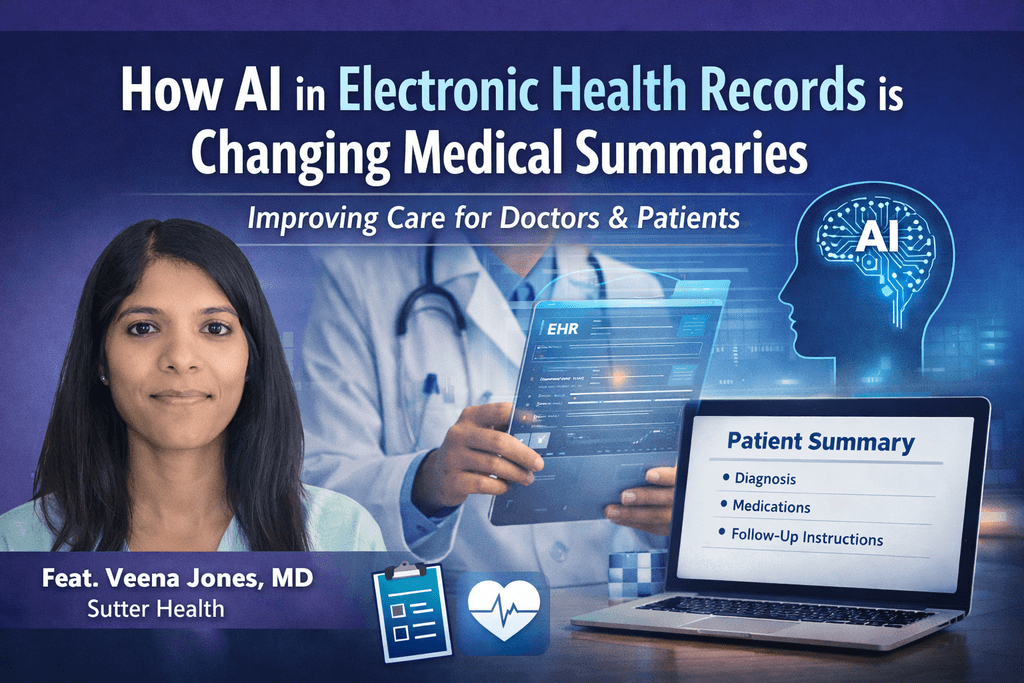
One practical example comes from Sutter Health, where AI has been used to turn care-team documentation into patient-friendly after-visit summaries.
The approach was discussed by Veena Jones, MD, Vice President and Chief Medical Information Officer at Sutter Health, during an AMA Update episode hosted by Todd Unger on July 21, 2025.
From Clinical Notes to Patient Understanding
Traditionally, clinical notes in EHR are primarily written for healthcare professionals.
They may contain:
• Medical terminology
• Diagnoses
• Clinical observations
• Medication information
• Test results
• Treatment plans
• Follow-up instructions
• Medical abbreviations
This information is essential for clinical care, but it is not always easy for patients to interpret.
The rise of open notes and patient access to electronic health records has changed this relationship.
Patients increasingly expect to see and understand their own health information.
That creates an important question:
How can healthcare organizations make complex medical information easier for patients to understand without compromising accuracy?
AI-powered medical summaries offer one possible answer.
At Sutter Health, the approach discussed by Dr. Jones involves using AI to transform clinical documentation into summaries written in language that is easier for patients to understand.
A patient-friendly summary can explain:
• What was discussed during the appointment
• Important diagnoses or findings
• Medications
• Recommended next steps
• Follow-up instructions
• Important information the patient should remember
Instead of leaving patients to interpret complex clinical notes on their own, AI can help create a clearer bridge between clinical documentation and patient understanding.
What Is AI in Electronic Health Records?
AI in EHRs refers to the use of artificial intelligence technologies to analyze, organize, summarize, generate, or assist with information contained in electronic health records.
Depending on the implementation, AI can assist with tasks such as:
• Clinical documentation
• Medical summarization
• Patient communication
• Information extraction
• Clinical decision support
• Administrative automation
• Medical coding assistance
• Data analysis
• Patient education
One of the most practical applications is AI-generated medical summaries.
Instead of asking a doctor to manually create multiple versions of the same information, AI can help transform existing documentation into different formats for different audiences.
For example:
Clinical conversation
↓
AI-assisted documentation
↓
Structured clinical note
↓
Patient-friendly summary
This can potentially reduce repetitive documentation while making healthcare information more accessible.
How AI Medical Summaries Work?
An AI-powered medical summary workflow can involve several stages.
1. Information Collection
The system receives information from appropriate clinical sources, such as:
• Clinical notes
• Patient history
• Diagnoses
• Medication records
• Test results
• Treatment plans
2. Information Processing
AI analyzes the available information to identify relevant details.
It may recognize:
• Key diagnoses
• Symptoms
• Clinical findings
• Medication changes
• Recommendations
• Follow-up requirements
3. Summarization
The system generates a shorter representation of the relevant information.
4. Patient-Friendly Transformation
The information can then be rewritten using simpler language.
For example:
Clinical language:
Hypertension management discussed; continue current antihypertensive regimen and monitor BP.
Patient-friendly explanation:
Your blood pressure treatment was reviewed. Continue taking your current blood pressure medicine and monitor your blood pressure as advised.
The objective is not to remove important medical information.
It is to make the information easier to understand.
5. Clinician Review
The generated summary should be reviewed according to the healthcare organization's workflow before being provided to the patient.
This human-review step is particularly important because healthcare information can directly affect patient decisions and care.
Can AI Really Write Good Patient Summaries?
This is one of the most important questions surrounding AI-generated medical documentation.
Large language models and other AI systems can produce fluent and understandable text, but healthcare requires a much higher standard than simply producing grammatically correct sentences.
A medical summary needs to be:
• Accurate
• Relevant
• Clear
• Contextually appropriate
• Clinically safe
• Consistent with the patient's record
The AMA discussion with Dr. Jones highlights a model where AI-assisted documentation is used to reduce the documentation burden while maintaining clinician involvement and review.
This distinction is critical.
AI should assist with:
Documentation → Organization → Summarization → Communication
Clinicians should remain responsible for:
Clinical judgment → Diagnosis → Treatment decisions → Patient care
The technology works best when these responsibilities remain clearly separated.
Ambient AI and Clinical Documentation
One of the major developments connected with AI in EHRs is ambient clinical documentation.
Traditionally, physicians may need to type notes or document information during or after patient consultations.
This can create significant administrative workload.
Ambient AI aims to reduce that burden by capturing relevant information from clinical conversations and helping generate structured documentation.
The potential workflow is:
Patient consultation
↓
Ambient AI captures relevant conversation
↓
AI structures information
↓
Clinical note generated
↓
Doctor reviews and edits
↓
Final documentation stored in EHR
The AMA's discussion with Dr. Jones specifically highlights the potential of ambient AI to reduce documentation burden for clinicians.
This can allow doctors to spend more attention on the patient rather than constantly switching between conversation and documentation.
AI in EHRs: Benefits for Doctors:
AI-powered EHR tools can potentially address some of the administrative challenges associated with clinical documentation.
✔ Reduced Documentation Burden
Doctors can spend considerable time documenting patient encounters.
AI-assisted documentation can help automate repetitive portions of this process.
✔ Lower Cognitive Load
Constantly switching between:
Patient → Screen → Notes → Patient → Screen
can make clinical interactions more difficult.
AI may help reduce this documentation burden.
✔ More Time for Patients
If less time is required for manual documentation, clinicians may have more opportunity to focus on direct patient interaction.
✔ Faster Information Review
AI-generated summaries can help clinicians quickly understand relevant information within large records.
✔ Better Workflow Efficiency
AI can potentially connect documentation, summarization, and patient communication into a more streamlined workflow.
AI in EHRs: Benefits for Patients:
The benefits are not limited to doctors.
Patients can also benefit significantly from better medical summaries.
✔ Easier-to-Understand Information
Medical terminology can be difficult for people without healthcare training.
AI can help transform technical information into clearer explanations.
✔ Better Recall After Appointments
Patients may forget some information discussed during a consultation.
A written summary provides a reference that can be reviewed later.
✔ Clearer Follow-Up Instructions
Patients can more easily understand:
• What they need to do
• Which medications to take
• When they need to return
• Which tests are required
• What symptoms require attention
✔ Greater Patient Engagement
When patients understand their health information, they can participate more effectively in discussions about their care.
AI Medical Summaries and Patient Engagement
Healthcare is increasingly moving from a provider-centered model toward a more collaborative approach.
Patients are not simply recipients of healthcare services.
They are participants in their own care.
That makes communication extremely important.
Consider the difference:
Traditional Approach
Doctor → Clinical Documentation → Patient
AI-Assisted Approach
Doctor → Clinical Documentation → AI-assisted summary → Patient
The second approach does not remove the doctor.
Instead, it adds a communication layer that can make medical information easier to understand.
This is particularly valuable for patients managing:
• Chronic diseases
• Long-term medications
• Multiple conditions
• Complex treatment plans
• Repeated hospital visits
• Follow-up appointments
Is AI Reliable in Healthcare?
Reliability is one of the biggest concerns surrounding AI in healthcare.
AI systems can make mistakes.
They can misunderstand context, omit information, generate inaccurate statements, or produce language that sounds convincing even when the underlying information is incorrect.
That means AI-generated medical summaries should not be treated as automatically correct simply because they are generated by sophisticated technology.
Important safeguards include:
• Human Oversight
Healthcare professionals should remain involved in reviewing clinically significant AI-generated content.
• Data Validation
AI output should be checked against reliable patient information.
• Transparency
Healthcare organizations should understand how AI systems are being used and where human review occurs.
• Continuous Monitoring
AI systems should be evaluated continuously for errors, quality, and unintended consequences.
• Patient Feedback
Patients can provide valuable feedback about whether summaries are actually understandable and useful.
The approach discussed by Dr. Jones emphasizes clinician involvement rather than fully autonomous AI decision-making.
AI Should Support — Not Replace — Clinical Judgment
This distinction should remain at the center of AI adoption in healthcare.
AI can be very good at:
• Processing large amounts of information
• Finding patterns
• Summarizing documentation
• Generating drafts
• Automating repetitive tasks
But clinical care involves:
• Context
• Experience
• Ethics
• Communication
• Uncertainty
• Human judgment
A useful model is:
AI handles information-intensive tasks while clinicians remain responsible for clinical judgment.
This approach can help healthcare organizations benefit from AI without treating it as an independent medical authority.
Privacy and Security in AI-Powered EHRs
AI introduces another important consideration: patient data privacy.
EHR systems contain highly sensitive information, including:
• Medical history
• Diagnoses
• Medication records
• Laboratory results
• Personal information
• Insurance information
• Clinical notes
When AI systems process this information, healthcare organizations need strong controls around:
• Data access
• User permissions
• Encryption
• Authentication
• Audit trails
• Data storage
• Third-party integrations
• Data retention
• Vendor security
AI adoption should therefore be considered as part of a broader healthcare cybersecurity and data governance strategy.
The goal should be:
Useful AI + Secure data + Human oversight + Responsible governance
What AI Could Mean for the Future of EHRs?
Medical summaries are only one potential application.
AI could eventually become an intelligent layer across different components of an EHR.
For example:
| EHR Area | Potential AI Application |
| Clinical Notes | Automated documentation |
| Medical Summaries | Patient-friendly summaries |
| Patient Records | Information extraction |
| Patient Education | Personalized explanations |
| Appointments | Scheduling assistance |
| Laboratory Data | Result summarization |
| Medication | Medication information and reminders |
| Reporting | Automated analytics |
| Administration | Workflow automation |
| Clinical Decision Support | Information-based assistance |
The important distinction is that these applications should be designed according to clinical risk and appropriate levels of human oversight.
AI in Electronic Health Records and the Future of Patient Communication
One of the most interesting possibilities is that the same EHR information could be presented differently depending on the user.
For a Doctor
A clinical summary might emphasize:
• Diagnoses
• Relevant history
• Medications
• Test results
• Clinical findings
For a Patient
The same information could emphasize:
• What happened
• What the diagnosis means
• What to do next
• Medication instructions
• Follow-up requirements
For a Hospital Administrator
The information might instead focus on:
• Operational metrics
• Patient volumes
• Resource utilization
• Financial information
• Performance indicators
This is where AI can become more than a summarization tool.
It can become a contextual information layer within healthcare systems.
What This Means for Nepal’s EHR and EMR Systems?
Nepal has an important opportunity to learn from global developments while building its own digital-health ecosystem.
The Ministry of Health and Population describes EHR as a system for bringing together information such as prescriptions, test reports, medical history, examinations, medications, diagnoses, treatment results, allergies, and other patient information. It also identifies the development of an EHR ecosystem across public and private healthcare facilities as an important objective.
Nepal Ministry of Health: Electronic Health Records 2.0
The Ministry's digital-health materials also emphasize interoperability and standardized EHR/EMR systems as part of Nepal's future digital-health direction.
Future Digital Health Plan of Nepal
This creates an interesting opportunity.
Instead of simply digitizing paper records, Nepal can consider how AI-ready EHR infrastructure could be designed from the beginning.
Why AI-Powered EHRs Could Be Important for Nepal?
Nepal's healthcare system includes hospitals, clinics, diagnostic centers, specialty facilities, and healthcare providers operating with varying levels of digital maturity.
AI could potentially help address several challenges.
1. Patient-Friendly Medical Summaries
AI could transform technical documentation into easier-to-understand explanations.
For Nepal, multilingual support could make this particularly valuable.
A future system could potentially generate:
English clinical documentation → Nepali patient summary
while maintaining the original clinical record separately.
2. Reduced Documentation Workload
Healthcare professionals can face significant administrative responsibilities.
AI-assisted documentation could help reduce repetitive manual work.
3. Better Continuity of Care
As healthcare records become more connected, clinicians can potentially access more complete patient histories.
4. Improved Patient Engagement
Clearer explanations can help patients better understand their treatment plans and follow-up requirements.
5. More Efficient Healthcare Operations
AI can potentially support administrative workflows, reporting, analytics, and information management.
Nepal’s Digital Health Direction
The opportunity is broader than individual hospital systems.
Nepal's Ministry of Health has been working toward broader digital-health infrastructure, including an envisioned national digital health platform that could connect public-sector health facilities and link with systems such as HMIS, EHR systems, and the Health Facility Registry.
Nepal National Digital Health Platform
This direction highlights why interoperability is so important.
If different healthcare systems cannot communicate with one another, AI cannot easily create a complete picture of a patient's healthcare journey.
The future therefore requires more than isolated EHR implementations.
It requires:
EHR + Interoperability + Standards + Security + AI + Human Oversight
AI, EHR and Interoperability
Imagine a patient who receives healthcare from:
• A local clinic
• A diagnostic center
• A specialist
• A hospital
• A pharmacy
If each facility maintains disconnected records, the patient's information becomes fragmented.
An interoperable digital-health ecosystem could allow authorized healthcare providers to access appropriate information when needed.
AI could then help summarize that information.
For example:
Multiple healthcare records
↓
Unified patient information
↓
AI-assisted summarization
↓
Clinician-friendly view
↓
Patient-friendly explanation
This could potentially reduce duplication and improve continuity of care.
However, interoperability should always operate within appropriate privacy, security, authorization, and governance frameworks.
The Role of AI in Patient-Friendly Healthcare
The most valuable use of AI may not always be the most technologically impressive one.
Sometimes the biggest impact can come from something simple:
Helping a patient understand what their doctor told them.
A patient who understands:
• Their diagnosis
• Their medication
• Their follow-up schedule
• Their test results
• Their next steps
is better positioned to participate in their own care.
This makes AI-generated summaries a particularly interesting healthcare application because they focus on communication rather than replacing medical professionals.
How Geofinity Is Approaching Healthcare Technology?
The transition toward AI-enabled healthcare requires a strong digital foundation first.
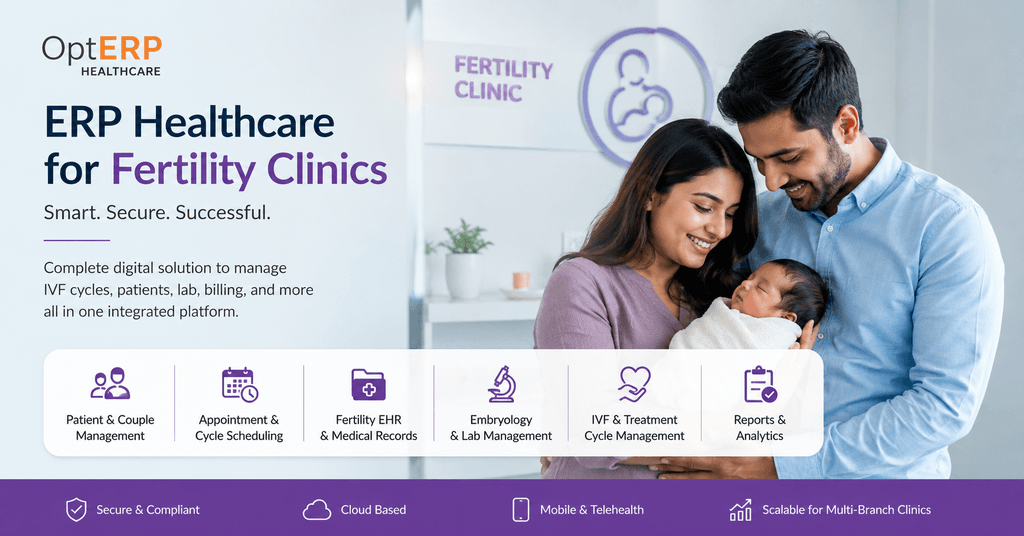
Geofinity Solutions currently develops healthcare-focused enterprise technology through its OptERP healthcare solution. The platform is positioned as a modular hospital and clinic management system integrating clinical, administrative, and financial workflows, including EHR, OPD/IPD, billing, pharmacy, diagnostics, and reporting.
Geofinity Healthcare Solutions
This is relevant to the broader AI discussion because AI works most effectively when healthcare organizations already have structured, accessible, and reliable digital information.
A practical progression is:
Digitize → Integrate → Standardize → Analyze → Automate → Apply AI
Without structured digital records, AI has limited high-quality information to work with.
OptERP and the Future of AI-Enabled Healthcare
OptERP Healthcare is positioned around integrating different hospital and clinic workflows into a centralized platform.
Its healthcare solution includes areas such as:
• Electronic Health Records
• OPD
• IPD
• Pharmacy
• Diagnostics
• Billing
• Inventory
• HR
• Accounts
• Reporting
The Geofinity company profile also identifies an AI module, mobile application, and telemedicine integration among planned developments for the healthcare solution.
This illustrates an important point about healthcare technology:
AI should not be treated as an isolated feature.
It should eventually work alongside:
EHR + Hospital Management + Billing + Pharmacy + Diagnostics + Analytics + Patient Engagement
A connected healthcare platform provides the foundation on which intelligent features can be built.
AI in EHR: What Healthcare Organizations Should Consider?
Before implementing AI, hospitals and clinics should evaluate more than the technology itself.
✔ Data Quality
AI output depends heavily on the quality and structure of the underlying data.
✔ Interoperability
Systems should be able to exchange information using appropriate standards.
✔ Privacy
Patient information must be protected.
✔ Human Oversight
Clinical professionals should remain involved in appropriate decisions and review processes.
✔ Transparency
Organizations should understand how AI is being used and what limitations exist.
✔ Usability
AI tools should simplify workflows rather than create additional complexity.
✔ Training
Doctors, nurses, administrators, and other staff need to understand how to use AI responsibly.
✔ Monitoring
AI performance should be evaluated continuously.
AI Medical Summaries: Benefits and Risks
| Area | Potential Benefit | Key Risk |
| Clinical Documentation | Less manual work | Incorrect documentation |
| Patient Summaries | Easier understanding | Missing important context |
| Patient Education | Clearer explanations | Oversimplification |
| Record Review | Faster information access | Important details overloaded |
| Workflow Automation | Improved efficiency | Automation errors |
| Analytics | Faster insights | Poor-quality data |
| Multilingual Communication | Better accessibility | Translation errors |
| Decision Support | Information assistance | Over-reliance on AI |
| Patient Engagement | Better communication | Misinterpretation |
The objective should therefore not be:
“Use AI everywhere.”
It should be:
“Use AI where it creates measurable value while maintaining appropriate clinical safeguards.”
The Future of AI in Electronic Health Records
The next generation of EHR systems could become much more intelligent.
Potential future capabilities include:
• Intelligent Clinical Summaries
AI could summarize large patient histories for clinicians.
• Personalized Patient Explanations
Patients could receive information tailored to their language and level of understanding.
• Automated Documentation
Ambient AI could help generate clinical notes.
• Intelligent Search
Doctors could ask questions about a patient's record using natural language.
• Predictive Analytics
Healthcare organizations could use historical data to identify patterns and operational risks.
• Automated Administrative Workflows
AI could assist with scheduling, documentation, reporting, and other repetitive tasks.
• Multilingual Healthcare Communication
AI could potentially translate or simplify healthcare information into multiple languages.
For Nepal, multilingual healthcare communication could become particularly valuable as digital health systems expand.
The Human Side of AI in Healthcare
Technology should ultimately make healthcare more human, not less.
If AI allows a doctor to spend more time looking at the patient rather than typing into a computer, that is meaningful.
If AI helps a patient understand their treatment plan after leaving the hospital, that is meaningful.
If AI reduces repetitive administrative work without removing clinical responsibility, that is meaningful.
The success of AI in healthcare should therefore not be measured only by:
• Number of AI models
• Processing speed
• Automation percentage
• Number of generated summaries
It should also be measured by:
Did doctors have more time for patients?
Did patients understand their care better?
Did healthcare workflows become safer and more efficient?
These are the outcomes that matter.
Frequently Asked Questions (FAQ's):
Q. What is AI in Electronic Health Records?
AI in EHR refers to using artificial intelligence to analyze, summarize, organize, or assist with information stored in electronic health records. Applications can include medical summaries, documentation, patient communication, analytics, and workflow automation.
Q. How does AI create medical summaries?
AI can analyze relevant information from clinical documentation and generate a shorter, structured summary. Depending on the system, the summary can be written for clinicians or transformed into simpler, patient-friendly language.
Q. Can AI replace doctors when writing medical summaries?
No. AI can assist with drafting and summarizing information, but appropriate clinical workflows should maintain human oversight. The doctor remains responsible for clinical judgment and patient care.
Q. How does AI help doctors?
AI can reduce repetitive documentation work, organize information, generate draft notes, summarize records, and potentially allow clinicians to spend more time interacting with patients.
Q. How does AI help patients?
AI can transform technical medical information into clearer language, help patients remember instructions, and improve understanding of diagnoses, medications, and follow-up plans.
Q. Is AI-generated medical information always accurate?
No. AI systems can make errors or omit important context. Healthcare organizations should use appropriate validation, monitoring, and human review, especially for clinically significant information.
Q. What is ambient AI in healthcare?
Ambient AI refers to technology that can capture relevant information from clinical interactions and assist in generating structured documentation, reducing the amount of manual note-taking required from clinicians.
Q. Is AI safe for Electronic Health Records?
AI can be used safely only with appropriate safeguards. Healthcare organizations need to consider privacy, cybersecurity, access controls, data quality, human oversight, transparency, and continuous monitoring.
Q. Can AI generate medical summaries in Nepali?
Technically, multilingual AI systems can generate or translate healthcare information into languages such as Nepali. However, medical translation requires careful validation because incorrect translation or oversimplification could affect patient understanding.
Q. What is the difference between EHR and EMR?
An EMR (Electronic Medical Record) generally refers to a digital medical record maintained within a healthcare provider or organization.
An EHR (Electronic Health Record) is generally broader and is designed to support information sharing and continuity of care across healthcare settings.
In practice, the terminology and scope can vary between systems and countries.
Q. What is the future of AI in EHR systems?
Future EHR systems are likely to incorporate more AI-assisted documentation, patient summaries, intelligent search, analytics, clinical decision support, workflow automation, and personalized patient communication.
Q. How is Nepal preparing for digital health?
Nepal's Ministry of Health and Population has identified EHR ecosystems, digital health platforms, interoperability, and standardized digital-health infrastructure as important parts of the country's digital-health direction.
Q. How can OptERP contribute to digital healthcare in Nepal?
OptERP Healthcare provides an integrated platform for areas such as EHR, OPD/IPD, billing, pharmacy, diagnostics, inventory, HR, accounts, and reporting. Its broader digital foundation can support healthcare organizations as they move toward more connected and intelligent systems.
Final Thoughts
AI-powered medical summaries represent a relatively simple but potentially powerful application of artificial intelligence in healthcare.
The technology does not need to diagnose patients or make autonomous treatment decisions to create value.
Sometimes, its most meaningful role can be helping people understand information that already exists.
The AMA Update discussion featuring Dr. Veena Jones provides a practical example of how AI can be used to transform clinical documentation into patient-friendly summaries while keeping clinicians involved in the process.
For doctors, this approach can help reduce documentation burden.
For patients, it can make complex medical information easier to understand.
For healthcare organizations, it can become part of a broader digital transformation strategy.
For Nepal, the opportunity is even more significant.
As the country develops its EHR ecosystem and works toward greater interoperability and digital-health integration, AI can potentially be incorporated into healthcare systems from the beginning rather than added as an afterthought.
The progression is straightforward:
Digital Records → Integrated EHR → Interoperability → Structured Data → AI → Better Communication
But the technology should always serve the people using it.
The future of AI in healthcare should not be about replacing the human connection between doctors and patients.
It should be about giving doctors better tools, giving patients clearer information, and making healthcare more connected, understandable, and human.
AI works best in healthcare when it supports human judgment—not when it tries to replace it.