From Digital Records to Intelligent Health Systems
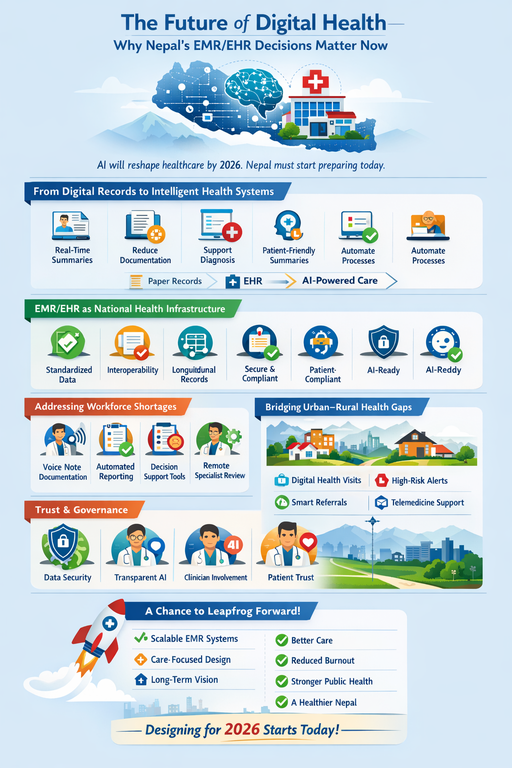
Healthcare is moving beyond simply digitizing paper records.
The next generation of Electronic Medical Records (EMRs) and Electronic Health Records (EHRs) is becoming increasingly connected, structured, interoperable, and capable of supporting intelligent clinical and operational tools.
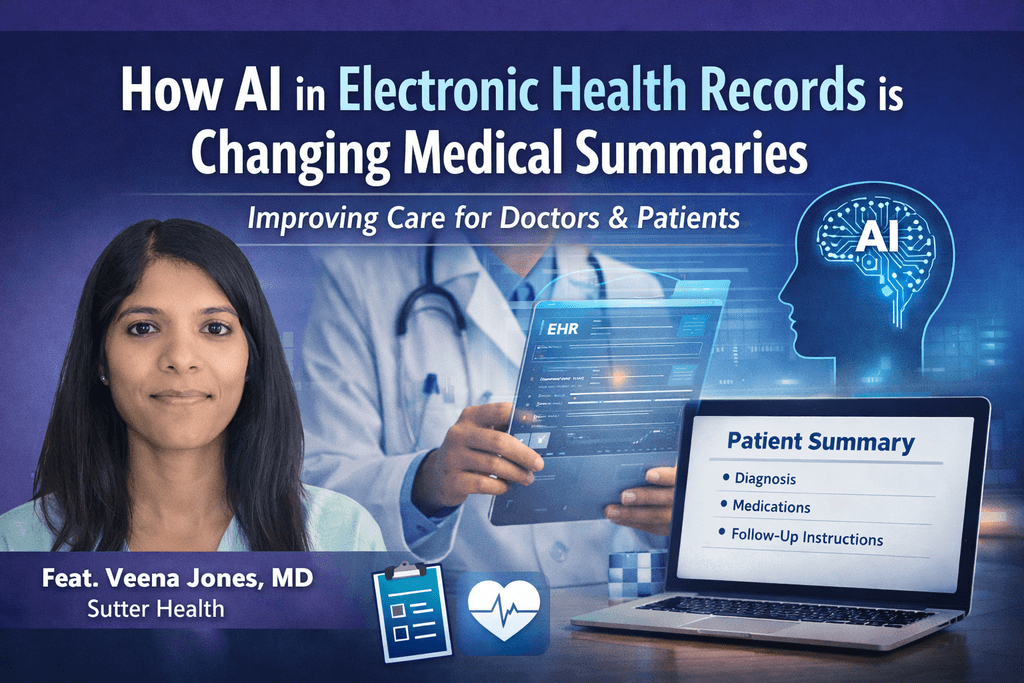
Artificial intelligence is accelerating this transformation. AI-enabled health systems can potentially:
- Summarize patient histories in real time
- Reduce clinical documentation burden
- Support diagnostic and treatment decisions
- Generate patient-friendly visit summaries
- Automate administrative and reporting processes
- Identify patterns across large volumes of clinical data
- Support population-health monitoring
But there is an important condition:
AI can only add meaningful value when the underlying health data is accurate, structured, interoperable, secure, and governed.
This makes today's EMR/EHR decisions much more important than they may initially appear.
Get more knowledge in: AI in Healthcare
Why This Matters for Nepal’s Health System?
Nepal is at an important stage in its digital-health journey.
The country is not starting from zero. The Ministry of Health and Population (MoHP) has been developing digital-health infrastructure, electronic health records, interoperability initiatives, and standards-based approaches.
The government's Digital Health platform describes EHR as a system capable of bringing together information such as prescriptions, test reports, medical history, examinations, medications, diagnoses, treatment results, allergies, risk factors, and other health information into a longitudinal record.
Nepal has also established the Standards and Interoperability Lab (SIL-Nepal) to help digital-health systems communicate using internationally recognized standards. The initiative specifically focuses on interoperability between healthcare applications, systems, devices, and data sources.
At the same time, many healthcare organizations still face challenges such as:
- Paper-based or partially digitized workflows
- Multiple disconnected software systems
- Data stored in organizational silos
- Limited interoperability
- Inconsistent data standards
- Different levels of digital maturity between facilities
- Infrastructure and connectivity constraints
This creates a critical question:
Will Nepal build connected digital health infrastructure — or simply digitize disconnected hospital systems?
The answer will influence how useful healthcare AI, analytics, telemedicine, and population-health systems can become.
EMR vs EHR: Why the Difference Matters
The terms EMR and EHR are often used interchangeably, but there is an important distinction.
| Feature | EMR | EHR |
|---|---|---|
| Primary purpose | Digital records with a healthcare organization | Longitudinal health record across healthcare settings |
| Patient history | Usually organization-specific | Designed for broader continuity |
| Interoperability | May be limited | Requires stronger interoperability |
| Data sharing | Primarily internal | Can support authorized exchange |
| Multi-provider care | Limited | Better suited |
| Population health | Limited | Stronger potential |
| AI readiness | Depends on data structure | Greater potential with standardized data |
| National health ecosystem | One component | Potential foundation |
An EMR can digitize a hospital's existing workflow.
An EHR ecosystem can connect information across the patient's healthcare journey.
That distinction is critical for Nepal.
EMR/EHR as National Health Infrastructure
EMRs should not be viewed only as hospital-management software.
They can become a component of national health infrastructure.
Nepal's own Digital Health initiative describes an EHR ecosystem involving public and private healthcare facilities and highlights benefits such as improved access to patient information, reduced paperwork and duplicate testing, coordinated care, secure information sharing, and safer clinical decision-making.
For this vision to work, Nepal's EMR/EHR systems need several foundational capabilities.
1. Standardized Clinical Data
Information such as:
- Diagnoses
- Medications
- Laboratory results
- Allergies
- Procedures
- Vital signs
- Imaging
- Clinical notes
should be stored in structured and meaningful formats.
Unstructured data is much harder to exchange, analyze, and use safely with AI.
2. Interoperability
A hospital's system should not become an isolated digital island.
A patient may receive care from:
Community Health Center → District Hospital → Specialist Hospital → Diagnostic Laboratory → Pharmacy
The information generated at each stage should be capable of being securely exchanged when appropriate and authorized.
3. Longitudinal Patient Records
Healthcare does not happen in a single visit.
A patient's health history may span decades.
An effective EHR should allow authorized clinicians to understand relevant information across time rather than relying solely on the patient's ability to carry documents between institutions.
4. Secure Data Governance
Healthcare data is extremely sensitive.
Nepal's digital-health ecosystem therefore needs clear approaches to:
- Consent
- Authentication
- Access control
- Data security
- Data ownership and stewardship
- Audit trails
- Data sharing
- Privacy
- Responsible AI
5. AI Readiness
AI should not be treated as something that can simply be added on top of any database.
AI-ready healthcare infrastructure requires high-quality and appropriately structured data.
The quality of tomorrow's healthcare AI will depend heavily on the quality of today's digital health infrastructure.
Nepal Is Already Moving Toward Interoperability
One of the most important developments in Nepal's digital-health ecosystem is the focus on standards and interoperability.
SIL-Nepal identifies interoperability as a major challenge because Nepal's healthcare environment contains multiple systems and applications that need to exchange information. It works toward standards-based digital health using technologies and frameworks including FHIR and other interoperability approaches.
Nepal's Ministry of Health and Population has also conducted dedicated activities around HL7 FHIR, a standard designed to support the exchange of electronic health information through modern APIs and structured resources.
This is important because interoperability is not simply a technical feature.
It is what allows different parts of the healthcare system to communicate.
Why FHIR Matters for Nepal's Digital Health Future
FHIR — Fast Healthcare Interoperability Resources is increasingly important in modern healthcare integration.
It provides standardized resources and APIs for exchanging healthcare information.
For example, a healthcare ecosystem could exchange structured information representing:
- Patient
- Practitioner
- Organization
- Encounter
- Observation
- Medication
- Diagnostic Report
- Allergy
- Procedure
This allows different systems to communicate without requiring every organization to use exactly the same software.
Nepal's digital-health authorities have already been exploring FHIR and interoperability. A 2024 MoHP workshop specifically focused on FHIR and its role in exchanging EHR information.
The Ministry's digital-health materials also discuss the relationship between DHIS2 and FHIR and the challenges of integrating systems with different architectures and data models.
This means Nepal's digital-health conversation is moving beyond "Should healthcare be digital?"
The more important question is becoming:
"How should healthcare systems communicate with each other?"
Addressing Workforce Shortages with Intelligent Systems
Nepal's healthcare system, like many health systems globally, operates under resource constraints.
Technology cannot magically create more doctors, nurses, specialists, or healthcare workers.
But well-designed digital systems can reduce unnecessary administrative work.
AI-enabled EMRs can potentially support clinicians through:
• Ambient Clinical Documentation
AI can assist in converting clinical conversations into structured documentation, reducing repetitive typing and paperwork.
• Automated Summaries
Large patient histories can potentially be summarized so clinicians can identify relevant information faster.
• Clinical Decision Support
Structured patient information can support alerts and decision-support tools.
• Automated Reporting
Routine administrative and reporting tasks can be partially automated.
• Remote Specialist Review
Digitally accessible records can allow specialists to review cases remotely where appropriate.
AI does not replace clinicians. The objective should be to help clinicians spend more time on patients and less time fighting paperwork.
WHO similarly emphasizes that AI has potential to address healthcare workforce gaps and resource limitations, while stressing the need for appropriate governance and safeguards.
Bridging Urban–Rural Health Gaps
Digital health could be particularly valuable outside Nepal's major urban centers.
A connected EMR/EHR ecosystem could support:
✔ Digital recording by community health workers
✔ Automatic identification of high-risk patients
✔ Data-supported referral prioritization
✔ Remote specialist consultation
✔ Digital access to previous medical records
✔ Follow-up monitoring
✔ Continuity of care between facilities
Imagine a patient receiving care in a rural health facility.
Instead of starting from zero when referred to a specialist in Kathmandu, an authorized specialist could potentially access relevant clinical information digitally.
That is the difference between digitizing a facility and connecting a health system.
Digital Health Infrastructure Is More Than Software
EMR adoption cannot succeed through software alone.
Nepal's Digital Health infrastructure framework identifies components such as computing devices, network infrastructure, internet connectivity, security systems, power backup, data backup, local application servers, and firewalls as important parts of digital health infrastructure.
This is especially important for Nepal because healthcare facilities operate under very different infrastructure conditions.
A successful digital-health strategy therefore needs to consider:
| Infrastructure Layer | Why It Matter |
|---|---|
| Devices | Enables data entry and clinical use |
| Network | Connects systems and departments |
| Internet | Enables secure data exchange |
| Power backup | Supports continuity of services |
| Servers/cloud | Stores and processes health data |
| Backup | Protects against data loss |
| Cybersecurity | Protects sensitive health information |
| Interoperability layer | Connects different systems |
| Standards | Gives data consistent meaning |
Without these foundations, even the best EMR software can fail in real-world environments.
From Episodic Care to Population Health
One of the biggest long-term benefits of digital health is that data can move beyond individual patient care.
When appropriately aggregated, governed, and de-identified data can support population-level health intelligence.
Potential applications include:
Chronic Disease Monitoring
Health systems could identify trends in:
- Diabetes
- Hypertension
- Cardiovascular disease
- Chronic respiratory conditions
Maternal and Child Health
Digital records can support monitoring of:
- Antenatal care
- High-risk pregnancies
- Child health
- Immunization
- Follow-up
Disease Surveillance
Connected digital systems can improve the availability of timely information for disease monitoring and outbreak preparedness.
Public Health Planning
Decision-makers can use better-quality information to understand where healthcare resources are needed.
This creates a progression:
Patient Data → Clinical Information → Health Intelligence → Better Decisions
But this only works when the underlying data is accurate, standardized, interoperable, and governed.
Nepal's Digital Health Journey Is Already Taking Shape
Nepal's progress should not be viewed simply as a future ambition.
There are already concrete initiatives.
In April 2025, MoHP and WHO conducted a workshop on the preliminary Nepal Digital Health Blueprint, bringing together more than 80 participants from government, provincial health authorities, development partners, academia, the private sector, and hospitals. The blueprint is intended to provide a strategic framework for using digital technologies to advance health goals and universal health coverage.
In June 2024, MoHP's Curative Service Division also conducted a consultation on EHR and telemedicine to gather implementation experience and inform a proposed standard operating procedure for integrated EHR and telemedicine. More than 65 participants, including doctors and EMR/telemedicine focal points, took part.
And in 2025, WHO handed over an open-source EMR system to APF Hospital, with phased implementation planned across hospital departments. The initiative was intended to reduce reliance on paper processes and support real-time access to medical records.
These developments suggest that Nepal's digital-health ecosystem is moving from discussion toward implementation.
The Next Challenge: Avoiding Digital Silos
Digitization itself is not enough.
A hospital can have:
- An EMR
- A billing system
- A laboratory system
- A pharmacy system
- A radiology system
- A separate appointment system
and still have a fragmented digital environment.
This is the digital silo problem.
MoHP's interoperability work explicitly recognizes the challenge of multiple systems and the need for healthcare applications to communicate using standards.
The goal should therefore not be:
"Every hospital should have software."
The goal should be:
"Healthcare systems should be able to securely exchange meaningful information."
That distinction could define the success or failure of Nepal's digital-health transformation.
AI is Only as Good as the Health Data Behind It
The excitement around AI in healthcare is understandable.
But AI cannot compensate for poor data.
Consider two scenarios.
Scenario A — Poorly Structured Data
A hospital stores information as disconnected PDFs, images, handwritten scans, inconsistent text, and incomplete records.
AI may struggle to reliably understand the patient's complete history.
Scenario B — Structured, Interoperable Data
The patient's diagnoses, medications, allergies, laboratory results, procedures, encounters, and other relevant information are consistently structured and exchangeable.
AI tools have a much stronger foundation from which to work.
Therefore:
Better EMR → Better Data → Better Analytics → Better AI Potential
This is why EMR/EHR architecture decisions made today matter far beyond today's software procurement.
Trust, Governance, & Human-Centered Design
Healthcare technology ultimately depends on trust.
Patients need confidence that their health information will not be misused.
Clinicians need confidence that digital tools support rather than obstruct their work.
Hospitals need confidence that systems are secure and reliable.
Government needs confidence that technology supports public-health objectives.
And AI systems need appropriate oversight.
WHO's guidance on AI for health emphasizes that AI should be developed and deployed with ethics, human rights, accountability, transparency, equity, and appropriate governance at the center.
For Nepal, this means digital-health transformation should consider:
- Clear data governance
- Patient consent and appropriate data access
- Strong cybersecurity
- Transparent use of AI
- Human oversight
- Clinician participation in system design
- Patient-centered workflows
- Equitable access
- Auditability and accountability
- Continuous evaluation
Technology should serve healthcare — not force healthcare workers to serve technology.
The 10–20–70 Principle: Why People Matter
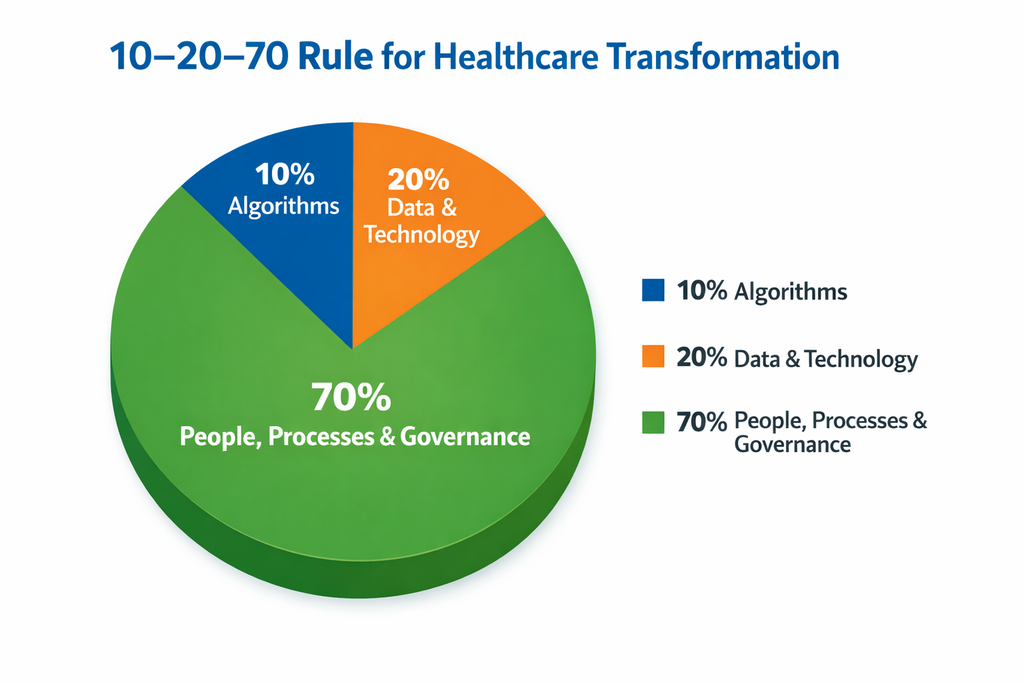
A common lesson in digital transformation is that technology alone rarely determines success.
The commonly referenced 10–20–70 framework emphasizes the importance of people, processes, and organizational change alongside technology and algorithms.
For Nepal's health system, this means that purchasing an advanced EMR will not automatically create digital transformation.
Success also depends on:
- Training
- Clinical workflow redesign
- Leadership
- Change management
- Data governance
- Technical support
- User adoption
- Continuous improvement
The most advanced software can fail if healthcare workers do not trust it, understand it, or find it practical.
What Should Nepal Look for When Choosing an EMR/EHR?
As Nepal's healthcare organizations evaluate digital systems, the checklist should go beyond features and price.
| Evaluation Area | What to Look For |
|---|---|
| Clinical functionality | OPD, IPD, emergency, nursing, pharmacy, laboratory, radiology |
| Interoperability | HL7/FHIR and standards-based integration |
| Data structure | Structured and machine-readable clinical information |
| Scalability | Ability to support growing facilities and users |
| Security | Authentication, authorization, encryption, audit trails |
| Privacy | Appropriate consent and access mechanisms |
| Integration | LIS, RIS/PACS, pharmacy, billing and other systems |
| Analytics | Dashboards and reporting |
| AI readiness | High-quality structured data and APIs |
| Offline capability | Important for connectivity-constrained environments |
| Localization | Nepal-specific workflows and requirements |
| Usability | Simple workflows for healthcare professionals |
| Support | Training, implementation and long-term maintenance |
| Vendor flexibility | Avoiding unnecessary vendor lock-in |
| Standards compliance | Alignment with national and international requirements |
The cheapest system today may not be the cheapest system over ten years.
Similarly, the system with the longest feature list is not necessarily the best system.
The better question is:
Can this platform become part of Nepal's connected digital-health ecosystem?
EMR/EHR Decisions Are Also Economic Decisions
Digital health is not only a healthcare issue.
It is also an economic and technology opportunity.
A strong digital-health ecosystem can create demand for:
- Health-tech companies
- Software developers
- Health informatics professionals
- Cybersecurity specialists
- Data engineers
- AI researchers
- Cloud infrastructure
- Interoperability specialists
- Digital-health consultants
- Technical support and training
Nepal can potentially build domestic expertise while improving healthcare delivery.
Get more knowledge on Nepal’s Booming IT Sector
A Chance to Leapfrog
Nepal does not necessarily need to reproduce every stage of healthcare digitization followed by wealthier countries.
It can learn from existing implementations and move toward:
- Scalable EMR platforms
- Standards-based interoperability
- Patient-centered EHR ecosystems
- Secure digital health infrastructure
- AI-ready clinical data
- Integrated telemedicine
- Population-health analytics
- Long-term digital-health governance
The opportunity is not simply to replace paper.
It is to build a healthcare information infrastructure capable of supporting the next generation of care.
What Happens If Nepal Gets EMR/EHR Right?
The potential benefits extend far beyond a hospital's IT department.
| Today's Challenge | Potential Digital Health Benefit |
|---|---|
| Paper-heavy records | Faster digital access |
| Fragmented patient history | More continuous care |
| Repeated tests | Better access to previous results |
| Administrative burden | Automated workflows |
| Limited specialist availability | Remote review and telemedicines |
| Data silos | Interoperable health information |
| Delayed reporting | Faster health intelligence |
| Poorly structured information | AI-ready clinical data |
| Limited population insights | Better public-health analytics |
| Urban-rural disparities | Greater potential for connected care |
The Real Question Is Not Whether Nepal Will Go Digital
Nepal's healthcare system is already moving toward digital transformation.
The more important question is what kind of digital health ecosystem Nepal will build.
Will hospitals adopt disconnected systems that solve only their internal administrative needs?
Or will Nepal build an interoperable ecosystem where:
Patients → Providers → Hospitals → Laboratories → Pharmacies → Specialists → Public Health Systems
can securely exchange meaningful information?
That decision matters because today's infrastructure will shape tomorrow's possibilities.
Conclusion:
Nepal's digital-health future will not be determined by AI alone.
It will be determined by the foundations beneath AI.
If Nepal gets EMR/EHR architecture, interoperability, data governance, cybersecurity, infrastructure, and clinical workflows right, the country can create a stronger foundation for intelligent and connected healthcare.
That could mean:
✔ Better care with fewer resources
✔ Reduced administrative burden
✔ Lower clinician burnout
✔ More coordinated patient care
✔ Stronger public-health intelligence
✔ Better urban-rural connectivity
✔ Greater potential for responsible healthcare AI
✔ A stronger domestic health-tech ecosystem
The Ministry of Health and Population's ongoing work on EHR, interoperability, FHIR, digital-health infrastructure, and the national Digital Health Blueprint shows that these are no longer purely theoretical issues.
The future of digital health is coming — but Nepal's EMR/EHR decisions today will determine how ready the country is for it.
Frequently Asked Questions
Q. What is EMR in healthcare?
EMR stands for Electronic Medical Record. It is a digital version of a patient's medical information used within a healthcare organization, including clinical notes, diagnoses, medications, laboratory results, and other relevant information.
Q. What is EHR?
EHR stands for Electronic Health Record. It is designed to provide a more comprehensive and longitudinal view of a patient's health information and can support information exchange between authorized healthcare providers.
Q. What is the difference between EMR and EHR?
An EMR is generally centered on records within a particular healthcare organization, while an EHR is designed to support broader information sharing and continuity of care across healthcare settings.
Q. Why does Nepal need EMR/EHR systems?
EMR/EHR systems can reduce reliance on paper records, improve access to patient information, support continuity of care, reduce duplication, and create better foundations for health analytics and digital services.
Q. Is Nepal already implementing EHR?
Yes. Nepal's Ministry of Health and Population has ongoing digital-health initiatives involving EHR, interoperability, digital infrastructure, and standards. The government's Digital Health initiative describes an EHR ecosystem connecting public and private healthcare facilities.
Q. What is FHIR in digital health?
FHIR, or Fast Healthcare Interoperability Resources, is an HL7 standard designed to facilitate the exchange of healthcare information through standardized resources and APIs.
Q. Why is interoperability important?
Interoperability allows different healthcare systems to exchange meaningful information. Without it, hospitals, laboratories, pharmacies, and other systems can become isolated digital silos.
Q. Can AI work without an EHR?
AI can be used with many types of healthcare data, but strong, structured and appropriately governed EHR/EMR data can provide a much stronger foundation for many clinical and operational AI applications.
Q. Can AI replace doctors?
AI should not be viewed as a replacement for clinicians. Properly governed AI can support healthcare professionals with documentation, information retrieval, decision support, analytics, and other tasks while keeping humans responsible for clinical judgment.
Q. What are the biggest challenges of EMR adoption in Nepal?
Challenges can include infrastructure, connectivity, costs, interoperability, cybersecurity, data governance, workforce training, workflow redesign, system usability, and differences in digital maturity between healthcare facilities.
Q. How can EMR help rural healthcare in Nepal?
Connected digital records can potentially support remote specialist review, referrals, continuity of care, digital documentation, risk identification, and better access to patient information.
Q. Why is healthcare data governance important?
Health records contain highly sensitive information. Strong governance helps ensure that data is collected, accessed, shared, stored, and used appropriately and securely.
Q. What should hospitals consider when selecting an EMR?
Hospitals should evaluate clinical functionality, interoperability, security, scalability, usability, integration capabilities, data standards, analytics, implementation support, infrastructure requirements, and long-term sustainability — not just purchase price.
Q. Is digital health only about software?
No. Digital health also depends on infrastructure, connectivity, devices, power, cybersecurity, standards, people, workflows, governance, and organizational change. Nepal's own digital-health infrastructure framework recognizes these components.
Q. Why do Nepal's EMR/EHR decisions matter for the future of AI?
Because future AI applications will depend heavily on the availability of reliable, structured, interoperable, and appropriately governed healthcare data.
Final Takeaway
Nepal should not think of EMR/EHR as simply replacing paper records. It should think of them as the foundation of a connected digital-health ecosystem.
The choices made now around standards, interoperability, data governance, infrastructure, security, and system architecture will determine what Nepal can build on top of its healthcare data in the years ahead.
The future of intelligent healthcare starts with getting the fundamentals right.
Get more knowledge on Healthcare ERP in Nepal and AI in Healthcare