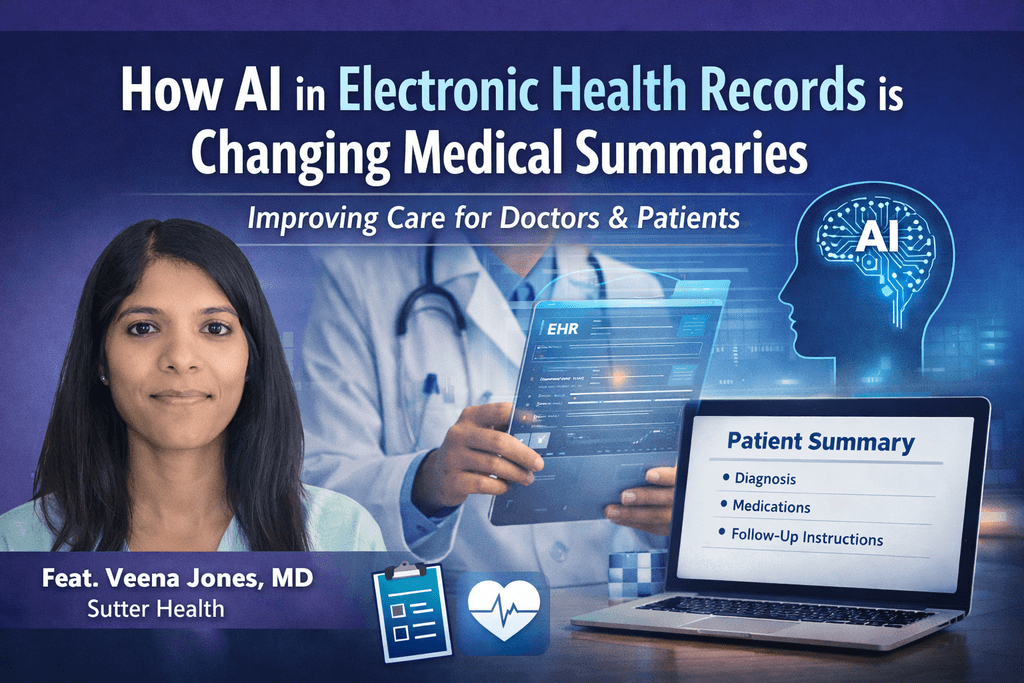
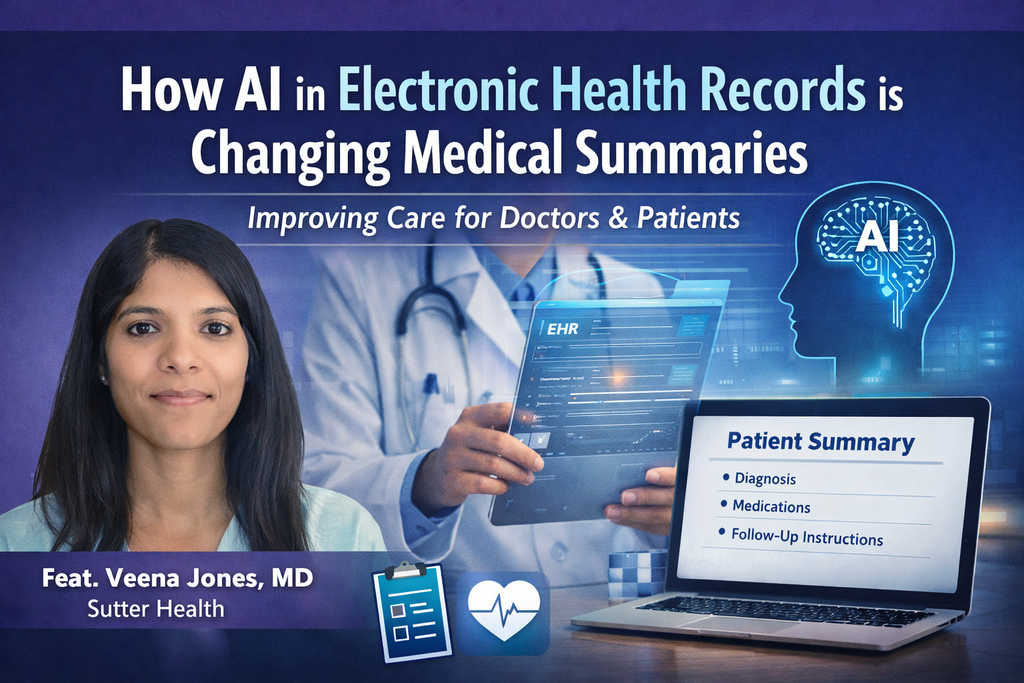
Featuring insights from Veena Jones, MD, Vice President and Chief Medical Information Officer at Sutter Health
AMA Update • July 21, 2025
Hosted by Todd Unger, Veena Jones, MD, Vice President and Chief Medical Information Officer at Sutter Health, shared how AI is being used to turn complex clinical notes into clear, patient-friendly summaries.
The conversation offers a practical look at how electronic health record (EHR) AI is improving workflows for clinicians while helping patients become more informed and engaged partners in their care.
From Clinical Notes to Patient Understanding
Traditionally, clinical notes in EHRs are written by clinicians for clinicians. They’re dense, technical, and optimized for documentation—not comprehension. Yet with the rise of open notes, driven in part by the 21st Century Cures Act, patients now have direct access to these records.
That shift raises an important question:
How do we ensure patients can actually understand what they read?
According to Dr. Jones, this is where AI steps in.
At Sutter Health, AI is used to translate care-team documentation into after-visit summaries written in plain, patient-friendly language. These summaries explain:
- What was discussed during the visit
- Key diagnoses or findings
- Medications and next steps
- Follow-up instructions
The goal isn’t to replace clinicians—but to extend their communication beyond the exam room.
Can AI Really Write Good Patient Summaries?
One of the most compelling parts of the discussion centers on ambient listening and AI-assisted documentation. Instead of typing throughout a visit, clinicians can focus on the patient while AI tools capture and structure the conversation.
Dr. Jones explains that AI can:
- Generate structured clinical notes for the care team
- Produce a separate, simplified version tailored for patients
- Reduce documentation burden and physician burnout
Importantly, these summaries are not published blindly. Clinicians review and approve the content, ensuring medical accuracy and appropriate tone.
Is AI Reliable in Health Care?
Reliability is a central concern and rightly so. Dr. Jones emphasizes that AI in health care must be:
- Transparent in how it generates summaries
- Clinician-supervised, not autonomous
- Continuously improved through patient and physician feedback
At Sutter Health, early feedback has been encouraging. Patients report that AI-generated summaries are:
- Easier to understand
- Less intimidating than raw clinical notes
- Helpful for remembering instructions after visits
Rather than introducing confusion, AI has helped close long-standing communication gaps.
Benefits for Both Doctors and Patients
The episode highlights a rare win-win scenario in health care technology.
For doctors:
- Less time spent on manual documentation
- Reduced cognitive load and burnout
- More meaningful face-to-face interactions
For patients:
- Clearer understanding of their condition and care plan
- Better recall after appointments
- Increased trust and engagement
As Dr. Jones notes, when patients understand their care, they’re more likely to follow treatment plans—leading to better outcomes overall.
The Future of AI in Electronic Health Records
Looking ahead, AI’s role in health care documentation is expected to grow. Future use cases include:
- Smarter clinical decision support
- More personalized patient education
- Seamless integration across hospital systems
However, the AMA Update discussion makes one thing clear:
AI works best when it supports—not replaces—human judgment.
Technology should make medicine more humane, not more mechanical.
What This Means for Nepal’s EHR and EMR Systems
Nepal is still in the early stages of widespread EHR and EMR adoption, with many hospitals and clinics using fragmented or partially digitized systems. However, the global shift toward AI-assisted documentation presents an important opportunity.
As Nepal continues to digitize health records, integrating AI from the outset—especially for patient summaries, multilingual explanations, and clinician workflow support—could help avoid many of the documentation burdens faced by other health systems.
AI-powered EHRs could be particularly impactful in Nepal by:
- Generating patient-friendly summaries in Nepali and local languages
- Reducing documentation workload in understaffed hospitals
- Improving continuity of care across public and private facilities
- Helping patients better understand diagnoses and follow-up care
If adopted thoughtfully and ethically, AI could help Nepal leapfrog traditional EHR challenges and move toward a more patient-centered digital health ecosystem.
Final Thoughts
AI-powered medical summaries represent a quiet but powerful shift in modern health care. By transforming complex EHR notes into understandable after-visit summaries, organizations like Sutter Health are showing how technology can improve both clinician experience and patient understanding.
As highlighted in this AMA Update episode, the real promise of AI in health care isn’t automation for its own sake—it’s clarity, connection, and better care for everyone involved.