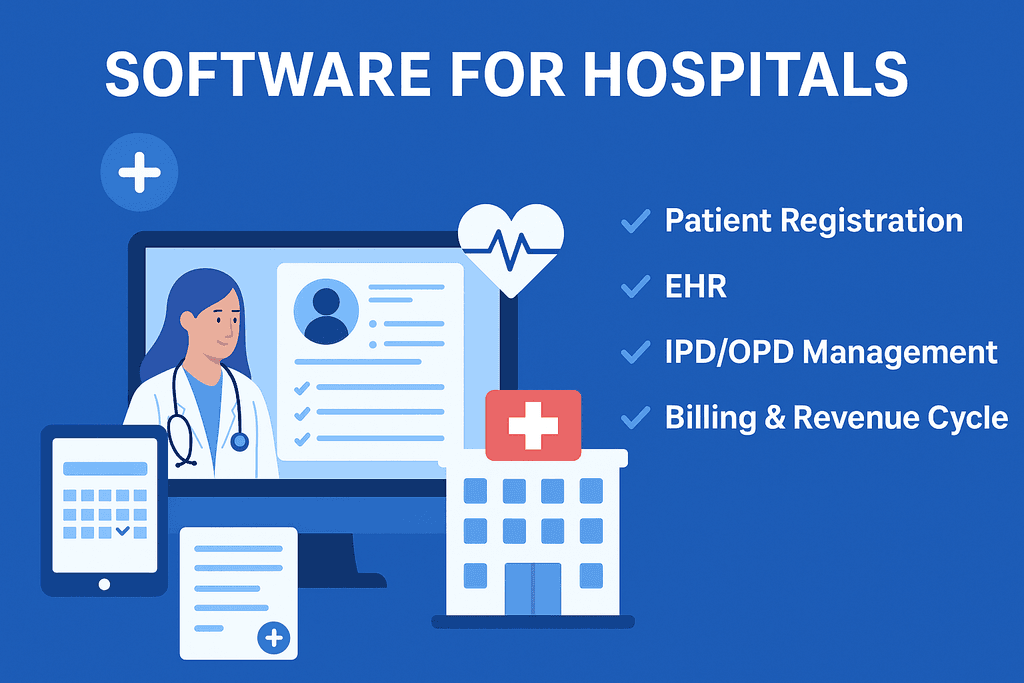
Software for Hospitals: Modernizing Healthcare Through Technology
Hospitals are among the most complex organizations to manage.
A single hospital may simultaneously handle:
Patients + Doctors + Nurses + Laboratories + Pharmacy + Radiology + Beds + Operating Rooms + Billing + Insurance + Inventory + Staff + Finance + Compliance
Every department generates information.
Every patient interaction generates data.
And many of those activities depend on one another.
When these processes are managed through paper records, spreadsheets, disconnected applications, or manual communication, even routine hospital operations can become slow and difficult to coordinate.
This is why Hospital Management Software (HMS) has become an important component of modern healthcare infrastructure.
A well-designed hospital information system can connect clinical, administrative, financial, and operational workflows while giving authorized users access to the information they need.
Modern hospital software is not simply about replacing paper. It is about connecting the hospital around a shared flow of information.
The Digital Transformation of Hospitals
Healthcare technology has moved far beyond basic computerization.
Earlier hospital systems often focused on individual tasks:
- patient registration,
- billing,
- pharmacy,
- laboratory reporting,
- or appointment scheduling.
Modern hospital platforms increasingly aim to connect those functions.
A simplified digital hospital ecosystem looks like this:
Patient
↓
Registration & Appointment
↓
OPD / Emergency
↓
Diagnosis & Investigation
↓
Doctor / Nursing Care
↓
Pharmacy / Laboratory / Radiology
↓
IPD / OT / ICU
↓
Billing & Insurance
↓
Discharge & Follow-up
↓
Analytics & Reporting
The value comes from the connections between these stages.
Why Hospitals Need Modern Software?
Healthcare organizations face several operational challenges that become increasingly difficult as patient volumes grow.
1. Fragmented Patient Information
A patient's information may be distributed across:
- registration records,
- consultation notes,
- laboratory reports,
- radiology reports,
- prescriptions,
- pharmacy records,
- billing records,
- and discharge documents.
When these systems are disconnected, staff may spend unnecessary time locating and reconciling information.
An integrated system can create a more complete digital view of the patient's hospital journey.
2. Paper-Based Documentation
Paper records can create challenges around:
- physical storage,
- retrieval,
- duplication,
- handwriting interpretation,
- loss or damage,
- delayed information sharing,
- and long-term record management.
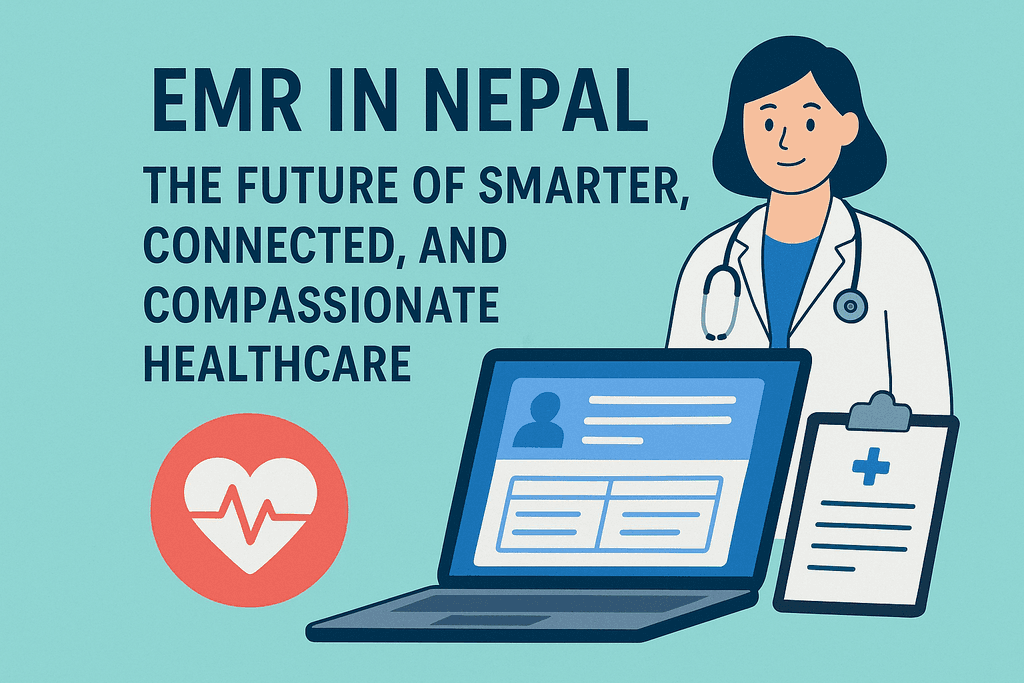
Nepal's own digital-health initiatives demonstrate the direction of change.
WHO reported that EMR systems introduced at facilities such as Gulmi Hospital, APF Hospital, and G.P. Koirala National Center for Respiratory Diseases are intended to reduce dependence on paper-based processes and provide more timely access to patient information.
WHO's 2024–2025 Nepal biennium report states that EMR implementation expanded to 16 hospitals nationwide during that period.
This is an important signal:
Hospital digitalization in Nepal is moving from isolated experimentation toward broader implementation.
3. Long Patient Waiting Times
Patient experience is influenced by much more than clinical care.
Delays can occur during:
- registration,
- appointment booking,
- consultation,
- billing,
- laboratory services,
- pharmacy,
- discharge,
- and insurance processing.
Hospital software can help create structured workflows around these activities.
For example:
Registration → Queue → Consultation → Investigation → Result → Doctor Review → Billing
instead of patients repeatedly moving between disconnected departments.
4. Billing and Revenue Leakage
Hospital finances can become complicated quickly.
A patient encounter may generate charges from:
- consultation,
- procedures,
- laboratory tests,
- imaging,
- pharmacy,
- bed charges,
- nursing services,
- consumables,
- surgery,
- and other services.
When charges are recorded manually or across disconnected systems, hospitals can face:
- missed charges,
- duplicate entries,
- delayed billing,
- reconciliation problems,
- and limited visibility into outstanding payments.
An integrated billing system can connect services with the patient's financial record.
5. Pharmacy and Inventory Problems
Hospitals cannot afford to run out of critical supplies.
At the same time, excessive inventory can result in:
- capital being tied up,
- expiry,
- wastage,
- storage costs,
- and unnecessary procurement.
Hospital inventory software can track:
Purchase → Receipt → Stock → Consumption → Reorder → Expiry
This creates a clearer picture of what the hospital has and what it needs.
6. Departmental Silos
A hospital is not a collection of independent departments.
Consider a patient admitted with a suspected medical condition.
The journey may involve:
OPD → Laboratory → Radiology → Doctor → Pharmacy → Nursing → Billing → Discharge
If each department works in isolation, information must repeatedly move between them.
Hospital software can create a connected workflow where an action in one department can become information for another authorized department.
7. Reporting and Accountability
Hospital management increasingly depends on data.
Leadership may need to understand:
- patient volumes,
- bed occupancy,
- revenue,
- pharmacy consumption,
- laboratory workload,
- doctor utilization,
- appointment trends,
- emergency activity,
- inventory levels,
- and operational bottlenecks.
Without centralized data, management decisions can depend heavily on manual reports.
With structured digital data, hospitals can move toward data-driven management.
What is Hospital Management Software (HMS)?
A Hospital Management System (HMS) is a digital platform designed to manage and coordinate hospital operations.
Depending on the system, it can cover:
- patient registration,
- appointments
- OPD
- IPD
- emergency
- electronic medical records
- nursing
- pharmacy
- laboratory
- radiology
- billing
- insurance
- inventory
- procurement
- HR
- finance
- reporting
- patient engagement
- and administration
The important distinction is that a modern HMS should not simply contain many modules.
Those modules should be able to communicate with one another.
Core Features of Modern Hospital Software
1. Patient Registration and Appointment Management
The patient's digital journey usually begins with registration.
A modern system can support:
- digital patient registration
- demographic information
- patient identification
- appointment booking
- doctor schedules
- queue management
- follow-up appointments
- automated reminders
- and patient history
This reduces repetitive data entry and provides a foundation for downstream clinical workflows.
2. Electronic Medical Records
Electronic Medical Records are at the center of modern hospital information systems.
An EMR can contain information such as:
- medical history
- diagnoses
- allergies
- prescriptions
- clinical notes
- investigations
- laboratory results
- procedures
- and treatment plans
WHO's current digital-health architecture describes EMR systems as supporting structured clinical records, registration, appointments, prescriptions, laboratory results, and other clinical information.
The important point is that an EMR should not be treated as merely a digital version of a paper file.
It should become part of the hospital's clinical workflow.
3. OPD Management
Outpatient departments often represent one of the highest-volume areas of a hospital.
Hospital software can help manage:
- doctor schedules
- appointments
- patient queues
- consultations
- diagnoses
- prescriptions
- investigations
- follow-ups
- and billing
A structured OPD workflow can reduce administrative friction while helping clinicians access relevant patient information.
4. IPD and Bed Management
Inpatient management introduces another layer of complexity.
An HMS can support:
- admission
- bed allocation
- ward management
- nursing documentation
- doctor progress notes
- medication records
- service tracking
- transfers
- discharge planning
- and discharge summaries
Hospital leadership can also use bed dashboards to understand:
Available beds → Occupied beds → Reserved beds → Department-wise occupancy
This is especially valuable for larger hospitals.
5. Emergency Department Management
Emergency care requires speed.
A digital emergency workflow can support:
- patient registration
- triage
- clinical documentation
- investigations
- medication
- procedures
- admission
- referral
- and discharge
The goal is not to add administrative steps.
It is to make critical information available quickly.
6. Laboratory Management
Laboratory information should ideally connect with the clinical workflow.
A digital laboratory module can support:
Doctor Order → Sample Collection → Processing → Result → Validation → Doctor/Patient Access
Potential features include:
- test ordering
- sample tracking
- result entry
- result validation
- reference ranges
- report generation
- critical-value alerts
- and historical result access
When integrated with the EMR, laboratory results can become part of the patient's longitudinal clinical record.
7. Radiology and PACS Integration
Modern hospitals also generate large amounts of diagnostic imaging data.
Hospital software may connect with:
- radiology workflows
- imaging orders
- reports
- and PACS
Integration can allow clinicians to move more easily from:
Clinical Question → Imaging Order → Study → Radiology Report → Clinical Review
Rather than treating radiology as a completely separate information system.
Nepal's recent EMR implementation work has also highlighted integration with Picture Archiving and Communication Systems (PACS).
8. Pharmacy Management
Hospital pharmacy software can manage:
- medicines
- batches
- expiry dates
- stock levels
- suppliers
- purchases
- dispensing
- returns
- consumption
- and reorder levels
Integration with clinical and billing workflows can create:
Prescription → Pharmacy → Dispensing → Inventory Update → Billing
This reduces unnecessary duplication.
9. Inventory and Procurement
Hospital inventory extends beyond medicine.
It can include:
- surgical supplies
- laboratory consumables
- medical equipment
- office supplies
- implants
- PPE
- and other materials
A modern inventory module can provide:
- purchase orders
- supplier management
- stock transfers
- batch tracking
- expiry monitoring
- minimum-stock alerts
- and consumption reports
10. Billing, Accounts and Revenue Cycle
Hospital software can connect clinical services with financial workflows.
For example:
Consultation
↓
Investigation
↓
Procedure
↓
Pharmacy
↓
Bed/Service Charges
↓
Invoice
↓
Payment
↓
Financial Report
Insurance workflows can be incorporated where required.
This creates greater visibility into hospital revenue and outstanding receivables.
11. Staff and Duty Management
Hospitals operate around people.
Software can support:
- employee records
- doctor schedules
- nurse rosters
- duty assignments
- leave management
- attendance
- payroll integration
- department assignments
- and role-based system access
This becomes increasingly important as hospitals grow across departments and branches.
12. Patient Portal and Mobile Services
Modern patients increasingly expect digital access.
Depending on the hospital, a patient portal or mobile application can provide:
- appointments
- laboratory reports
- prescriptions
- invoices
- payment options
- follow-up information
- telemedicine
- and communication
The design should always prioritize security and only expose information appropriate to the patient's authenticated account.
13. Analytics and Dashboards
Hospital leadership should not have to wait until the end of the month to understand what is happening.
Dashboards can provide near-real-time visibility into:
Clinical
- patient volume
- admissions
- discharges
- emergency activity
- investigations
Operational
- bed occupancy
- appointment volume
- waiting times
- laboratory workload
- pharmacy activity
Financial
- revenue
- outstanding payments
- department performance
- insurance claims
Inventory
- stock levels
- expiry
- consumption
- procurement
The objective is simple:
Turn hospital data into actionable information.
14. Security and Audit Trails
Healthcare data is highly sensitive.
A hospital information system should therefore include appropriate controls such as:
- role-based access
- authentication
- audit logs
- encrypted communication
- secure backups
- access monitoring
- data retention controls
- and disaster recovery
Security should be considered from the beginning of implementation rather than added later.
Interoperability must also be designed around security and trust. WHO guidance emphasizes that effective health-information exchange requires standards, governance, security, confidentiality, and privacy.
Interoperability Is the Next Big Requirement
One of the biggest mistakes hospitals can make is creating another isolated data silo.
A modern hospital may already have:
- HMS
- EMR
- LIS
- RIS
- PACS
- pharmacy software
- accounting software
- insurance systems
- and government reporting systems
The question becomes:
Can these systems communicate?
WHO's digital-health guidance increasingly emphasizes standards-based interoperability so health systems can exchange information consistently across facilities and services.
For Nepal, this is particularly relevant as the country develops its broader digital-health architecture.
In 2025, MoHP and WHO conducted a workshop involving federal and provincial stakeholders, hospitals, academia and the private sector to develop the Nepal Digital Health Blueprint.
A hospital buying software today should therefore think beyond:
"Does this software have enough features?"
It should also ask:
"Can this software connect with the healthcare ecosystem of tomorrow?"
Hospital Software Architecture
A mature hospital platform can be understood as several interconnected layers.
| Layer | Purpose |
|---|---|
| Patient Layer | Registration, appointments, portal |
| Clinical Layer | EMR, OPD, IPD, emergency |
| Diagnostic Layer | Laboratory, radiology, PACS |
| Pharmacy Layer | Prescription, dispensing, inventory |
| Financial Layer | Billing, insurance, accounts |
| Operational Layer | Beds, staffs, scheduling, procurement |
| Analytics Layer | Dashboards and reporting |
| Integration Layer | APIs and interoperability |
| Security Layer | Authentication, authorization, audit, backup |
The architecture matters because a hospital is not a single workflow.
It is a network of interconnected workflows.
Hospital Software vs Hospital ERP
These terms are sometimes used interchangeably, but there is an important distinction.
| Hospital Management System | Healthcare ERP |
|---|---|
| Primarily focused on hospital operations | Broader enterprise-wide management |
| Strong clinical workflows | Clinical + financial + administrative workflows |
| EMR/OPD/IPD often central | ERP integrates clinical and business operations |
| Patient-centric | Organization-wide |
| Pharmacy/lab/diagnostics | Pharmacy/lab + procurement + finance + HR |
| Clinical reporting | Enterprise analytics |
For larger healthcare organizations, the strongest approach may be an integrated healthcare ERP that combines clinical systems with enterprise functions.
This is one of the areas where OptERP-Healthcare is positioned differently from a narrowly focused hospital application.
Examples of Well-known Hospital Software / Systems
Here are some widely recognized hospital software solutions used globally and regionally:
1. GNU Health
GNU Health is a Free/Libre healthcare platform that includes functionality for EMR, hospital management, and health information systems. Its official documentation includes patient management, appointments, admissions, financial accounting, pharmacy/stock, laboratory, imaging, nursing, inpatient management, reporting, and other modules.
Its open-source model can be attractive to organizations that want greater control over software and infrastructure.
2. OpenEMR
OpenEMR is an open-source electronic health record and medical practice management platform. Its official project describes integrated EHR, practice management, scheduling, electronic billing, patient portal, access controls, and other capabilities.
It is particularly relevant when organizations prioritize open-source deployment and community-supported development.
3. HOSxP
HOSxP is a comprehensive hospital information system widely used across Thailand, particularly in public and private healthcare facilities. It supports a range of hospital operations, including patient registration and management, outpatient and inpatient services, pharmacy management, laboratory workflows, medical records, billing, and insurance or claims processing. Its broad functionality makes it suitable for managing day-to-day clinical and administrative activities while helping hospitals maintain centralized patient information and streamline healthcare workflows.
4. Hospital OS
Hospital OS is a healthcare management system designed primarily for small hospitals, clinics, and community health centers that require essential digital tools without the complexity of larger hospital platforms. It provides core functionalities such as outpatient and inpatient management, patient registration, medical records, pharmacy operations, and basic reporting. By focusing on essential healthcare workflows, Hospital OS can help smaller healthcare facilities reduce manual processes, organize patient information, and improve the efficiency of routine clinical and administrative operations.
5. Ezovion HMS
Ezovion HMS is a cloud-based hospital management system that combines healthcare management with AI-supported capabilities and data-driven analytics. The platform provides modules for electronic health records (EHR), laboratory management, pharmacy operations, bed management, billing, patient administration, and hospital analytics. Its cloud-based architecture enables healthcare organizations to access and manage information across different departments while reducing dependence on traditional paper-based processes. The inclusion of analytics and AI-supported features also helps healthcare providers gain better insights into hospital operations and make more informed decisions.
6. OptERP – Healthcare Solution
Alongside open-source options, healthcare organizations may choose commercial or locally supported platforms.
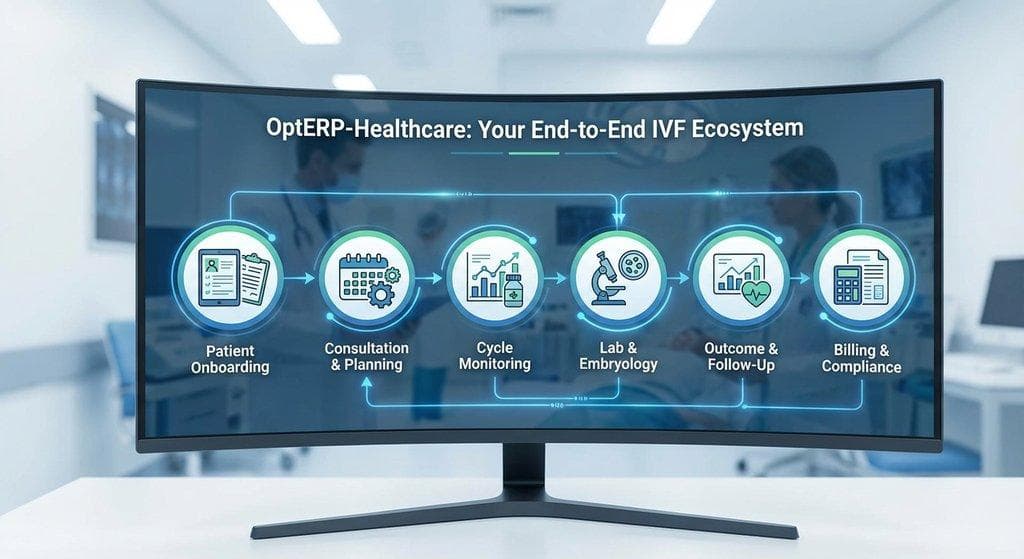
OptERP-Healthcare by Geofinity is positioned as an integrated hospital and clinic management platform designed to connect clinical, administrative, financial, and operational workflows.
Its capabilities can include:
Clinical
- OPD management
- IPD management
- EMR
- Doctor workflows
- Nursing workflows
- Patient records
Diagnostics
- Laboratory
- Radiology
- Diagnostic reporting
Pharmacy
- Prescription
- Pharmacy management
- Stock management
- Inventory
Finance
- Billing
- Revenue management
- Accounts
- Insurance-related workflows
Administration
- Staff management
- Scheduling
- Procurement
- Reporting
Digital Services
- Patient engagement
- Telemedicine integration
- Dashboards
- Configurable workflows
The key proposition is not simply having many modules.
It is connecting them.
Get more knowledge on OptERP
Why Local Context Matters in Hospital Software?
Healthcare software should fit the environment in which it is deployed.
A hospital in Nepal may have requirements involving:
- local billing practices
- Nepali healthcare workflows
- local reporting
- insurance processes
- local tax/accounting requirements
- connectivity constraints
- multilingual interfaces
- local support
- and integration with Nepal's evolving digital-health ecosystem
A technically impressive system can still fail if it does not fit the organization's actual workflow.
This is why implementation support matters as much as software features.
Cloud vs On-Premise Hospital Software
Hospitals may also need to decide how their software is deployed.
| Cloud | On-Premise |
|---|---|
| Accessible through network/internet | Hosted within hospital infrastructure |
| Easier centralized updates | Greater infrastructure control |
| Potentially lower upfront infrastructure cost | Higher infrastructure responsibility |
| Vendor manages much of infrastructure | Hospital manages infrastructure |
| Requires reliable connectivity | Can support local system |
| Easier multi-location access | Strong local-control model |
There is no universal winner.
The right choice depends on:
- hospital size
- infrastructure
- connectivity
- security requirements
- budget
- IT expertise
- number of locations
- disaster-recovery strategy
- and regulatory considerations
Hybrid deployment can also be appropriate in some environments.
How to Choose the Right Hospital Software
Hospitals should not select software based only on a feature checklist.
A better evaluation framework includes:
✔ Clinical Fit
Does the system match actual hospital workflows?
✔ Usability
Can doctors, nurses and administrative staff use it efficiently?
✔ Interoperability
Can it communicate with laboratory, imaging, pharmacy and external systems?
✔ Security
Are access controls, audit trails and backups appropriate?
✔ Scalability
Can it grow with the hospital?
✔ Customization
Can workflows be configured without excessive development?
✔ Reporting
Can management obtain the information it actually needs?
✔ Implementation
Does the vendor provide training, migration and deployment support?
✔ Support
Is local technical support available when something goes wrong?
✔ Total Cost of Ownership
What will the hospital pay over several years—not just during initial deployment?
Hospital Software Implementation: Technology Is Only Half the Project
Buying software does not automatically create digital transformation.
Implementation usually requires:
Process Mapping
↓
Data Preparation
↓
System Configuration
↓
Integration
↓
Testing
↓
Staff Training
↓
Pilot Deployment
↓
Feedback
↓
Phased Rollout
↓
Monitoring & Improvement
Staff adoption is particularly important.
A hospital can have excellent software and still fail to achieve value if users continue to maintain parallel paper processes or avoid using the system.
Digital transformation is therefore as much about people and processes as technology.
Data Migration is a Major Consideration
Hospitals often have years of historical data.
Migration may involve:
- patient demographics,
- medical records,
- laboratory history,
- billing records,
- inventory,
- supplier data,
- staff information,
- and financial data.
Before migration, hospitals should determine:
- what data needs to move,
- what needs cleaning,
- what should be archived,
- how duplicates will be handled,
- and how historical information will be validated.
Poor-quality data migrated into a new system simply creates a digital version of the old problem.
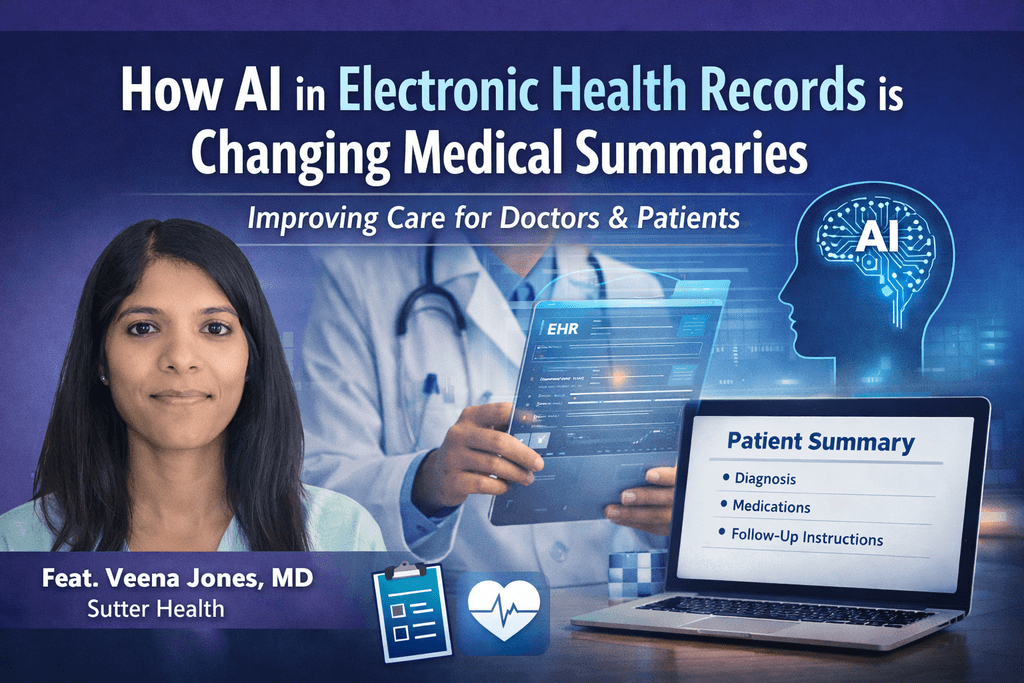
AI is the Next Layer of Hospital Software
Once hospitals have structured digital data, AI becomes increasingly possible.
Potential applications include:
- clinical documentation assistance,
- appointment forecasting,
- operational optimization,
- medical coding assistance,
- patient communication,
- predictive analytics,
- inventory forecasting,
- and decision-support tools.
But AI should not be treated as a replacement for clinicians.
The correct progression is:
Digitization
↓
Structured Data
↓
Interoperability
↓
Analytics
↓
AI-Assisted Workflows
Without good underlying data and governance, advanced AI cannot reliably deliver value.
WHO's SMART Guidelines approach similarly emphasizes standards-based, interoperable digital systems and evidence-based implementation rather than treating software as an isolated technology layer.
The Future of Hospital Software in Nepal
Nepal is moving toward a more connected digital-health ecosystem.
The country is developing a Digital Health Blueprint, expanding EMR implementation, and working toward stronger interoperability across health information systems.
This creates several opportunities.
1. Connected Hospitals
Hospitals can increasingly exchange information with authorized external systems.
2. National Health Information
Hospital data can contribute to broader health-system planning.
3. Better Emergency Preparedness
Real-time information can support faster identification of health-system events.
4. Better Resource Planning
Hospitals can use data to understand demand for beds, staff, medicines and services.
5. Patient-Centered Care
Patients can increasingly access relevant healthcare information digitally.
6. Data-Driven Management
Hospital leaders can move from retrospective reports toward more timely operational dashboards.
What a Modern Digital Hospital Looks Like?
A truly digital hospital is not simply one where computers have replaced paper.
It is one where information flows efficiently.
Imagine:
A patient books an appointment.
↓
Registration creates the patient record.
↓
The doctor accesses the relevant history.
↓
The doctor orders a laboratory test.
↓
The laboratory receives the order.
↓
The result is recorded digitally.
↓
The doctor receives the result.
↓
A prescription is sent to the pharmacy.
↓
The pharmacy updates inventory.
↓
The service is automatically reflected in billing.
↓
The patient receives relevant information through the portal.
↓
Hospital management sees the activity in aggregated dashboards.
That is the difference between:
Computerized Hospital
and
Connected Digital Hospital.
Key Benefits of Hospital Management Software
| Area | Potential Benefit |
|---|---|
| Patient Records | Faster access to information |
| OPD | Better appointment and queue management |
| IPD | More organized inpatient workflows |
| Laboratory | Structured test and result management |
| Radiology | Better diagnostic workflow integration |
| Pharmacy | Improved stock visibility |
| Billing | Better charge capture and financial tracking |
| Inventory | Reduced stock-related inefficiencies |
| Staff | Better scheduling and workflow visibility |
| Management | Real-time operational dashboards |
| Patients | More convenient access to services |
| Security | Controlled access and auditability |
| Data | Better reporting and decision-making |
The actual benefits depend on implementation quality, workflow design, staff adoption, infrastructure, and system configuration.
The Bigger Picture: Healthcare Software as Infrastructure
Hospital software should increasingly be treated as healthcare infrastructure, not merely an administrative application.
Just as hospitals need:
- electricity,
- medical equipment,
- laboratories,
- operating rooms,
- and communication systems,
they increasingly need reliable digital infrastructure.
That infrastructure must be:
Secure.
Interoperable.
Scalable.
Usable.
Resilient.
Patient-centered.
And capable of evolving with healthcare itself.
Conclusion: The Hospital of the Future Is Connected
Healthcare is becoming increasingly data-driven.
Hospitals are managing more patients, more information, more regulations, and more operational complexity than ever before.
Manual processes and disconnected systems make that complexity harder to manage.
Modern hospital management software provides an opportunity to connect the hospital around a shared digital infrastructure.
From:
Registration → Consultation → Diagnosis → Treatment → Pharmacy → Billing → Discharge
every stage can become part of a coordinated workflow.
For Nepal, this transformation is already underway. The expansion of EMR systems across hospitals, the development of the national Digital Health Blueprint, and the increasing emphasis on interoperability demonstrate that hospital digitalization is becoming a strategic part of healthcare development.
The next challenge is not simply putting more hospitals online.
It is building systems that can work together.
That means choosing hospital software based not only on today's features, but also on tomorrow's requirements:
Interoperability.
Security.
Scalability.
Analytics.
Patient engagement.
AI readiness.
Local support.
Platforms such as GNU Health and OpenEMR demonstrate the possibilities of open-source healthcare software, while solutions such as OptERP-Healthcare represent the broader healthcare-ERP approach of connecting clinical and enterprise operations.
The ultimate objective is not simply a paperless hospital.
It is a connected hospital where technology reduces friction, information supports better decisions, and healthcare professionals can spend more time focused on patients.
Get more knowledge on: Transforming Fertility Care with ERP & EMR , EMR in Nepal
Frequently Asked Questions (FAQs):
Q. What is hospital management software?
Hospital management software is a digital system used to manage clinical, administrative, financial, and operational activities within a hospital. Depending on the platform, it can include EMR, OPD, IPD, laboratory, radiology, pharmacy, billing, inventory, HR, reporting, and patient-engagement functions.
Q. What is the difference between HMS and EMR?
An HMS manages broader hospital operations, while an EMR primarily focuses on electronic clinical records. A modern HMS may contain or integrate an EMR as one of its core components.
Q. Why do hospitals need software?
Hospitals need software to manage increasing volumes of clinical and administrative information, coordinate departments, reduce repetitive manual work, improve reporting, strengthen information access, and support more efficient operations.
Q. Can hospital software replace doctors or nurses?
No. Hospital software is designed to support healthcare professionals. Clinical decisions remain the responsibility of qualified healthcare professionals.
Q. What are the most important HMS modules?
Common modules include patient registration, appointment management, OPD, IPD, EMR, emergency, laboratory, radiology, pharmacy, inventory, billing, insurance, HR, reporting, and patient portals.
Q. Is hospital software useful for small hospitals?
Yes. Smaller hospitals can benefit from digitized registration, billing, pharmacy, clinical records, laboratory workflows, inventory, and reporting. However, implementation should be appropriately scaled to the organization's needs and resources.
Q. Is cloud-based hospital software better than on-premise software?
Neither is universally better. Cloud, on-premise, or hybrid deployment should be selected based on infrastructure, connectivity, security, IT capacity, budget, scalability, and organizational requirements.
Q. What should hospitals consider before buying HMS software?
Hospitals should evaluate clinical workflow fit, usability, security, interoperability, scalability, customization, reporting, implementation support, vendor reliability, training, data migration, and total cost of ownership.
Q. Can hospital software integrate with laboratory and radiology systems?
Yes, depending on the platform's integration capabilities. APIs and recognized interoperability standards can help connect hospital systems with laboratory, imaging, pharmacy, and other applications.
Q. Why is interoperability important in healthcare?
Interoperability allows authorized information to move between systems in a structured and meaningful way. It helps reduce data silos and supports continuity of care and stronger health information systems.
Q. Is Nepal moving toward digital hospitals?
Yes. Nepal has been expanding EMR implementation and developing a broader digital-health architecture. WHO reported that EMR implementation had expanded to 16 hospitals during 2024–2025, while MoHP and WHO worked on the Nepal Digital Health Blueprint in 2025.
Q. What is OptERP Healthcare?
OptERP Healthcare is Geofinity's healthcare-management platform aimed at connecting hospital and clinic operations across areas such as clinical management, diagnostics, pharmacy, billing, inventory, administration, and reporting.
Q. Is GNU Health free and open source?
Yes. GNU Health describes its hospital management system as a Free/Libre project and provides EMR, hospital management, and health information system functionality.
Q. Is OpenEMR open source?
Yes. OpenEMR describes itself as a free and open-source electronic health records and medical practice management solution.
Q. What will the future of hospital software look like?
Hospital software is likely to become increasingly interoperable, cloud/hybrid capable, analytics-driven, patient-centered, and AI-assisted. However, strong data quality, security, governance, and interoperability will remain foundational.