Nepal’s Booming IT Sector: Growth, Opportunities, Challenges and Future
Nepal’s IT sector is undergoing a remarkable transformation, rapidly establishing itself as a burgeoning player in the global tech landscape. With a combination of a young, dynamic workforce, increasing investments, and government support, the country is making strides to position itself as a technology hub. This boom is creating opportunities for innovation, employment, and digital advancement, making Nepal an attractive destination for investors and IT professionals alike. Here’s a closer look at the factors driving Nepal’s IT sector and what lies ahead.
Nepal's technology landscape has changed significantly over the past decade. What was once largely associated with basic software services and IT support has expanded into software development, fintech, artificial intelligence, cloud computing, digital payments, cybersecurity, e-commerce, enterprise software, healthcare technology, education technology, and IT outsourcing.
The growth of the IT sector in Nepal is creating opportunities at multiple levels. Students and professionals are finding new career paths, businesses are adopting digital systems, startups are developing technology products, and local IT companies are increasingly serving customers beyond Nepal.
At the same time, Nepal still faces challenges such as brain drain, infrastructure limitations, access to investment, regulatory complexity, and intense international competition.
So, is Nepal truly becoming a technology hub?
And can the country's growing pool of IT talent develop into a globally competitive technology industry?
Let's explore the major forces behind Nepal's booming IT sector, the opportunities available, the challenges that need to be addressed, and the role of local technology companies in Nepal's digital transformation.
Nepal’s IT Sector at a Glance
Nepal's IT industry is becoming increasingly diverse.
The country's technology ecosystem now includes:
• Software development
• Web and mobile app development
• IT outsourcing
• Business Process Outsourcing (BPO)
• Artificial intelligence and machine learning
• Fintech
• Cloud computing
• Cybersecurity
• Digital marketing
• E-commerce
• Enterprise Resource Planning (ERP)
• Healthcare technology
• Education technology
• Data analytics
• Digital government services
• SaaS products
• Remote technology services
This diversification is an important sign of growth for the Nepal IT sector.
Businesses are no longer adopting technology only for websites or basic accounting. Organizations across healthcare, education, manufacturing, retail, finance, logistics, and professional services are increasingly looking for integrated digital systems.
| Technology Area | Growing Opportunity in Nepal |
| Software Development | Web, mobile, enterprise and custom applications |
| IT Outsourcing | International development and technology services |
| Fintech | Digital payments and financial technology |
| Artificial Intelligence | Automation, analytics and intelligent applications |
| ERP | Business process integration and enterprise management |
| Healthcare IT | Hospital, EMR and healthcare management |
| EdTech | Digital learning and education management |
| Cloud Computing | Scalable infrastructure and SaaS |
| Cybersecurity | Protection of digital businesses and infrastructure |
| E-commerce | Online retail and digital commerce |
| Digital Government | Online public services and digital infrastructure |
The expansion of these areas is creating demand for both technical talent and businesses capable of developing practical technology solutions.
Why Is Nepal’s IT Sector Booming?
There is no single reason behind the growth of Nepal's IT industry.
Instead, several factors are working together.
Major drivers include:
- A young and increasingly technology-oriented workforce
- Expansion of IT education and technical training
- Growing internet and smartphone adoption
- Increasing use of digital payments and online services
- Growth of IT outsourcing and remote work
- Expansion of technology startups
- Growing demand for business digitalization
- Increasing adoption of cloud technologies
- Growth of fintech and e-commerce
- Government focus on digital transformation
These factors reinforce each other.
More skilled professionals → More IT companies → More digital services → More international projects → More employment → More investment → Stronger technology ecosystem
This cycle can accelerate the development of Nepal's technology industry if supported by appropriate infrastructure, policy, investment, and education.
➞ A Young and Skilled IT Workforce
One of Nepal's strongest advantages in the technology sector is its young workforce.
Universities, colleges, technical institutions, coding schools, and online learning platforms are producing an increasing number of people interested in:
• Software engineering
• Computer science
• Information technology
• Data science
• Artificial intelligence
• Cybersecurity
• Cloud computing
• UI/UX design
• DevOps
• Digital marketing
• Networking
Young professionals are also developing skills outside traditional academic programs.
Online courses, open-source projects, coding communities, freelance platforms, internships, hackathons, and technology events are helping students gain practical experience.
➞ From Local Jobs to Global Opportunities
Remote work has created another important opportunity for Nepal.
A skilled developer, designer, data professional, or digital marketer based in Nepal can potentially work with international clients without relocating.
This creates a valuable economic pathway:
Nepali talent → International clients → IT exports → Foreign revenue → Local employment
This is one of the reasons IT outsourcing in Nepal has considerable long-term potential.
However, retaining experienced professionals remains a major concern. If highly skilled workers leave the country permanently, local companies can struggle to maintain senior-level expertise and build globally competitive products.
➞ Growing Demand for Software and Digital Services
Nepal's IT boom is not being driven only by technology companies.
Traditional businesses are becoming important consumers of technology as well.
Organizations in industries such as:
• Healthcare
• Manufacturing
• Education
• Retail
• Banking
• Hospitality
• Construction
• Logistics
• Agriculture
• Professional services
are increasingly adopting digital systems.
Businesses are investing in:
• ERP systems
• CRM platforms
• Cloud applications
• Accounting software
• HR management
• Inventory systems
• Digital payment solutions
• E-commerce platforms
• Business analytics
• Mobile applications
This growing demand is creating a domestic market for software development in Nepal.
The change is particularly important because digital transformation is gradually becoming a business necessity rather than simply a competitive advantage.
➞ Government Support for Nepal’s Digital Transformation
Government policy plays an important role in the development of Nepal's technology ecosystem.
Nepal's Digital Nepal Framework established a national direction for using digital technologies across sectors such as agriculture, health, education, energy, tourism, finance, and urban infrastructure. The framework also identifies initiatives related to high-speed connectivity, e-governance, digital skills, ICT industry development, cybersecurity, and digital innovation.
Government digital initiatives can create opportunities for technology companies while encouraging businesses and citizens to adopt digital services.
Areas of digital transformation include:
• E-government services
• Digital records
• Online public services
• Digital identity
• Electronic payments
• Digital healthcare
• Online education
• Data-driven decision-making
• Smart infrastructure
• Digital business services
The government has also been moving toward the next stage of digital policy. The Ministry of Communication and Information Technology published a notice seeking feedback on a draft Digital Nepal Framework 2.0, indicating continued policy development around Nepal's digital future.
For Nepal's IT sector, consistent implementation will be just as important as policy development.
Nepal as an IT Outsourcing Destination
One of the biggest opportunities for the IT industry in Nepal is international outsourcing.
Companies around the world outsource technology work to external teams to access specialized skills, manage development costs, expand engineering capacity, and accelerate product development.
Nepal can compete in this market through:
• A growing technical workforce
• Competitive operating costs
• English-language capabilities
• Remote-work readiness
• Software development expertise
• Flexible teams
• Increasing international exposure
Nepali IT companies can provide services including:
• Web development
• Mobile application development
• Software engineering
• UI/UX design
• Quality assurance
• Cloud services
• AI development
• Data services
• Digital marketing
• BPO services
Why IT Outsourcing Matters?
IT outsourcing can create a broader economic impact than individual employment alone.
The cycle can look like:
International clients
↓
IT service exports
↓
Foreign revenue
↓
Business expansion
↓
More technology jobs
↓
More skills and experience
↓
New startups and products
The long-term opportunity is to move beyond low-cost outsourcing and develop expertise in higher-value areas such as AI, cloud engineering, cybersecurity, SaaS, enterprise software, and specialized product development.
Rise of IT Startups and Innovation
Nepal's startup ecosystem has become another important part of the country's technology story.
Technology startups are developing solutions around:
• Fintech
• Artificial intelligence
• E-commerce
• SaaS
• Logistics
• Healthcare
• Education
• Tourism
• Digital payments
• Business automation
Companies such as Fusemachines, F1Soft, and CloudFactory have demonstrated that technology businesses with roots in Nepal can operate in international markets.
The growth of incubators, accelerators, startup communities, technology events, and entrepreneurship programs is also creating opportunities for young founders.
From Service Companies to Product Companies
One of the most important potential shifts in Nepal's IT sector is the transition from project-based services toward scalable technology products.
Traditional Service Model:
Client → Requirement → Development → Delivery
Product Model:
Market Problem → Product → Multiple Customers → Continuous Improvement → Scalability
The product model can create recurring revenue, stronger intellectual property, international expansion opportunities, and greater long-term scalability.
This is particularly relevant to sectors such as ERP, healthcare technology, fintech, AI, and SaaS.
Growing Internet Penetration and Digital Adoption
Internet connectivity is another foundation of Nepal's digital economy.
As access to mobile internet and digital services increases, businesses gain larger digital audiences and consumers gain access to more online services.
This supports the growth of:
• E-commerce
• Digital payments
• Online education
• Digital healthcare
• Social commerce
• Mobile applications
• Online financial services
• Cloud-based business tools
Nepal Telecommunications Authority provides telecommunications policies and regulatory information covering areas including broadband and cybersecurity.
Nepal Telecommunications Authority
The relationship is straightforward:
More connectivity → More digital users → More digital services → More technology businesses → More innovation
Digital adoption therefore contributes directly to the expansion of Nepal's technology market.
Key Areas Driving Nepal’s Technology Industry
1. Software Development
Software development remains one of the foundations of Nepal's IT sector.
Nepali companies and professionals work on:
• Web applications
• Mobile applications
• Enterprise systems
• SaaS platforms
• Custom business software
• E-commerce platforms
2. Fintech
Fintech has become one of Nepal's most visible technology sectors.
Digital wallets, online banking, mobile payments, and other financial technologies are changing how consumers and businesses manage transactions.
The growth of fintech also creates demand for secure infrastructure, APIs, data management, analytics, and cybersecurity.
3. Artificial Intelligence
AI is creating new opportunities in:
• Business automation
• Data analysis
• Computer vision
• Natural language processing
• Customer support
• Recommendation systems
• Predictive analytics
• Generative AI
For Nepal, AI represents both a technology opportunity and a chance to increase productivity across existing industries.
4. Healthcare Technology
Healthcare is another major area of digital transformation.
Modern healthcare systems can help organizations manage:
• Patient records
• Appointments
• Pharmacy
• Laboratory workflows
• Billing
• Inventory
• Reporting
• Healthcare analytics
For a Nepal-based technology company, healthcare technology also represents an opportunity to develop specialized products for local operational requirements.
Healthcare ERP in Nepal: Proprietary vs. Hybrid Approach
5. Education Technology
Educational institutions increasingly require digital systems for:
• Student management
• Learning management
• Examination management
• Communication
• Administration
• Finance
• Reporting
6. Cloud Computing
Cloud technology enables businesses to access scalable infrastructure and applications without maintaining all infrastructure themselves.
Cloud-based software can be especially useful for SMEs because it can reduce the need for extensive local hardware and simplify access to business applications.
7. Cybersecurity
As businesses become increasingly digital, cybersecurity becomes increasingly important.
Organizations need to protect:
• Customer information
• Financial records
• Employee data
• Business systems
• Cloud infrastructure
• Digital transactions
The growth of cybersecurity requirements will create demand for security professionals, monitoring systems, compliance solutions, and secure software development.
The Rise of Enterprise Software and ERP in Nepal
As Nepali businesses become more digitally mature, the need for integrated enterprise software is increasing.
An Enterprise Resource Planning (ERP) system can connect business functions such as:
• Finance and accounting
• Human resources
• Inventory
• Procurement
• Sales
• CRM
• Manufacturing
• Payroll
• Projects
• Reporting
Instead of maintaining separate systems for each department, businesses can use a centralized platform to connect operational information.
This can improve:
• Data visibility
• Process automation
• Reporting
• Decision-making
• Operational efficiency
The growing ERP market also creates an opportunity for Nepal's local technology companies to develop solutions suited to the country's business environment.
Geofinity Solutions and Nepal’s Digital Transformation
The growth of Nepal's IT industry is also reflected in the development of local technology companies.
Geofinity Solutions is a Nepal-based IT company focused on digital transformation and technology solutions. Its current services include enterprise resource planning, AI solutions, web and cloud services, content management, digital marketing, and mobile application development.
Geofinity's development of industry-focused technology solutions reflects an important direction in Nepal's IT market: moving from generic software services toward specialized digital products and platforms.
The company currently highlights solutions across areas including:
| Industry | Digital Technology Opportunity |
| Healthcare | Hospital and healthcare management |
| Fertility Care | Fertility and IVF management |
| Manufacturing | Production and inventory management |
| Education | Education management |
| SMEs | Integrated business management |
This type of industry specialization can help local technology companies develop deeper domain expertise while creating products that can potentially scale beyond the domestic market.
OptERP and the Growth of Local Enterprise Software
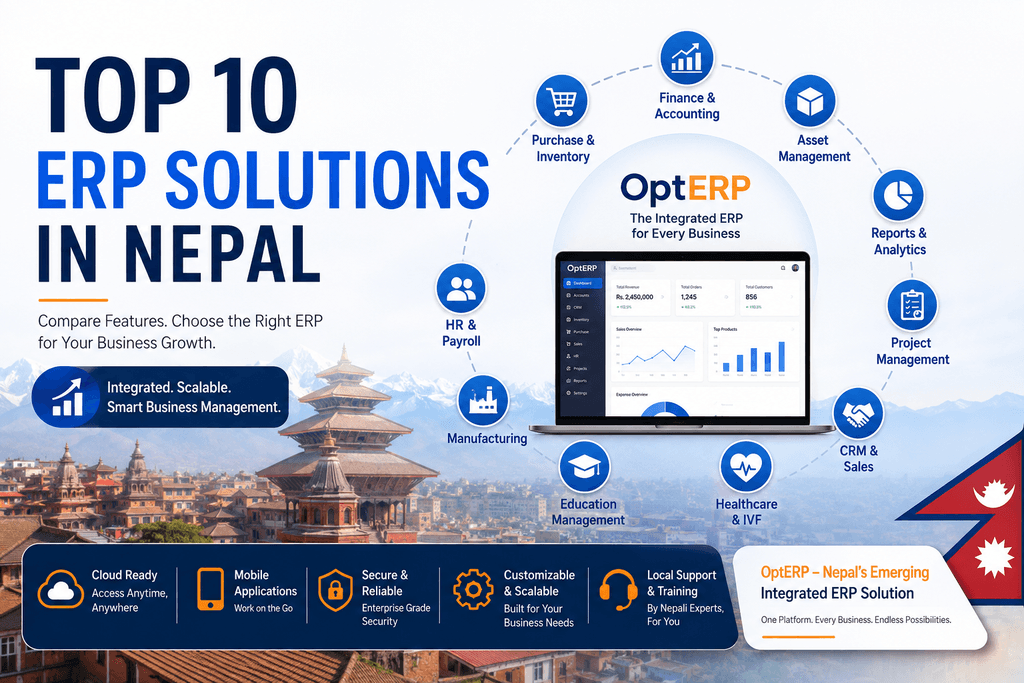
One of Geofinity Solutions' major technology products is OptERP, an enterprise resource planning platform designed to support organizations across different industries.
The current OptERP ecosystem includes solutions for healthcare, fertility clinics, manufacturing, education, and SMEs. Geofinity also positions ERP as one of its core digital transformation services.
The importance of OptERP in this discussion is not simply that it is an ERP platform.
It represents a broader trend in Nepal's IT sector: local companies developing reusable technology products instead of relying entirely on one-off client projects.
Why Local ERP Development Matters?
A locally developed enterprise platform can potentially provide:
• Understanding of local business workflows
• Local implementation support
• Industry-specific configuration
• Local technical assistance
• Flexible customization
• Integration capabilities
• Continuous product development
For businesses evaluating ERP solutions, both global and local platforms can have their own advantages.
The important factors include:
• Business requirements
• Industry
• Scalability
• Customization
• Integration
• Implementation
• Support
• Total cost of ownership
The growth of local ERP products therefore contributes to the wider development of Nepal's enterprise software industry.
Why Nepal Needs More Local Technology Products?
Developing local technology products can strengthen Nepal's digital economy in several ways.
1. Solving Local Problems
Local technology companies understand the operational challenges faced by Nepali organizations.
2. Creating Skilled Employment
Product companies require:
• Developers
• Designers
• QA engineers
• Product managers
• Sales professionals
• Marketing teams
• Customer support
• Data professionals
3. Building Intellectual Property
Successful products can become valuable technology assets.
4. Creating Export Opportunities
A product developed in Nepal does not have to remain limited to Nepal.
5. Encouraging Continuous Innovation
Products require continuous development based on customer feedback and changing technology.
This creates a potentially powerful cycle:
Local problem → Local product → Local customers → Product improvement → International market
Challenges Facing Nepal’s IT Sector
Despite its growth, Nepal's technology industry still faces several challenges.
1. Brain Drain
The migration of skilled technology professionals is one of the biggest concerns.
Experienced developers, engineers, designers, and technology specialists may seek education and employment opportunities abroad.
Retaining experienced professionals is important for developing strong local technology companies.
2. Infrastructure Limitations
Technology businesses depend on:
• Reliable electricity
• Stable internet
• Cloud infrastructure
• Data centers
• High-speed connectivity
• Secure digital infrastructure
Infrastructure improvements can directly influence productivity and investor confidence.
3. Limited Access to Capital
Technology startups often need funding to:
• Hire skilled employees
• Build products
• Enter international markets
• Invest in research
• Build sales teams
• Expand internationally
Access to suitable capital can therefore have a major effect on startup growth.
4. Regulatory Complexity
Technology companies can be affected by regulations related to:
• Taxation
• Foreign exchange
• Investment
• Data protection
• Intellectual property
• Employment
• Digital payments
Clear and predictable regulations can make long-term technology investment easier.
5. Global Competition
Nepal competes with established technology markets including:
• India
• Bangladesh
• Pakistan
• The Philippines
• Vietnam
• Eastern Europe
• Southeast Asia
Therefore, Nepal cannot compete solely on low cost.
The sector increasingly needs to compete through:
Quality + Specialization + Innovation + Reliability + Security + Global Standards
Opportunities for Nepal’s Technology Industry
Despite these challenges, Nepal has substantial opportunities in the digital economy.
| Opportunity | Potential Impact |
| IT Outsourcing | Increase international service exports |
| Remote Work | Connect Nepali talent with global companies |
| SaaS | Build scalable software businesses |
| Artificial Intelligence | Create automation and intelligent products |
| Fintech | Expand digital financial services |
| Healthcare IT | Improve healthcare operations |
| EdTech | Modernize education |
| ERP | Digitize business operations |
| Cloud Computing | Enable scalable digital infrastructure |
| Cybersecurity | Protect increasingly digital organizations |
| Digital Government | Improve public services |
| Product Development | Build globally scalable technology companies |
The greatest opportunity may be the combination of several of these technologies.
For example:
AI + SaaS + Cloud + Industry Expertise = Scalable Technology Products
What Could Make Nepal a Global IT Hub?
Nepal already has several of the basic ingredients needed to become a stronger technology destination.
Nepal has:
• A young workforce
• Increasing technical education
• Growing internet access
• Competitive operating costs
• An emerging startup ecosystem
• Increasing international connectivity
• Growing software development expertise
• Expanding demand for digital services
But potential alone is not enough.
Nepal needs to convert these advantages into sustainable companies, products, exports, and intellectual property.
The transition needs to move from:
Talent → Employment
toward:
Talent → Products → Companies → Global Customers → Investment → Economic Growth
What Should Nepal Focus on Next?
✔ Better Digital Infrastructure
Reliable electricity, high-speed connectivity, cloud infrastructure, and data centers are fundamental for a competitive digital economy.
✔ Advanced Technical Education
Education should increasingly emphasize practical and advanced skills such as:
• Artificial intelligence
• Cloud computing
• Cybersecurity
• Data science
• Software engineering
• DevOps
• Product management
✔ More Product-Based Companies
Nepal needs more companies developing scalable software products rather than depending exclusively on project-based outsourcing.
✔ International Market Access
Technology companies need access to:
• International customers
• Investment
• Payment infrastructure
• Partnerships
• Global distribution channels
✔ Startup-Friendly Policies
Entrepreneurs need simpler processes for starting, funding, operating, and scaling technology businesses.
✔ Stronger Cybersecurity
As more services move online, trust and security become essential for both domestic users and international clients.
The Future of Nepal’s IT Sector
The next phase of Nepal's technology growth is likely to be shaped by several major technologies.
✔ Artificial Intelligence
AI is changing software development, automation, analytics, customer service, healthcare, finance, and other industries.
Nepali companies that develop practical AI expertise can potentially compete in international markets.
✔ Cloud Computing
Cloud infrastructure allows businesses to access scalable computing resources without maintaining all infrastructure themselves.
✔ SaaS
Software-as-a-Service provides an opportunity for Nepali technology companies to build products that serve customers internationally.
✔ Remote Work
Remote teams allow Nepalese professionals and companies to participate directly in global technology projects.
✔ Digital Government
Digital public services can increase technology adoption while creating demand for secure and interoperable systems.
✔ Industry-Specific Software
Businesses increasingly require software tailored to specific industries rather than generic tools.
This is particularly relevant to enterprise platforms such as OptERP, where a common ERP foundation can support different industries through specialized solutions.
A New Frontier for Innovation and Growth
Nepal's IT sector is entering an important stage.
The question is no longer simply:
Can Nepal produce software developers?
The bigger question is:
Can Nepal build globally competitive technology companies, products, platforms, and digital services?
There are already signs of this transition.
Nepali companies are increasingly working in areas such as:
• Artificial intelligence
• Fintech
• Healthcare technology
• ERP
• SaaS
• E-commerce
• Digital payments
• Education technology
• Cloud services
The development of companies such as Geofinity Solutions and products such as OptERP is one example of Nepal's movement toward locally developed enterprise technology.
The opportunity now is to take these products beyond Nepal.
Local innovation → Regional markets → International customers → Global technology brands
That could become one of the most important stages in Nepal's IT development.
Frequently Asked Questions (FAQ's):
1. Is Nepal’s IT sector growing?
Yes. Nepal's IT ecosystem is expanding across software development, IT outsourcing, fintech, startups, AI, digital payments, enterprise software, and other technology services.
2. Why is Nepal’s IT sector booming?
The growth is being driven by a young workforce, increasing technical education, internet adoption, digital transformation, IT outsourcing, startup activity, and growing demand for software and digital services.
3. Is Nepal a good destination for IT outsourcing?
Nepal has strong potential as an IT outsourcing destination because of its growing technical workforce, competitive operating costs, English-language capabilities, remote-work opportunities, and increasing experience with international projects.
4. What are the major IT industries in Nepal?
Major areas include software development, IT outsourcing, fintech, artificial intelligence, cloud computing, cybersecurity, e-commerce, healthcare technology, education technology, digital marketing, and ERP.
5. What are the fastest-growing technology areas in Nepal?
Growth is occurring across multiple areas, including AI, fintech, cloud computing, software development, digital payments, healthcare technology, enterprise software, and SaaS.
6. What are the biggest challenges facing Nepal’s IT sector?
Major challenges include brain drain, infrastructure limitations, access to capital, regulatory complexity, advanced skill gaps, cybersecurity requirements, and competition from established international IT markets.
7. Can Nepal become a global IT hub?
Nepal has the workforce and emerging technology ecosystem required to strengthen its position in the global IT market. Continued investment in infrastructure, advanced skills, policy, cybersecurity, international market access, and product development will be important.
8. What is IT outsourcing in Nepal?
IT outsourcing involves providing software development, technology, design, data, BPO, or other digital services to external clients. Nepali companies can provide these services to international organizations through remote and distributed teams.
9. What role do IT startups play in Nepal?
IT startups introduce new products, services, technologies, and business models. They can create employment, attract investment, solve local problems, and potentially take Nepali technology products into international markets.
10. What is Geofinity Solutions?
Geofinity Solutions Pvt. Ltd. is a Nepal-based IT company focused on digital transformation and technology solutions. Its current services include enterprise resource planning, AI solutions, web and cloud services, content management, digital marketing, and mobile application development.
Learn More About Geofinity Solutions
11. What is OptERP?
OptERP is an enterprise resource planning platform developed by Geofinity Solutions. The platform supports different industries through specialized ERP solutions, including healthcare, fertility clinics, manufacturing, education, and SMEs.
12. How does OptERP contribute to Nepal’s IT sector?
OptERP represents the development of locally built enterprise software in Nepal. It demonstrates how Nepalese technology companies can move beyond project-based services and develop reusable platforms capable of supporting multiple industries.
13. Why are local IT companies important for Nepal?
Local IT companies create jobs, develop technical skills, support business digitalization, encourage innovation, and create opportunities for international technology services and products.
14. What is the future of Nepal’s IT industry?
The future of Nepal's IT industry is likely to involve greater adoption of AI, cloud computing, SaaS, cybersecurity, fintech, healthcare technology, enterprise software, and digital public services.
The ability to develop globally competitive technology products will be particularly important.
Conclusion
Nepal's booming IT sector is more than a short-term trend. It is becoming an increasingly important part of the country's economic and digital transformation.
A young workforce, growing technical education, increasing internet adoption, expanding IT outsourcing, startup activity, and rising demand for digital solutions are creating a strong foundation for future growth.
However, Nepal's next challenge is to move beyond being primarily a source of technical talent.
The greater opportunity lies in building:
• Globally competitive software products
• SaaS platforms
• AI solutions
• Enterprise applications
• Fintech products
• Healthcare technologies
• Digital services
Local technology companies such as Geofinity Solutions are contributing to this evolution through digital transformation services and products such as OptERP.
For Nepal to establish itself as a stronger global technology destination, continued investment in infrastructure, education, innovation, cybersecurity, supportive policies, and international partnerships will be essential.
The country's IT story is therefore not simply about how much the sector has grown.
It is about what Nepal can build next.
From talent to technology, from outsourcing to products, and from local innovation to global impact, Nepal has an opportunity to establish itself as a stronger force in the global digital economy.
The future of Nepal’s IT sector is being built today — and the next chapter could be its biggest yet.