Nepal’s Tech Ecosystem: The Momentum is Building
Nepal is increasingly being recognized not only for tourism, hydropower, and natural beauty, but also for its growing technology and digital services ecosystem.
Over the past decade, the country’s technology sector has evolved from a collection of small software companies, outsourcing firms, freelancers, and IT consultancies into a broader ecosystem involving fintech, software development, digital payments, e-commerce, cloud services, business-process outsourcing, health technology, enterprise software, and digital platforms.
Companies such as eSewa, Khalti, F1Soft, CloudFactory, Hamro Patro, Vianet, and other Nepali technology businesses demonstrate that locally developed products and services can reach users and customers beyond Nepal.
The opportunity is becoming increasingly visible in economic data as well. The World Bank's 2025 Nepal Country Economic Memorandum found that Nepal's digitally delivered service exports grew at a compound annual rate of 11.6% between 2005 and 2023. By 2023, digitally delivered services accounted for more than half of Nepal's total services exports.
That does not mean Nepal has already become another Silicon Valley. Rather, it suggests something potentially more valuable: Nepal is developing the foundations of a competitive digital-services economy from a relatively small base.
Get more knowledge on: Nepal’s Booming IT Sector
Nepal's Digital Economy at a Glance
| Indicator | What the data show |
|---|---|
| ICT services | Nepal has developed an export-oriented ICT services sector |
| Digitally delivered services | Grew at a 11.6% CAGR from 2005–2023 |
| Digital services share | More than 50% of total services exports in 2023 |
| ICT private investment | Around NPR 7.1 billion invested across 109 industries during 2017–2023 |
| ICT employment from those investments | Approximately 6,746 jobs created |
| Young people entering workforce | Around 500,000 annually |
| ICT investment opportunity | World Bank identifies digital services as a high-potential growth sector |
| Digital public infrastructure | Nepal Digital Transformation Project backed by US$50 million World Bank financing |
Sources: World Bank Nepal Country Economic Memorandum, World Bank Nepal Digital Transformation Project, and World Bank youth employment research.
Nepal’s Strength: Youth, Skills, and Adaptability
One of Nepal's most important technology assets is its human capital.
Approximately 500,000 young people enter Nepal's workforce every year, creating both a major employment challenge and a significant opportunity for technology companies that can build scalable, knowledge-based jobs.
Nepali professionals are increasingly participating in:
- Software development
- UI/UX and product design
- Data analytics
- Artificial intelligence
- Cloud computing
- Cybersecurity
- Digital marketing
- Business-process outsourcing
- IT consulting
- Remote software development
The growth of remote work has also made it easier for Nepali professionals and companies to work directly with international clients.
However, talent alone is not enough.
The World Bank has highlighted skills gaps and low labor productivity as continuing constraints on Nepal's ability to generate better jobs.
This creates an important investment opportunity: international companies can contribute not only capital, but also training, management expertise, technology transfer, international standards, and access to global markets.
Why International Companies Should Consider Nepal for Technology Investment?
1. A Growing Digital-Services Export Base
One of Nepal's strongest arguments as a technology destination is that the country is already exporting digital services.
The World Bank estimates that Nepal's digitally delivered service exports grew much faster than traditional non-digital services between 2005 and 2023. By 2023, digitally delivered services represented more than half of total service exports.
This includes activities such as:
- Software development
- IT consulting
- Business-process outsourcing
- Cloud and digital services
- Online platforms
- Professional and technical services
Nepal therefore does not need to build its digital economy from zero. It already has an emerging export base on which further investment can build.
2. Competitive Operating Costs
Cost competitiveness remains one of Nepal's potential advantages.
Technology companies can operate with lower labor and certain operating costs than many established technology centers. For international businesses, this can make Nepal attractive for:
- Software development teams
- Product-support operations
- BPO and ITeS
- QA and testing
- Digital marketing
- Data operations
- Back-office technology functions
- Research and development teams
However, the better investment argument is not simply “Nepal is cheap.”
The stronger proposition is:
Nepal can combine competitive costs with a growing pool of technically capable professionals and access to global digital markets.
That distinction matters because long-term investors generally look for productivity and scalability, not just low wages.
3. A Strategic Location Between India and China
Nepal sits between two of Asia's largest economies: India and China.
This geographic position does not automatically make Nepal a regional technology hub, but it provides a useful strategic context for companies interested in South Asian markets.
Nepal can potentially serve as:
- A software development base
- A regional support center
- A remote engineering hub
- A BPO/ITeS location
- A testing and innovation center
- A base for digital products targeting Nepal and surrounding markets
The bigger opportunity, however, lies in digital connectivity rather than physical proximity.
Software companies can export products from Nepal without needing to overcome the same transportation constraints faced by manufacturing businesses.
The World Bank has specifically noted that IT services are less constrained by Nepal's landlocked geography and physical logistics challenges than many traditional sectors.
4. Government Push Toward Digital Transformation
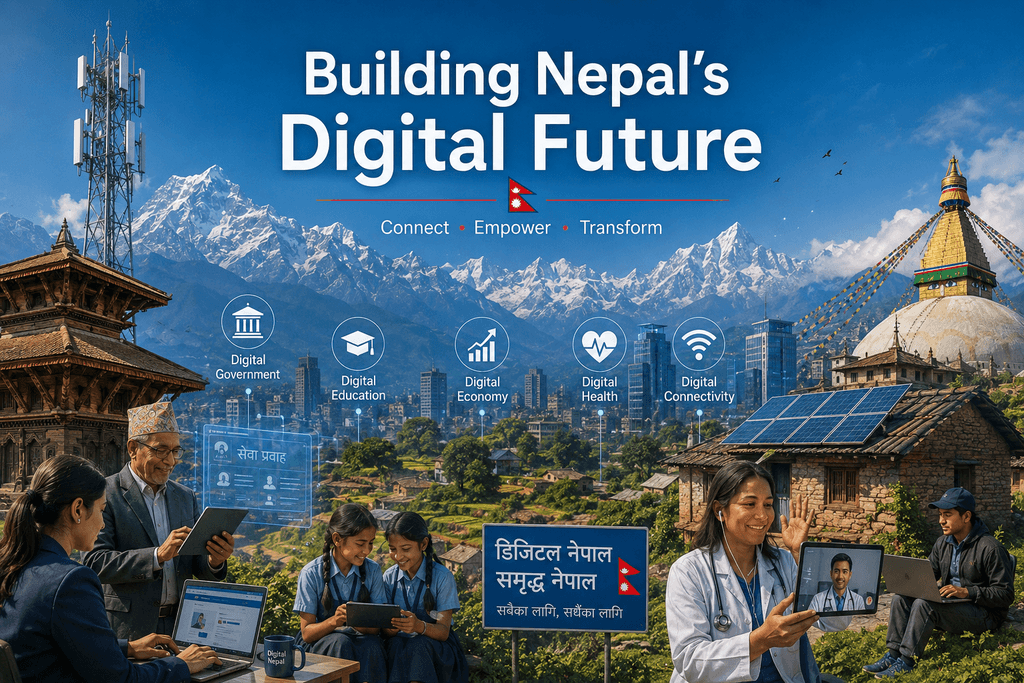
Nepal's digital transformation is increasingly becoming part of national economic policy.
The World Bank's 2025 Country Economic Memorandum identified digital services as a high-potential sector and recommended reforms to strengthen digital infrastructure, skills, and the business environment.
More recently, the World Bank approved US$50 million for Nepal's Digital Transformation Project in February 2026.
The project includes:
- An integrated citizen service portal
- A social registry
- Government-wide secure data exchange
- Digital lockers
- Digital wallets
- Electronic signatures
- Cybersecurity improvements
- Data-governance measures
- Digitization of high-impact public services
The project also aims to encourage private-sector investment in digital infrastructure.
This creates an important signal for investors: digital transformation is moving beyond individual startups and into national infrastructure.
Get more knowledge on: Driving Digital Resilience
5. Increasingly Attractive Framework for Foreign Investment
Technology investors also need a clear pathway for entering the market.
Nepal's Department of Industry states that foreign investment is regulated under the Foreign Investment and Technology Transfer Act (FITTA) 2019 and the Industrial Enterprises Act 2020. The Department of Industry serves as the government agency responsible for administering foreign investment and technology transfer.
For the ICT sector, the World Bank's Country Economic Memorandum highlights several investment incentives, including:
- No minimum investment threshold for FDI in the ICT sector
- A 50% income-tax exemption on foreign-currency earnings from qualifying exports such as BPO, software programming, cloud computing, and other IT-enabled services
- Additional incentives for eligible IT parks operating within Special Economic Zones
Nepal has also established a One Stop Service Center intended to simplify investment-related procedures by bringing services for registration, renewal, exit, and related investor facilitation into one location.
These measures do not eliminate every regulatory challenge, but they provide a more structured environment for technology investment.
6. Nepal Already Has Proof of Technology Entrepreneurship
Nepal's technology story is not purely theoretical.
Over the years, Nepali entrepreneurs have built businesses in:
| Sector | Examples of opportunity |
|---|---|
| Fintech | Digital wallets, payments and financial technology |
| Internet & connectivity | ISPs and digital connectivity |
| Software | Enterprise applications and SaaS |
| BPO/ITeS | International outsourcing and support |
| E-commerce | Digital marketplaces |
| Media & platforms | Mobile applications and digital content |
| Cloud & IT services | Infrastructure and managed services |
| HealthTech | Digital healthcare and hospital systems |
| Education technology | Online learning and digital education |
| AI & data | Analytics, automation and emerging AI applications |
The significance is not that every company will become a global giant.
The significance is that Nepal has already demonstrated the ability to build, operate, export, and scale technology-enabled businesses.
7. A Growing Startup and Entrepreneurship Ecosystem
Nepal's startup ecosystem is still developing, but entrepreneurial activity is increasing.
Incubators, accelerators, venture organizations, technology communities, universities, and private-sector organizations are helping entrepreneurs transform ideas into businesses.
Recent World Bank-supported entrepreneurship initiatives provide an example of this direction. By July 2026, an entrepreneurship program had supported 62 student and alumni ventures and around 1,900 students, with participating ventures receiving training, mentorship, and seed financing.
This matters to international investors because a healthy technology ecosystem needs more than established companies.
It needs a pipeline of:
Ideas → Startups → Funding → Products → Customers → Scale-ups
Nepal is still building this pipeline.
That means there is room for international investors to participate early.
8. Remote Work Has Changed Nepal’s Technology Opportunity
Technology has fundamentally changed what it means to be geographically competitive.
- A software engineer in Kathmandu can work with:
- A startup in Singapore
- A software company in Australia
- A healthcare organization in the United States
- A European technology business
- A global BPO operation
without physically relocating to those markets.
This creates opportunities for Nepal to develop as a distributed technology-services destination.
Rather than trying to replicate Silicon Valley's physical concentration of companies, Nepal can build a different model:
A digitally connected technology workforce serving global markets from Nepal.
This is particularly relevant to software development, BPO, consulting, design, data services, and other digitally delivered work.
The Numbers Tell an Important Story
Nepal's technology sector is still relatively small, but its growth potential is significant.
According to the World Bank's 2025 Country Economic Memorandum, private-sector ICT investment reached approximately NPR 7.1 billion across 109 industries between 2017 and 2023, associated with an estimated 6,746 jobs. The report also notes that ICT services accounted for approximately 1.7% of nominal GDP in 2022.
Meanwhile, digitally delivered services have become an increasingly important part of Nepal's service exports.
| Area | Opportunity for Nepal |
|---|---|
| Software | Export-oriented development |
| BPO/ITeS | International business operations |
| Fintech | Digital financial services |
| AI | Emerging AI and data applications |
| Cloud | Infrastructure and managed services |
| HealthTech | Digitization of healthcare |
| GovTech | Digital public sevices |
| SaaS | International software products |
| Cybersecurity | Growing digital-risk requirements |
| Remote work | Global distributed teams |
The opportunity is therefore broader than simply establishing more software companies.
The Challenges Nepal Must Solve
Calling Nepal the next Silicon Valley should not mean ignoring the problems.
The country's technology ecosystem still faces significant barriers.
1. Brain Drain
One of Nepal's biggest challenges is the migration of skilled workers.
The World Bank estimates that more than 7% of Nepal's population had migrated abroad by 2021, largely for employment, while remittances accounted for around a quarter of GDP by 2023.
For technology companies, this creates a difficult question:
How can Nepal retain enough skilled workers to build globally competitive companies?
The answer cannot simply be restricting migration.
Instead, Nepal needs to make domestic technology careers sufficiently attractive through:
- Competitive salaries
- Better career progression
- Research opportunities
- Startup financing
- International projects
- Remote global employment
- Stronger management practices
- Employee ownership opportunities
Get more knowledge on: Will Nepal Retain Its Talent or Export Its Future?
2. Skills Gap
Having a young population does not automatically mean having a highly skilled technology workforce.
The World Bank has identified low digital skills and workforce capability gaps as important constraints on Nepal's digital development.
Universities and the private sector therefore need stronger collaboration around:
- Industry-oriented curriculum
- Software engineering practices
- AI and data science
- Cloud computing
- Cybersecurity
- Product management
- Communication skills
- International certifications
- Practical internships
The objective should be to move from degree production to employable technical talent.
3. Infrastructure and Connectivity
Digital businesses still depend on reliable infrastructure.
Nepal needs continued investment in:
- Broadband connectivity
- Reliable electricity
- Data centers
- Cloud infrastructure
- International connectivity
- Cybersecurity
- Digital public infrastructure
The country has made substantial progress, but digital development remains uneven, particularly outside major urban centers.
That creates another investment opportunity: building the infrastructure that allows the next generation of digital businesses to operate.
4. Limited Venture Capital
A startup ecosystem cannot scale on ideas alone.
Entrepreneurs need access to:
Capital + Mentorship + Markets + Talent + Infrastructure
Nepal's venture capital and startup financing ecosystem remains comparatively small.
More domestic and international capital could help promising companies move from:
Prototype → Product → Revenue → Regional Expansion
rather than stopping at the prototype stage.
5. Regulatory Complexity
Nepal has made progress in improving investment facilitation, but regulatory processes remain an area where further simplification could improve investor confidence.
The World Bank has identified regulatory challenges and the broader business environment as constraints on Nepal's growth and digitalization.
For technology investors, priorities should include:
- Faster company formation
- Clear digital-service regulations
- Easier cross-border payments
- Predictable taxation
- Strong intellectual-property protection
- Data-protection frameworks
- Cybersecurity standards
- Easier access to international markets
What Could Make Nepal a True Technology Hub?
Nepal does not need to copy Silicon Valley.
It needs to identify its own competitive advantages.
A successful Nepali technology ecosystem could be built around five pillars:
| Pillar | Focus |
|---|---|
| Talent | Build and retain globally competitive professionals |
| Infrastructure | Reliable connectivity, cloud and digital system |
| Capital | Increase startup and growth-stage financing |
| Policy | Create predictable, investment-friendly regulations |
| Global Markets | Export software, services and digital products |
If these five areas improve simultaneously, Nepal could move from being primarily a technology-services destination toward becoming a technology-product and innovation hub.
From Outsourcing to Product Innovation
One of the most important transitions for Nepal will be moving beyond a simple low-cost outsourcing model.
There is nothing wrong with outsourcing.
It creates jobs, generates foreign exchange, and gives companies international experience.
But the larger opportunity is to develop:
- SaaS companies
- AI products
- Fintech platforms
- Healthtech products
- Cybersecurity solutions
- Enterprise software
- Tourism technology
- Climate technology
- Digital government platforms
- Global consumer applications
The goal should be:
Build technology in Nepal that the world is willing to buy.
This is where Nepal's technology story could become much more powerful.
Nepal’s Opportunity in AI
Artificial intelligence adds another dimension to Nepal's technology opportunity.
AI reduces some traditional barriers to entering global technology markets because smaller teams can now build sophisticated software products with relatively limited resources.
Nepal could potentially develop capabilities in:
- AI-powered SaaS
- Business automation
- Computer vision
- Natural-language processing
- Healthcare AI
- Financial analytics
- Nepali-language AI
- Data labeling and AI operations
- AI-enabled customer service
But AI also increases the importance of computing infrastructure, data, technical skills, cybersecurity, and responsible AI governance.
The World Bank's Digital Progress and Trends Report 2025 highlights both the opportunity AI creates for developing economies and the major gaps in infrastructure, skills, startups, and venture capital that still separate developing countries from leading AI ecosystems.
For Nepal, this means AI should be viewed as an opportunity to leapfrog, but not as a shortcut around foundational development.
The Role of International Investors
International investors can play a much larger role than simply providing funding.
A technology investment can bring:
✔ Capital
Funding allows startups and technology companies to expand faster.
✔ Knowledge
International companies can introduce global engineering and management practices.
✔ Markets
Foreign partnerships can give Nepali companies access to international customers.
✔ Technology Transfer
Investors can introduce modern cloud, cybersecurity, AI, data, and enterprise technologies.
✔ Talent Development
International projects expose Nepali professionals to global standards.
✔ Product Innovation
Collaboration can help Nepali companies move from service delivery toward globally scalable products.
This creates a potential cycle:
International Investment → Skills → Technology → Jobs → Exports → More Investment
Nepal as a Digital-Services Gateway
The strongest near-term opportunity may not be for Nepal to become another Silicon Valley in the traditional sense.
Instead, Nepal could become a South Asian digital-services and innovation hub built around:
Software + Talent + Remote Work + Digital Services + Entrepreneurship + Global Markets
The World Bank's 2025 economic analysis supports this broader direction by identifying digital services as one of the sectors capable of generating economic and employment opportunities if Nepal addresses infrastructure, regulatory, skills, and competitiveness constraints.
What Global Technology Companies Could Build in Nepal?
The opportunity extends across multiple business models.
| Investment Type | Potential Opportunity |
|---|---|
| Development Center | Software engineering and product development |
| BPO/ITeS Center | International business operations |
| R&D Center | AI, data and emerging technologies |
| SaaS Startup | Globally distributed software products |
| Fintech Venture | Digital financial products |
| HealthTech Venture | Healthcare digitization |
| AI Company | Automation and intelligent applications |
| Cybersecurity Firm | Security and compliance services |
| Cloud Services | Infrastructure and managed services |
| Startup Investment | Early-stage technology companies |
This diversification is important because a mature technology ecosystem should not depend on a single business model.
Nepal’s “Silicon Valley” Moment Should Be About Building, Not Copying
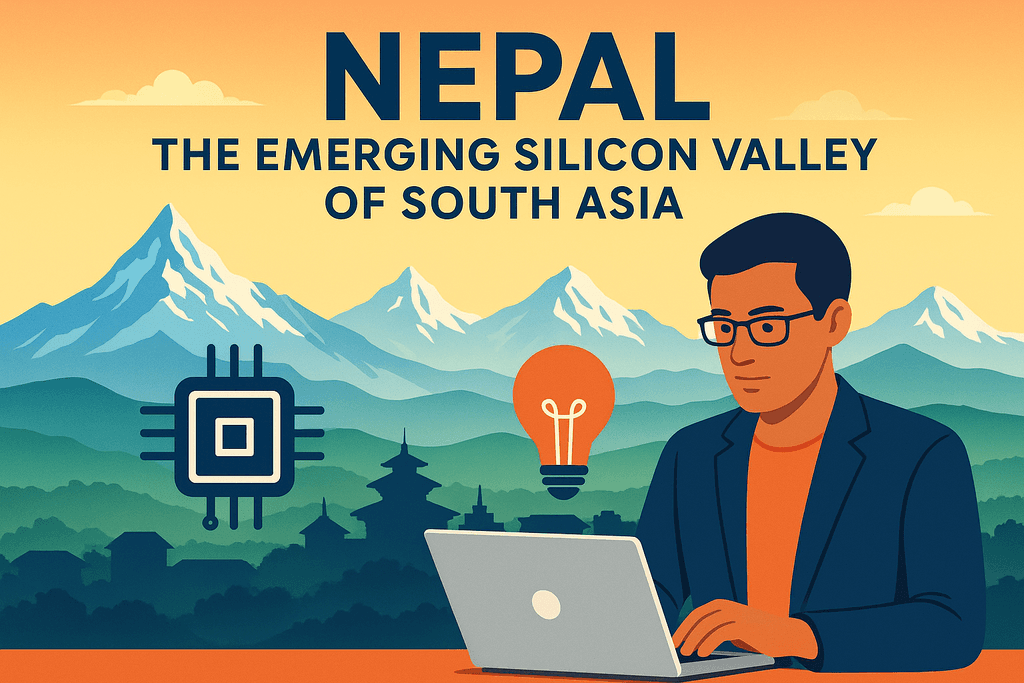
The phrase “Silicon Valley of South Asia” is ambitious.
Nepal is not Silicon Valley today, and it should not pretend to be.
Silicon Valley was built through decades of interaction between:
- Universities
- Venture capital
- Entrepreneurs
- Technology companies
- Research institutions
- Government
- Global markets
Nepal will need its own version of that ecosystem.
Its advantage could come from a different combination:
Young talent + competitive costs + digital exports + entrepreneurship + global connectivity + emerging digital infrastructure.
That could create a technology ecosystem with its own identity rather than simply copying another country.
The Future: From the Himalayas to the Global Cloud
Nepal's technology opportunity is becoming increasingly difficult to ignore.
The country already has:
- A growing digital-services sector
- Export experience
- Technology entrepreneurs
- A large young workforce
- Increasing digital infrastructure
- Growing startup activity
- Government digital-transformation initiatives
- International development support
- A growing pool of globally connected professionals
At the same time, the challenges are equally real:
- Brain drain
- Skills gaps
- Limited venture capital
- Infrastructure constraints
- Regulatory complexity
- Uneven digital development
The next stage of Nepal's technology story will depend on whether the country can convert its human potential into productive domestic and export-oriented businesses.
Why the Timing Matters?
The timing is particularly important because Nepal is under pressure to create more productive jobs for its growing working-age population.
The World Bank estimates that around 500,000 young people enter Nepal's workforce each year.
Technology can help address this challenge because digital services are:
- Exportable
- Scalable
- Knowledge-intensive
- Less dependent on physical transportation
- Capable of serving international markets from Nepal
This gives Nepal an opportunity to transform its demographic challenge into an economic advantage.
Conclusion: Nepal’s Time is Now
Nepal may not replicate Silicon Valley overnight—and it does not need to.
Its opportunity is to create something distinctly Nepali: a technology ecosystem built around talent, affordability, innovation, digital exports, entrepreneurship, and global collaboration.
The evidence already points toward a growing opportunity. Nepal's digitally delivered services have expanded significantly, ICT investment is increasing, and international institutions are identifying digital services as a sector with potential to contribute to future growth and employment.
The real question is no longer whether Nepal can participate in the global technology economy.
It already does.
The bigger question is:
Can Nepal build an ecosystem capable of keeping its talent, attracting international capital, creating globally competitive products, and turning digital skills into long-term economic growth?
If the answer is yes, the country's technology story could extend far beyond outsourcing and freelancing.
From Kathmandu to the global cloud, Nepal has an opportunity to build its own digital future.
And perhaps the better goal than becoming another Silicon Valley is to become Nepal's own version of a global technology hub.
Frequently Asked Questions (FAQs):
Q. Is Nepal really becoming the Silicon Valley of South Asia?
Not yet in the traditional sense. “Silicon Valley of South Asia” is better understood as an aspirational description of Nepal's growing technology ecosystem. Nepal's digital-services exports, technology companies, startups, and skilled workforce provide a foundation, but major gaps remain in investment, infrastructure, skills, and scale.
Q. Why is Nepal attractive for technology investment?
Nepal offers a combination of growing technical talent, competitive operating costs, an emerging digital-services export sector, startup opportunities, and increasing government investment in digital infrastructure.
Q. Is Nepal's IT industry growing?
Yes. The World Bank reports that Nepal's digitally delivered service exports grew at an 11.6% compound annual rate between 2005 and 2023, while digitally delivered services accounted for more than half of total services exports in 2023.
Q. Can foreign companies invest in Nepal's ICT sector?
Yes. Nepal has a foreign-investment framework administered by the Department of Industry, and the World Bank's 2025 economic analysis notes that there is no minimum FDI threshold for the ICT sector.
Q. What are Nepal's biggest challenges for becoming a technology hub?
The major challenges include skills gaps, brain drain, limited venture capital, infrastructure constraints, regulatory complexity, and uneven digital development.
Q. Does Nepal have enough technology talent?
Nepal has a large and growing pool of young workers and technology professionals, but developing higher-level technical, managerial, and product-development skills remains important. Around 500,000 young people enter the workforce annually, making skills development a major national priority.
Q. What technology sectors have the greatest potential in Nepal?
Potential areas include software development, SaaS, BPO/ITeS, fintech, AI, healthtech, cybersecurity, cloud services, enterprise software, e-commerce, and digital public infrastructure.
Q. What role can international investors play in Nepal's technology sector?
International investors can provide capital, technology, management expertise, international market access, training, and partnerships that help Nepali companies scale.
Q. Can Nepal compete globally in software and digital services?
Yes. Nepal already exports digitally delivered services, and the sector has demonstrated international potential. The next challenge is moving toward higher-value services, stronger products, greater productivity, and globally scalable companies.
Q. What could make Nepal a successful technology hub?
A combination of skilled talent, reliable digital infrastructure, startup capital, investor-friendly regulation, strong universities, industry collaboration, and access to international markets will be critical.