On December 25, 2025 (Poush 10, 2082), Nepal witnessed a remarkable academic milestone at Tribhuvan University's 51st Convocation at Dasarath Stadium, Kathmandu.
More than 16,000 graduates participated in person, while the university marked approximately 90,000 graduates across Bachelor’s, Master’s, M.Phil., and PhD programs. Nobel Prize-winning physicist Prof. Takaaki Kajita of Japan served as the chief guest—the first Nobel laureate to serve as chief guest at a Tribhuvan University convocation.
The symbolism was powerful.
Nepal was celebrating not simply degrees, but human capital.
And that creates a much harder question:
What happens to all that talent after graduation?
Will these graduates build companies, conduct research, work in Nepal, create jobs, and strengthen public institutions?
Or will Nepal continue to educate its young population while other economies benefit from their skills?
The question is no longer simply about brain drain.
It is about whether Nepal can convert education into economic opportunity.
90,000 Graduates: A Celebration and a Warning
The 51st Convocation represented an enormous concentration of human potential.
But the number should not be interpreted as meaning that all 90,000 graduates entered the labour market simultaneously. They represent graduates across different academic levels and programs.
That distinction matters.
The real issue is much larger:
How effectively can Nepal's economy absorb, employ, and retain its growing pool of educated people?
The latest World Bank analysis provides an important perspective.
Nepal now has more than 1,400 higher-education institutions and approximately 633,000 students enrolled in higher education. At the same time, around 500,000 young people enter the workforce every year. The World Bank argues that higher education has expanded considerably, but this expansion has not been matched by sufficient labour-market readiness, technical skills, soft skills, and job creation.
That creates a structural problem:
| Nepal's Human-Capital Challenge | What It Means |
|---|---|
| Growing higher education | More educated young people |
| ~500,000 young people entering workforce annually | Huge annual employment pressure |
| Limited quality job creation | Graduates compete for a relatively small pool of desirable jobs |
| Skills mismatch | Degrees do not always translate into employability |
| International migration | Young people look outside Nepal for opportunity |
| Remittance dependence | Migration supports households but does not automatically create domestic productive capacity |
The problem, therefore, is not that Nepal is producing too many graduates.
The problem is that Nepal is not creating enough high-quality opportunities for the people it is educating.
Get more knowledge on Nepal's Digital Future
The Graduate Retention Question
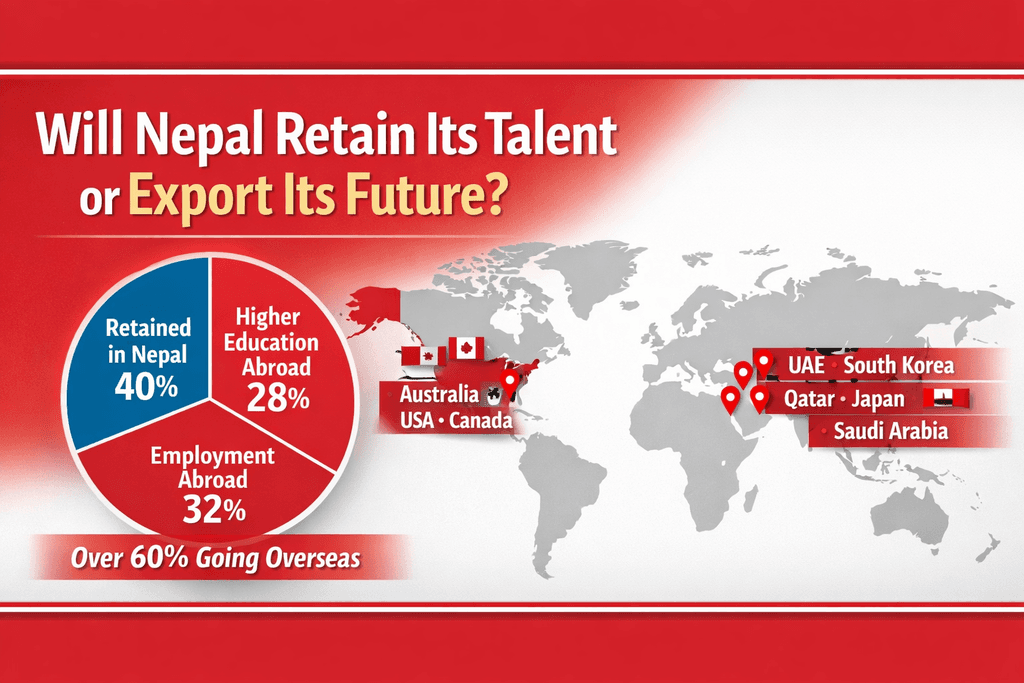
Your original article estimated the following distribution:
| Category Approx. | Estimated % | Numbers |
|---|---|---|
| Retained in Nepal (employment/self-employment) | 35–40% | 31,500 – 36,000 |
| Going abroad for higher education | 25–30% | 22,500 – 27,000 |
| Going abroad for employment | 30–35% | 27,000 – 31,500 |
These percentages are useful as an illustrative scenario, but there is currently no authoritative dataset that supports using them as a precise forecast for the 90,000 graduates.
A better way to frame the issue is:
Nepal does not yet have a sufficiently reliable graduate-tracking system to say exactly how many of these graduates will remain, study abroad, migrate for work, return, or become entrepreneurs.
And that itself reveals a policy gap.
Nepal needs better graduate tracer systems that follow students after graduation:
Graduation → Employment → Migration → Entrepreneurship → Return → Career progression
The University Grants Commission already uses graduate tracing and employment indicators as part of higher-education quality and employability mechanisms, demonstrating that graduate tracking can become part of institutional accountability.
Instead of guessing where graduates go, Nepal should systematically measure it.
Where Are Nepalis Going?
International migration is not a single phenomenon.
- There is a major difference between:
- migration for higher education,
- migration for professional employment,
- migration for temporary labour,
- migration for permanent settlement,
- and migration followed by eventual return.
Nepal's Labour Migration Report 2024 shows how geographically diverse Nepali migration has become.
For 2022/23, the report recorded approximately 3.02 million Nepali migrants across major destination countries/regions in the referenced dataset, including:
| Destination | Migrants |
|---|---|
| India | 1,088,371 |
| Qatar | 341,310 |
| Malaysia | 320,251 |
| Saudi Arabia | 316,931 |
| UAE | 253,857 |
| Australia | 131,662 |
| Japan | 91,376 |
| USA | 62,640 |
| South Korea | 43,577 |
| UK | 32,988 |
| Canada | 16,054 |
These figures are from the Nepal Labour Migration Report 2024's NLSS 2022/23 data and should not be interpreted as a count of graduates specifically.
That distinction is important.
Nepal's migration story is much broader than graduate migration.
But it also shows the scale of the international labour market that Nepali workers are already participating in.
The New Migration Map Is Changing
The traditional image of Nepali migration was dominated by the Gulf countries and Malaysia.
That remains important.
In 2023/24, Nepal issued 460,102 new labour approvals, according to the Nepal Labour Migration Report 2024. The largest destinations included the UAE, Malaysia, Saudi Arabia, Qatar, Kuwait and Japan, while newer European destinations were also becoming increasingly important.
For example, new labour approvals in 2023/24 included:
| Destination | New Labour Approvals |
|---|---|
| UAE | 131,026 |
| Malaysia | 81,382 |
| Saudi Arabia | 73,094 |
| Qatar | 40,932 |
| Kuwait | 28,776 |
| Croatia | 14,240 |
| Romania | 12,700 |
| Japan | 10,500 |
| Mauritius | 7,397 |
| Maldives | 5,958 |
This tells us something important:
Nepal's migration destinations are diversifying.
That creates both a challenge and an opportunity.
Nepal should not simply ask:
"How do we stop people from leaving?"
It should ask:
"How do we make migration increase Nepal's long-term human and economic capital?"
Why Are Nepal's Graduates Leaving?
1. Limited Quality Employment
A degree does not guarantee a career.
Many graduates encounter:
- low starting salaries,
- limited career progression,
- internships without meaningful pathways to employment,
- informal employment,
- jobs unrelated to their field,
- limited research opportunities,
- and weak professional networks.
The World Bank's 2025 Country Economic Memorandum found that Nepal's economy has struggled to generate enough quality non-agricultural jobs and that young workers continue to migrate in search of better opportunities.
This is perhaps the most important point in the entire discussion.
People rarely migrate simply because another country exists.
They migrate because the opportunity gap is large enough to justify leaving home.
2. The Salary Gap Is Only Part of the Problem
It is tempting to reduce migration to salary.
But graduates often compare much more than income.
They compare:
| Factor | Nepal | International Markets |
|---|---|---|
| Salary | Often lower | Often higher |
| Career progression | Ueven | More structured in many sectors |
| Research funding | Limited | Stronger in many destinations |
| Industry exposure | Growing | Often deeper |
| Professional networks | Smaller | Larger international ecosystems |
| Startup capital | Limited | Greater access in established ecosystems |
| Infrastructure | Improving | Often more developed |
| Global mobility | Limited | Often greater |
Therefore, retaining talent requires more than simply increasing salaries.
Nepal needs to create an environment in which skilled people can build ambitious careers.
3. Education–Industry Disconnect
A graduate can spend years studying:
- computer science,
- engineering,
- management,
- medicine,
- agriculture,
- economics,
- science,
- or social sciences,
and still struggle to demonstrate practical workplace capability.
The World Bank's 2026 analysis specifically highlights the gap between higher education and labour-market readiness, including technical and soft skills.
Nepal therefore needs to move from:
Degree → Job
toward:
Degree → Skills → Experience → Employment/Entrepreneurship
Universities should work more closely with employers to define what students actually need to know.
4. Entrepreneurship Is Still Too Difficult
Nepal frequently talks about startups.
But talking about entrepreneurship and building an entrepreneurial ecosystem are two different things.
A graduate with a good idea may still encounter:
- financing difficulties,
- registration complexity,
- limited mentorship,
- weak market access,
- lack of early customers,
- limited research commercialization,
- uncertainty around regulation,
- and difficulty accessing skilled teams.
However, there are signs that targeted intervention can work.
A recent World Bank-supported program worked with student and alumni ventures and supported 62 promising ventures across three cohorts, including training, mentoring, and approximately NPR 2 million average seed financing per venture through a revolving fund.
The lesson is important:
Young people do not necessarily lack ideas. They often lack the ecosystem required to turn ideas into sustainable businesses.
5. Research Rarely Becomes a Product
Nepal produces dissertations, research papers, engineering projects, medical research, software projects, and scientific studies.
But how many become:
- companies?
- patents?
- technologies?
- commercial products?
- public-sector solutions?
- exportable services?
This is where Nepal's universities can become much more economically relevant.
A university should not only measure:
How many students graduated?
It should also measure:
How many jobs were created?
How many startups emerged?
How much research was commercialized?
How many patents were filed?
How many industry partnerships were created?
How many graduates returned from abroad?
That is how universities become engines of economic development rather than simply degree providers.
The Cost of Talent Drain
Talent migration has both benefits and costs.
It would be wrong to argue that every person leaving Nepal represents a national loss.
Migration provides:
- remittances,
- international exposure,
- skills,
- professional networks,
- household income,
- and opportunities that may not exist domestically.
The problem arises when migration becomes the default pathway for economic mobility.
Nepal's economy already depends heavily on remittances.
World Bank data shows remittances equivalent to around 26% of GDP in 2024, while Nepal's 2025 economic data continued to show the importance of remittance inflows.
The World Bank has also emphasized that migration and remittances have played a major role in Nepal's poverty reduction, while the country continues to struggle with domestic job creation.
So the question should not be:
Are remittances good or bad?
They are clearly important.
The better question is:
Can Nepal use migration and remittances as a bridge toward a more productive domestic economy rather than allowing migration to become the economy's permanent safety valve?
Brain Drain vs Brain Circulation
There is a major difference between brain drain and brain circulation.
Brain Drain
Nepal → Education → Foreign employment → Permanent settlement
Knowledge and skills increasingly remain outside Nepal.
Brain Circulation
Nepal → Education/Experience abroad → International networks → Return/Investment/Remote work → Nepal
The second model can be far more valuable.
A Nepali software engineer working in Australia can:
- invest in a Nepali startup,
- mentor Nepali developers,
- outsource work to a Nepali company,
- create a company in Nepal,
- return later,
- or build a Nepal-based remote team.
A Nepali researcher abroad can collaborate with Nepali universities.
A Nepali doctor abroad can participate in medical research or telemedicine initiatives.
A Nepali entrepreneur abroad can bring capital and international customers.
Therefore:
Nepal does not have to choose between migration and development.
It needs to create systems that connect the two.
What Nepal Must Do Now?
1. Government: Move From Policy to Performance
Nepal already has policies.
The bigger question is implementation.
A graduate-retention strategy should focus on:
High-growth sectors:
- Information technology
- Digital services
- Hydropower
- Renewable energy
- Tourism technology
- Agritech
- Healthcare
- Biotechnology
- Financial technology
- Manufacturing
- Creative industries
The World Bank has specifically identified sectors including hydropower, tourism and digital services as areas with significant potential to generate economic and employment opportunities if regulatory and infrastructure constraints are addressed.
Policy priorities:
- Graduate employment incentives
- Industry-linked university programs
- Research commercialization funds
- Startup financing
- Export incentives for digital services
- Simplified SME regulation
- Graduate entrepreneurship programs
- Public-sector technology recruitment
- Returnee talent programs
- Diaspora investment mechanisms
2. Industry: Become Talent Anchors
Nepali companies cannot expect universities to produce perfectly job-ready employees.
Industry must participate.
Companies should:
- provide paid internships,
- establish graduate trainee programs,
- collaborate on curriculum,
- sponsor university projects,
- create research partnerships,
- provide mentorship,
- support certification programs,
- and establish clear career progression.
A graduate should be able to see a pathway like:
Intern → Junior → Mid-Level → Senior → Specialist/Manager → Leadership
If that pathway does not exist in Nepal, international opportunities will remain extremely attractive.
3. Universities: Become Innovation Hubs
Nepal's universities should measure their success through more than enrollment and graduation.
A modern university should connect:
Education + Research + Industry + Entrepreneurship + Employment
Every major university should consider establishing:
- startup incubators,
- industry labs,
- entrepreneurship centers,
- technology-transfer offices,
- research commercialization programs,
- internship networks,
- alumni investment networks,
- and international collaboration programs.
Students should graduate with more than a certificate.
They should graduate with:
Skills + Portfolio + Network + Experience + Opportunity
4. Government as a Customer for Nepali Innovation
One of the fastest ways to help startups survive is to give them customers.
The government itself is one of Nepal's largest potential technology customers.
Instead of always purchasing established foreign solutions, public agencies can create structured opportunities for qualified Nepali startups to compete for:
- digital government platforms,
- GIS systems,
- healthcare technology,
- education technology,
- agricultural platforms,
- cybersecurity solutions,
- public-data systems,
- municipal technology,
- and citizen-service applications.
This creates a powerful cycle:
Government demand → Startup revenue → Hiring → Skills → Innovation → More exports
5. Make Nepal an Exporter of Digital Services
Nepal cannot compete with every country on manufacturing scale.
But it can compete globally in knowledge-intensive services.
Consider:
- software development,
- AI services,
- cybersecurity,
- graphic design,
- animation,
- accounting services,
- digital marketing,
- engineering services,
- architecture,
- consulting,
- data services,
- and remote professional work.
A graduate does not necessarily have to physically leave Nepal to participate in the global economy.
The ideal future is:
Global income, Nepali residence.
That requires reliable internet, payment infrastructure, business-friendly regulation, international market access, and companies capable of selling services globally.
The Remote Work Opportunity
Technology changes the traditional definition of migration.
Previously:
To earn an international salary → move abroad.
Increasingly:
To earn from an international company → connect remotely.
This does not eliminate migration.
But it creates a new form of digital retention.
A software engineer in Kathmandu can potentially work for:
- an American company,
- an Australian company,
- a European startup,
- a Japanese technology company,
without permanently leaving Nepal.
This is why digital infrastructure and digital-service exports should be considered part of Nepal's talent-retention strategy.
Diaspora Should Be an Economic Network
Nepal's diaspora should not be viewed only as a source of remittances.
It can become a source of:
- investment,
- expertise,
- mentorship,
- technology transfer,
- international customers,
- research collaboration,
- startup capital,
- and market access.
A Nepali professional in Sydney, Tokyo, London or New York could potentially connect a Nepali company with an international customer.
That is brain circulation.
Nepal should build formal platforms that make those connections easier.
A New Graduate Retention Model for Nepal
Instead of trying to prevent migration, Nepal should build a system around five outcomes:
| Outcome | Goal |
|---|---|
| Stay | Make domestic careers competitive |
| Study Abroad | Build international knowledge and networks |
| Work Abroad | Improve skills and income |
| Return | Make coming home professionally attractive |
| Connect Remotely | Allow global work without permanent migration |
This is more realistic than simply telling young people:
"Don't leave Nepal."
The question should instead be:
"How can Nepal remain part of your career, wherever you are?"
What Would a Talent-Retention Economy Look Like?
Imagine a graduate in 2026.
Instead of seeing only two options:
Option A: Low-paying job in Nepal
or
Option B: Leave Nepal
the country should provide multiple pathways:
Path 1 — Build in Nepal
Graduate → Startup → Investment → Employees → Export
Path 2 — Global Remote Career
Graduate → Skills → International company → Remote work → Nepal-based income
Path 3 — Study Abroad and Return
Graduate → Master's/PhD abroad → Research/experience → Return
Path 4 — Diaspora Entrepreneurship
Graduate → International career → Investment in Nepal → Nepal-based company
Path 5 — Hybrid Career
Graduate → Work abroad → Mentor/invest/investigate opportunities in Nepal → Return later
This is what brain circulation looks like.
Nepal Needs Better Data on Its Graduates
One of the most important reforms may be surprisingly simple:
Track graduates.
Nepal should know:
- Where graduates work
- How long they take to find employment
- How many work in their field
- How many start businesses
- How many migrate
- Why they migrate
- Which countries they choose
- How many return
- How many work remotely for foreign companies
- How many create jobs
A national Graduate Outcomes Dashboard could combine university, labour, migration, and employment data while protecting individual privacy.
Instead of asking:
"Are our graduates leaving?"
Nepal could finally answer:
"Where are they going, why are they going, what skills are they gaining, and how can those skills contribute to Nepal?"
The 90,000-Graduate Moment Should Become a Policy Moment
The 51st Convocation should not be remembered only as a ceremony.
It should trigger a national conversation about:
- Education: Are universities producing the skills the economy needs?
- Employment: Are enough quality jobs being created?
- Entrepreneurship: Can graduates realistically start businesses?
- Research: Is academic research reaching industry and society?
- Migration: Can migration generate long-term national benefits?
- Technology: Can Nepal export knowledge rather than only labour?
- Diaspora: Can Nepalis abroad become economic partners rather than permanent losses?
The Real Problem Is Not That Nepalis Leave
Migration itself is not failure.
A student studying in Japan is not automatically a loss.
A software engineer working in Australia is not automatically a loss.
A doctor conducting research in the United States is not automatically a loss.
A Nepali entrepreneur building a company in Dubai is not automatically a loss.
The problem is when Nepal has no mechanism to benefit from their knowledge, networks, investment, or eventual return.
That is the difference between:
Brain Drain
and
Brain Circulation.
What Nepal Should Measure?
If Nepal genuinely wants to retain talent, it needs measurable indicators.
| KPI | What Nepal Should Track |
|---|---|
| Graduate employment rate | Employment within 6/12 months |
| Field-aligned employment | Graduates working in their discipline |
| Graduate migration | Number and destination |
| Graduate return rate | Migrants returning within 5–10 years |
| Startup formation | Graduate-founded companies |
| Startup survival | Businesses surviving 3–5 years |
| Research commercialization | Research converted into products/services |
| Graduate salaries | Domestic career competitiveness |
| Digital exports | Revenue from international digital services |
| Diaspora investment | Investment by Nepali professionals abroad |
| Remote employment | Nepal-based workers earning foreign income |
| Industry partnerships | University-company collaborations |
This would turn talent retention from a political slogan into a measurable economic policy.
Nepal's Opportunity: 500,000 Young People Every Year
The scale of the challenge is enormous.
Approximately 500,000 young people enter Nepal's workforce annually.
That means the question surrounding the 90,000 graduates is actually much bigger than one convocation.
Every year, another generation asks:
"Can I build my future here?"
If the answer remains uncertain, migration will continue to be one of the most rational choices available to young people.
But if Nepal creates productive industries, technology companies, research institutions, startups, competitive salaries, export opportunities and credible career pathways, staying can become equally rational.
Nepal Does Not Need to Stop Migration
It needs to change the economics of staying.
That means creating an environment where:
➞ Staying is viable.
➞ Returning is respected.
➞ Entrepreneurship is possible.
➞ Research is rewarded.
➞ Innovation is funded.
➞ Global work can happen from Nepal.
➞ International experience can come back into Nepal.
That is a much more sustainable vision than trying to prevent young people from leaving.
Final Reflection: 90,000 Graduates, One Choice
The 51st Convocation was a celebration of what Nepal's education system can produce.
But it also represents a national question.
Nepal has invested years of education, public infrastructure, family resources and personal effort into developing its human capital.
The next question is:
Can Nepal create an economy capable of using it?
The answer will not come from one policy.
It will come from the combined actions of:
Government + Universities + Industry + Startups + Investors + Diaspora + Graduates
Nepal does not need every graduate to stay forever.
It needs them to remain economically connected to Nepal.
Some will stay.
Some will leave.
Some will return.
Some will build companies abroad.
Some will work remotely.
Some will invest.
Some will teach.
Some will create jobs.
The goal should be to transform all of those pathways into national value.
Because the greatest danger is not that 90,000 graduates leave Nepal.
The greatest danger is that Nepal produces talented people without creating an economy in which their talent can reach its full potential.
Nepal's future should not be exported by default.
It should be connected to the world—and still rooted in Nepal.
Pie Chart – Graduate Retention vs Migration
Shows the scale of talent outflow at a glance
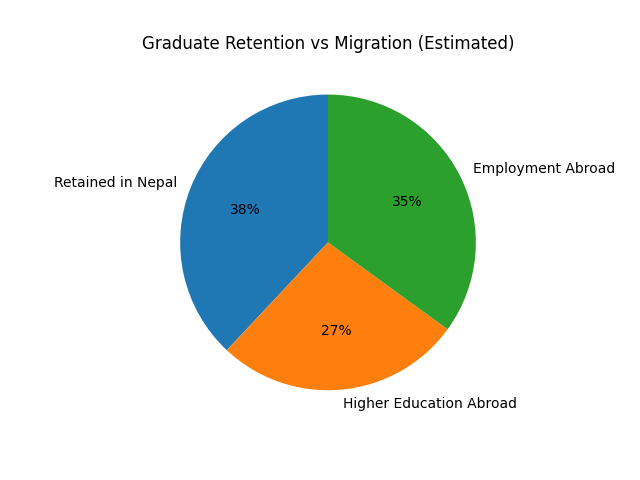
“Less than 40% of Nepal’s graduates are likely to remain in the country.”
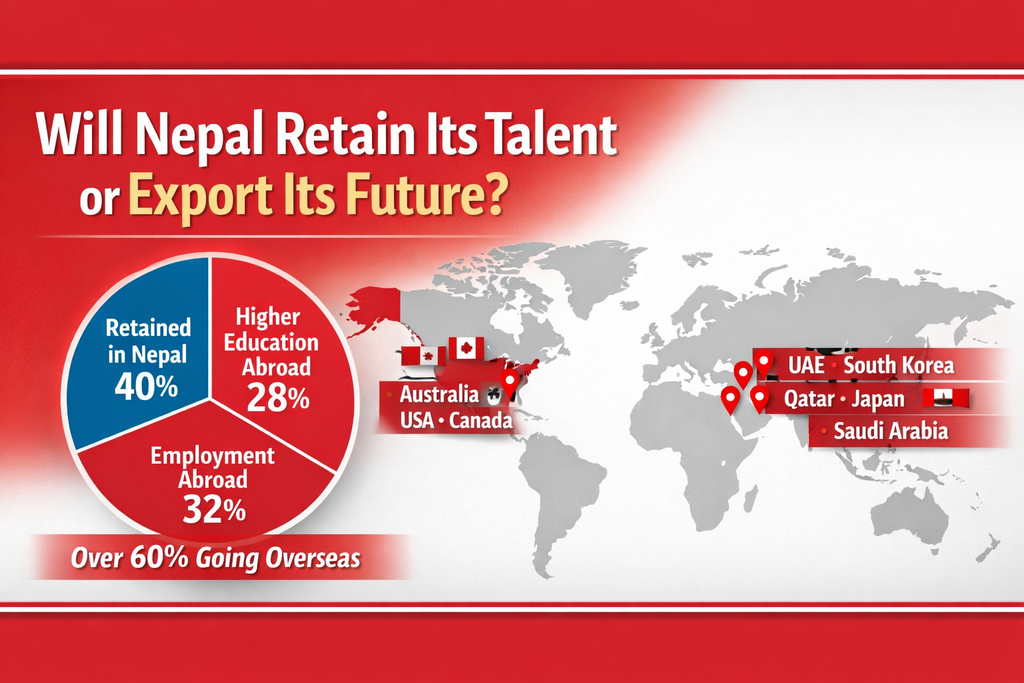
World Map (Bar Representation) – Major Destination Countries
Highlights where Nepal’s educated youth go

“Nepali graduates increasingly choose Australia, North America, Japan, Korea, and the Gulf. Trend in 2023”
Frequently Asked Questions (FAQs):
Q. Did 90,000 students graduate from Tribhuvan University in the 51st Convocation?
Tribhuvan University reported around 90,000 total graduates across Bachelor’s, Master’s, M.Phil. and PhD programs, while more than 16,000 participated in person at the December 25, 2025 convocation. The figures should not be interpreted as 90,000 students physically graduating on the same day.
Q. Is it true that more than half of these 90,000 graduates will leave Nepal?
There is currently no authoritative evidence that establishes that exact percentage. The original 35–40%, 25–30%, and 30–35% estimates should therefore be treated as an illustrative scenario rather than a statistical forecast.
Q. Why do Nepali graduates leave the country?
Major factors include limited quality employment, career progression, wage differences, skills mismatches, research opportunities, education opportunities and the broader availability of international career pathways. The World Bank identifies weak domestic job creation as a major structural challenge.
Q. Is migration bad for Nepal?
Not necessarily. Migration generates remittances, international experience, skills and networks. The challenge is ensuring that Nepal can capture more of those benefits through return migration, investment, entrepreneurship, knowledge transfer and diaspora networks.
Q. What is brain circulation?
Brain circulation occurs when people gain education or experience abroad but continue contributing to their home country through return migration, investment, remote work, research, mentoring, entrepreneurship or international networks.
Q. How much does Nepal depend on remittances?
Remittances are extremely important to Nepal's economy. World Bank data places remittances at approximately 26% of GDP in 2024.
Q. How many young people enter Nepal's workforce every year?
The World Bank estimates that approximately 500,000 young people enter Nepal's workforce annually.
Q. What can Nepal do to retain graduates?
Nepal can focus on quality job creation, industry-linked education, startup financing, research commercialization, digital-service exports, competitive career paths, graduate tracking, diaspora engagement and policies that make returning to Nepal economically attractive.
Q. Can Nepal benefit from graduates who work abroad?
Yes. Graduates abroad can contribute through investment, entrepreneurship, research collaboration, mentoring, technology transfer, international market access, remittances and eventual return.
Q. Should Nepal try to stop students from studying abroad?
No. The better objective is to ensure that international education produces long-term benefits for both the individual and Nepal through knowledge transfer, networks, investment and return opportunities.
Conclusion
The 90,000-graduate moment should not become a debate about whether Nepalis should leave.
It should become a debate about why they leave, what they gain abroad, and whether Nepal can create mechanisms to bring that value back.
Nepal has the people.
It has the universities.
It has an increasingly connected digital economy.
It has a large diaspora.
It has entrepreneurs.
It has young workers entering the workforce every year.
The missing ingredient is the ability to convert all of that human potential into productive domestic opportunity.
The real question is therefore not:
"Will Nepal retain all its talent?"
It is:
"Can Nepal build a country that talented people remain connected to—whether they stay, leave, return, or work globally?"
That is the future Nepal should build.
Get more knowledge on: Nepal's Booming IT Sector