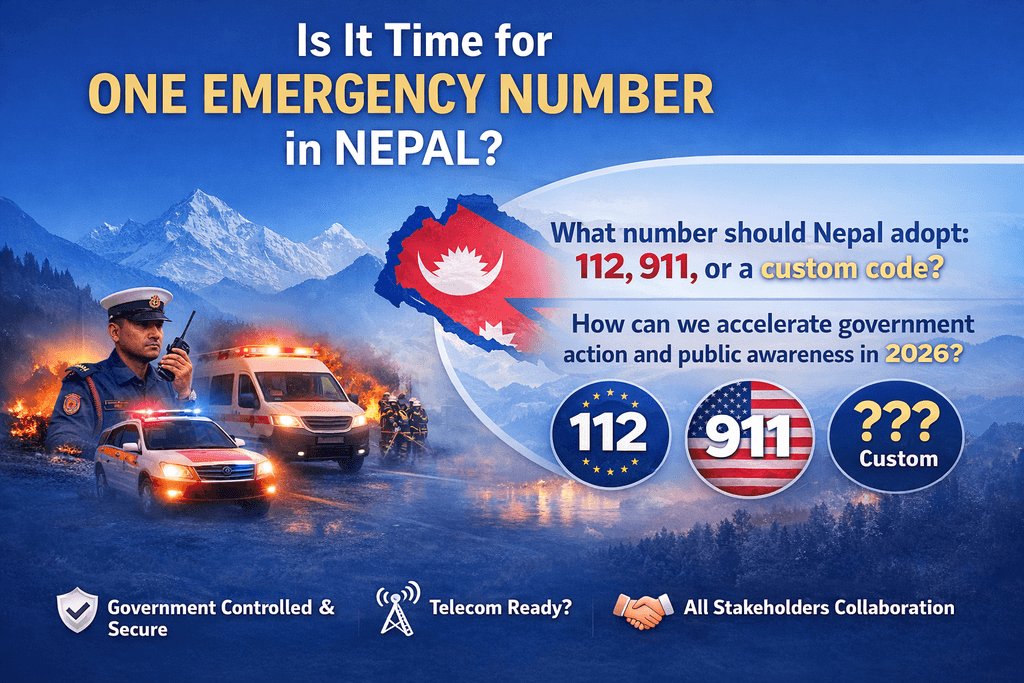
Should Nepal Move Toward One National Emergency Number?
Imagine witnessing a serious road accident.
Someone needs an ambulance.
Someone else thinks the police should be called.
Another person is trying to find the nearest fire service.
In a stressful situation, the problem is not necessarily knowing that emergency services exist. The problem is knowing which number to call, which agency will respond, and how those agencies will coordinate.
Nepal already has several short emergency and public-service numbers.
The Nepal Telecommunications Authority's numbering plan lists dedicated numbers such as 100 for police, 101 for fire, 102 for ambulance, and 103 for Valley Traffic Police. At the same time, NTA's national numbering documentation has allocated 112 as Nepal's national emergency number.
This creates an important policy question:
Should Nepal turn 112 into a genuinely unified emergency-access number connected to a coordinated national dispatch system?
The issue is no longer simply about choosing a three-digit number.
It is about building the infrastructure, institutions, technology, and coordination behind that number.
How Other Countries Handle Emergency Calls
Different countries have adopted different emergency-number models.
| Emergency Number | Countries | Regions Country Flags |
|---|---|---|
| 911 | United States, Canada, Mexico (partial), Bahamas | 🇺🇸 🇨🇦 🇲🇽 🇧🇸 |
| 112 | European Union, India, Sri Lanka, UAE, South Africa, Australia (alt), New Zealand (alt) | 🇪🇺 🇮🇳 🇱🇰 🇦🇪 🇿🇦 🇦🇺 🇳🇿 |
| 999 | United Kingdom, Ireland, Hong Kong, Malaysia, Singapore | 🇬🇧 🇮🇪 🇭🇰 🇲🇾 🇸🇬 |
| 110 | China (Police) | 🇨🇳 |
| 119 | Japan (Fire & Ambulance), South Korea (Fire & Ambulance) | 🇯🇵 🇰🇷 |
| 101 | China (Fire) | 🇨🇳 |
| 120 | China (Ambulance) | 🇨🇳 |
| 000 | Australia | 🇦🇺 |
| 113 | Switzerland (Medical Emergency) | 🇨🇭 |
| 118 | Italy (Fire), Switzerland (Fire) | 🇮🇹 🇨🇭 |
| 111 | New Zealand (primary emergency number) | 🇳🇿 |
The important lesson is that the number itself is only the front door.
A successful unified emergency system also requires:
- Call centers
- Trained dispatchers
- Location technology
- Computer-aided dispatch
- Inter-agency protocols
- Ambulance and rescue networks
- Reliable telecommunications
- Real-time data
- Public awareness
- Strong governance
A country does not create a 911- or 112-style emergency system simply by advertising a three-digit number.
What Does Nepal Have Today?
Nepal currently operates several emergency and public-service numbers.
| Service | Number |
|---|---|
| 🚓 Police | 100 |
| 🚒 Fire | 101 |
| 🚑 Ambulance | 102 |
| 🚦 Traffic | 103 |
| 👶 Child Helpline | 1113 |
| 👩 Domestic Violence | 1133 |
| 💻 Cybercrime | 1144 |
| 🛒 Consumer | 1155 |
Nepal Police officially continues to list 100 as Police Control, while NDRRMA currently lists 1234 as the NEOC toll-free number.
NTA's current National Numbering Allocation Plan also confirms the dedicated allocations for police, fire, ambulance and traffic services.
This means Nepal already has the basic building blocks of an emergency communications system.
The challenge is integration.
The Important Point: Nepal Already Allocated 112
One of the most important facts often missed in discussions about a unified emergency number is that 112 is not merely a hypothetical choice.
Nepal's Telecommunications Authority has previously allocated 112 as the national emergency number. Its numbering documentation states that a national emergency number needs to be defined and identifies 112 for national emergency situations.
The same numbering framework recognizes that emergency services need common access across telecommunications networks.
This changes the policy question.
Instead of asking:
Should Nepal choose 112, 911, or another number?
the more practical question is:
How can Nepal operationalize 112 as an effective, nationwide, multi-agency emergency service?
That is a much more useful policy discussion.
Nepal Has Tried to Move Toward Common Emergency Access Before
This is not an entirely new idea.
In 2018, the government initiated a process to introduce 112 as a common ambulance-service number, with calls routed through a central dispatch center and plans to expand the model beyond Kathmandu Valley.
That history is important because it demonstrates that the concept of centralized emergency access has already been considered in Nepal.
The next step would be to move from a primarily ambulance-oriented common number toward a broader multi-agency emergency communications and dispatch system.
Why Does a Unified Number Matter?
Daily Emergency Demand
🚗 75 road accidents every day
⚠️ 7 deaths daily from road crashes
📅 35,404 accidents, 2,368 deaths (latest fiscal year)
5-Year Comparison (2019–2024)
🚗 Road Accidents
████████████████████████████ 12,500+ deaths
🌧️ Natural Disasters
█████ 1,500+ deaths
Insight: Road accidents alone create a daily national emergency, far exceeding disaster fatalities.
During an emergency, people rarely behave like calm administrators.
They may be:
- Injured
- Frightened
- Disoriented
- In an unfamiliar location
- Under time pressure
- Surrounded by other people
- Unsure which agency has jurisdiction
A simple emergency number reduces one layer of complexity.
Instead of asking:
"Should I call 100, 101, 102 or another number?"
the public could remember:
112 — Emergency
The operator could then determine what services are required.
Current Model vs Unified Emergency Model
Current Model
Incident
↓
Citizen determines which service is needed
↓
Calls individual number
↓
Service-specific operator
↓
Possible transfer or coordination
↓
Response
This can work for straightforward incidents.
But major emergencies are rarely straightforward.
A serious road crash might simultaneously require:
- Police
- Ambulance
- Fire and rescue
- Traffic management
- Hospital coordination
Proposed Unified Model
One Emergency Number + Multi-Agency Dispatch
Incident
↓
112
↓
Trained emergency call taker
↓
Location + incident classification
↓
Computer-Aided Dispatch (CAD)
↓
Police + Ambulance + Fire + Other Required Services
↓
Real-time coordination
↓
Incident Resolution
The caller should not need to understand the government's organizational structure.
The system should do that work for them.
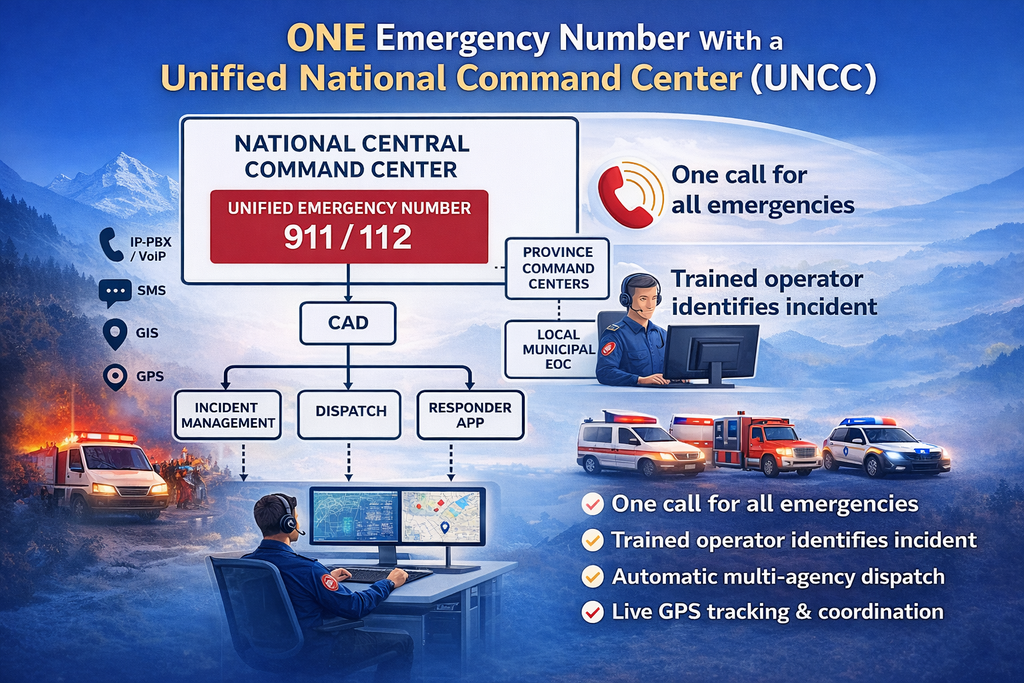
The Real Innovation Is the Command Center
A unified number is only useful if it is backed by a capable command-and-control system.
A future national emergency communications center could combine:
▸ Call Handling
Receive emergency calls through 112.
▸ Location
Determine the caller's location through available telecommunications and geospatial capabilities.
▸ Incident Classification
Determine whether the incident involves:
- Medical emergency
- Fire
- Road crash
- Crime
- Disaster
- Rescue
- Multiple agencies
▸ Dispatch
Automatically identify and notify the appropriate response teams.
▸ Tracking
Monitor emergency vehicles and responders in real time.
▸ Coordination
Allow multiple agencies to work on the same incident.
▸ Escalation
Automatically involve additional agencies when the situation requires them.
Nepal Already Has a Disaster Emergency Operations Network
Nepal does not have to build emergency coordination completely from scratch.
The National Disaster Risk Reduction and Management Authority (NDRRMA) describes an Emergency Operations Center network that includes:
- National Emergency Operations Center (NEOC)
- Provincial Emergency Operations Centers
- District Emergency Operations Centers
- Municipal Emergency Operations Centers
The Nepal Disaster Report 2024 describes this network as an important part of emergency preparedness and response.
NDRRMA currently lists 1234 as the NEOC toll-free number.
This existing structure provides an important institutional foundation.
The challenge would be connecting emergency public access, dispatch, first responders, hospitals, disaster-management systems, and local authorities into a coherent operational architecture.
Why Road Accidents Make This Urgent
Road crashes alone create a substantial emergency-response burden in Nepal.
Nepal Traffic Police's published road-traffic data shows:
| Year | Reported Road Crashes | Fatalities |
|---|---|---|
| 2015 | 9,145 | 2,004 |
| 2016 | 10,013 | 2,385 |
| 2017 | 10,178 | 2,789 |
| 2018 | 10,955 | 2,500 |
| 2019 | 13,366 | 2,376 |
| 2020 | 15,559 | 2,251 |
| 2021 | 20,640 | — |
| 2022 | 24,537 | 2,883 |
| 2023 | 23,597 | — |
| 2024 | 21,287 | 2,198 |
These figures come from Nepal Traffic Police's published traffic-safety material.
The exact annual figures vary depending on the reporting dataset and definitions used, but the broader point is clear:
Road crashes create a persistent, nationwide emergency-response requirement.
And road crashes are only one category.
Nepal must also respond to:
- Floods
- Landslides
- Earthquakes
- Fires
- Medical emergencies
- Industrial accidents
- Missing persons
- Security incidents
- Aviation and transport incidents
A coordinated emergency system therefore has value beyond traffic accidents.
Why Response Time Matters?
Emergency medicine contains a basic principle:
Time matters.
The impact of response time varies according to the type of emergency.
Cardiac arrest, severe trauma, major bleeding, respiratory emergencies and other time-sensitive conditions can deteriorate rapidly.
Research on emergency medical services has found associations between shorter response times and improved survival in particular emergency contexts, although the relationship is not a universal fixed percentage for every type of emergency.
This is why the original goal should not be to promise a specific percentage reduction in deaths.
The stronger argument is:
A well-designed system should reduce avoidable delays between incident recognition, call handling, dispatch, arrival and definitive care.
What Happens When One Emergency Requires Multiple Agencies?
Consider a major road crash on a highway.
There may be:
- Multiple injured people
- Trapped passengers
- Fuel leakage
- Traffic congestion
- Fire risk
- Need for police investigation
- Need for ambulances
- Need for traffic diversion
Calling one agency is not enough.
A unified system could classify the event as a multi-agency incident and dispatch appropriate resources simultaneously.
This is where a unified emergency number becomes much more powerful than simply replacing four numbers with one.
GIS + Computer-Aided Dispatch
Technology can significantly improve emergency coordination.
A modern emergency command center could integrate:
GIS Mapping
Display:
- Caller location
- Incident location
- Hospitals
- Ambulance locations
- Police units
- Fire stations
- Road networks
- Traffic conditions
- Disaster zones
Computer-Aided Dispatch
CAD can help dispatchers:
- Create incidents
- Assign responders
- Track response status
- Prioritize emergencies
- Record timestamps
- Coordinate multiple agencies
GPS Tracking
Emergency vehicles could be tracked in real time.
The dispatcher could identify:
Which ambulance is closest?
rather than simply:
Which ambulance belongs to this district?
That distinction could save valuable time.
A Future 112 Architecture for Nepal
A simplified architecture could look like this:
Citizen
↓
112
↓
National Emergency Contact Center
↓
GIS + Caller Location + Incident Management
↓
Computer-Aided Dispatch
↙️ ↓ ↘️ ↘️
Police | Ambulance | Fire & Rescue | Disaster Response
↓
Hospitals / Local Government / Specialized Agencies
↓
Incident Resolution + Digital Record
The system could also feed anonymized operational data into national dashboards.
Real-Time Emergency Data Could Improve Governance
A unified system would generate valuable operational data.
For example, authorities could measure:
- Number of emergency calls
- Geographic distribution
- Response times
- Dispatch times
- Ambulance availability
- Fire response times
- Police response times
- Hospital destination
- Incident categories
- Repeat emergency locations
- Peak emergency periods
This could help identify dangerous roads, underserved areas, recurring fire zones, ambulance shortages and gaps in emergency infrastructure.
The emergency system would therefore become not only a response platform, but also a national planning tool.
Information Security and Data Sovereignty
A national emergency system would handle sensitive information.
Calls could contain:
- Names
- Phone numbers
- Locations
- Medical information
- Criminal information
- Photographs
- Audio recordings
- Incident details
Security therefore cannot be an afterthought.
A national system should incorporate:
- Encryption: Protect data during transmission and storage.
- Role-Based Access: Users should only access information required for their responsibilities.
- Audit Logs: Every sensitive action should be traceable.
- Data Retention Policies: Emergency recordings and records should not be stored indefinitely without justification.
- Disaster Recovery: Emergency infrastructure must remain operational even when the primary system fails.
- Government Oversight: Critical emergency infrastructure requires clear public accountability and security governance.
The objective should not simply be:
"Put everything in one database."
It should be:
"Connect the necessary information securely and only when it is necessary."
Telecommunications Resilience Is Critical
A unified emergency number is only as reliable as the telecommunications network behind it.
Nepal's geography makes this especially important.
A national emergency system must account for:
- Mountainous terrain
- Rural connectivity gaps
- Floods
- Landslides
- Earthquakes
- Power outages
- Network congestion
- Fiber cuts
- Telecom infrastructure damage
Nepal's telecom operators, regulators and emergency agencies would therefore need strong redundancy arrangements.
Potential measures include:
- Multiple network paths
- Backup power
- Redundant data centers
- Disaster-resilient communication links
- Cross-network emergency routing
- Satellite or alternative communications for critical locations
- Priority handling of emergency traffic
Public Awareness Is as Important as Technology
A perfect emergency system is useless if people do not know how to use it.
If Nepal adopts 112 as a unified emergency access number, public education should be continuous.
Awareness could use:
- Television
- Radio
- Social media
- Schools
- Road signs
- Public transport
- Government websites
- Mobile notifications
- Tourism information
- Hospital campaigns
The message should be simple:
112 = Emergency
People should not have to memorize a list of numbers during a crisis.
Tourists and Foreign Visitors Would Benefit Too
Nepal receives visitors from around the world.
A single emergency number would reduce the need for visitors to understand Nepal's individual emergency-service structure.
A globally recognizable emergency number could make it easier for:
- Tourists
- Foreign residents
- International students
- Business travelers
- Migrant workers
to seek emergency assistance.
However, the number itself is only useful if operators can provide appropriate language support and dispatch services.
Multilingual Emergency Response
Nepal's emergency call center should ideally support multiple languages.
At minimum, the system should be capable of handling:
- Nepali
- English
- Major regional languages
AI-assisted translation could eventually support communication between callers and operators.
But emergency translation should not depend entirely on experimental AI.
Critical emergency communication requires:
- Human oversight
- Verified terminology
- Clear protocols
- Reliable fallback mechanisms
Technology can assist the operator, but should not become a single point of failure.
Challenges Nepal Must Address
1. Institutional Coordination
Police, fire, ambulance, health services, disaster authorities and local governments operate under different structures.
A unified system requires clearly defined responsibilities.
2. Governance
Who owns the national command system?
Who operates it?
Who controls the data?
Who is accountable when something goes wrong?
These questions need legal and institutional answers.
3. Funding
Emergency infrastructure requires long-term investment in:
- Call centers
- Telecom integration
- Software
- GIS
- CAD
- Data centers
- Vehicles
- Radios
- Training
- Cybersecurity
4. Rural Coverage
A Kathmandu-centered emergency system is not enough.
The system must work across Nepal.
5. Human Resources
Emergency call-taking is a specialized skill.
Operators need training in:
- Incident classification
- Communication
- Medical triage protocols
- Crisis management
- Location gathering
- Multi-agency dispatch
6. Legacy Systems
Nepal already has functioning emergency numbers.
A unified model must coexist with existing systems during transition.
7. Public Trust
People need confidence that calling the number will result in a meaningful response.
Who Needs to Collaborate?
A unified emergency system cannot belong to only one institution.
Government
- Ministry of Home Affairs
- Ministry of Health and Population
- Ministry of Communication and Information Technology
- NDRRMA
- Provincial governments
- Local governments
Telecommunications
- Nepal Telecommunications Authority
- Nepal Telecom
- Ncell
- Other licensed operators
Emergency Services
- Nepal Police
- Armed Police Force
- Fire services
- Ambulance providers
- Hospitals
- Traffic Police
- Local emergency teams
Technology Ecosystem
- GIS providers
- Software developers
- Cybersecurity specialists
- Cloud/data-center providers
- Emergency communication specialists
Civil Society and Academia
- Emergency medicine experts
- Disaster-management specialists
- Universities
- Training institutions
- Public-awareness organizations
Policy Priorities for Nepal
Rather than creating another isolated emergency project, Nepal could focus on several policy priorities.
1. Operationalize 112
Since 112 has already been allocated as the national emergency number, Nepal should evaluate how to make it operational as a truly nationwide emergency access point.
2. Establish a Multi-Agency Dispatch Architecture
The system should be capable of dispatching multiple services from one incident.
3. Integrate Existing Emergency Numbers
Numbers such as 100, 101 and 102 should not simply disappear overnight.
They can remain operational during a carefully managed transition.
4. Connect Emergency Operations Centers
The existing NEOC, provincial, district and municipal structures provide a potential foundation for broader coordination.
5. Deploy GIS and CAD
Emergency dispatch should be location-aware and data-driven.
6. Strengthen Telecom Resilience
Emergency calls should receive priority routing and remain available during major network disruptions where technically feasible.
7. Establish Strong Data Governance
Emergency information needs clear rules for access, retention, sharing and security.
8. Train Specialized Operators
A unified number requires professional emergency call-taking and dispatch.
9. Build Public Awareness
People need to know what 112 means and when to use it.
10. Measure Performance
The system should publish meaningful performance indicators such as:
- Call answer time
- Dispatch time
- Travel/response time
- Abandoned calls
- Call resolution
- Ambulance availability
- Geographic coverage
- Service-level performance
Should Nepal Choose 112, 911, or Something Else?
The original debate often frames the decision as:
112 vs 911 vs a new number.
But Nepal has already allocated 112 as its national emergency number.
Therefore, introducing an entirely different number would create additional transition and public-awareness costs without an obvious advantage.
112 has several practical advantages:
- Already allocated in Nepal's numbering framework
- Widely recognized internationally
- Used across Europe
- Used as an emergency number in several Asian and other countries
- Easy to remember
- Already associated with previous Nepal ambulance-service initiatives
The stronger policy question is therefore not:
"Which number sounds better?"
It is:
"Can Nepal build a world-class emergency response system behind 112?"
What a Successful Nepal Model Could Look Like?
A mature national emergency system could eventually operate like this:
Step 1 — Citizen Calls 112
One number regardless of emergency type.
Step 2 — Call Is Located
The system obtains available location information.
Step 3 — Operator Assesses the Incident
The trained dispatcher determines:
- What happened?
- Where?
- How many people are affected?
- What immediate danger exists?
- Which agencies are required?
Step 4 — System Creates an Incident
The CAD platform creates a digital emergency record.
Step 5 — Resources Are Dispatched
The system identifies appropriate nearby resources.
Step 6 — Agencies Coordinate
Police, ambulance, fire and disaster-response teams can share incident information.
Step 7 — Hospital Coordination
Where appropriate, ambulance teams can coordinate with receiving hospitals.
Step 8 — Incident Is Closed
The system records the outcome and response metrics.
Step 9 — Data Supports Planning
Aggregated data helps authorities identify patterns and improve future response.
What Success Should Actually Be Measured By?
The success of a unified emergency number should not be measured simply by:
"How many people called 112?"
More meaningful indicators would include:
| KPI | Why It Matter |
|---|---|
| Call answer time | Measures accessibility |
| Dispatch time | Measures operational efficiency |
| Emergency response time | Measures field performance |
| Call abandonment rate | Identifies capacity problems |
| Multi-agency dispatch time | Measures coordination |
| Ambulance availability | Measures resource capacity |
| Geographic response coverage | Measures equity |
| Hospital handover time | Measures healthcare coordination |
| False/abusive call rate | Measures misuse |
| Public awareness | Measures system usability |
| Incident outcome | Measures real-world impact |
The ultimate objective is not simply faster phone answering.
It is faster and better emergency response.
Nepal Is Not Starting From Zero
It would be inaccurate to describe Nepal as having no emergency coordination infrastructure.
Nepal already has:
- Dedicated emergency service numbers
- Nepal Police emergency control
- Ambulance services
- Fire services
- Traffic Police
- National Emergency Operations Center
- Provincial and district emergency operations structures
- Municipal emergency operations centers
- A national emergency number allocation for 112
- Telecommunications infrastructure
- Disaster-management institutions
NDRRMA's disaster-reporting framework identifies an extensive Emergency Operations Center network across national, provincial, district and municipal levels.
The opportunity is to connect these pieces more effectively.
A Unified Number Is Not a Magic Solution
It is important not to oversell the concept.
A single number will not automatically:
- Create more ambulances
- Build more hospitals
- Fix rural roads
- Solve telecom blackouts
- Increase the number of doctors
- Improve fire-station coverage
- Eliminate response delays
If Nepal launches 112 without sufficient dispatch capacity and emergency resources, the number could simply become a centralized queue.
Therefore:
Unified access must be accompanied by stronger emergency-response capacity.
The phone number is the entry point.
The real system is everything behind it.
Expected Benefits
If implemented properly, a unified emergency-access and dispatch system could contribute to:
⏱️ Faster Coordination
Reduce time spent determining which agency should respond.
🚑 Better Resource Allocation
Dispatch the closest appropriate available resource.
🚓 Multi-Agency Response
Send police, ambulance and fire services to the same incident when necessary.
🗺️ Better Location Awareness
Use GIS and available location technologies to identify incidents.
📊 Better Emergency Data
Create a national picture of emergency demand.
🌧️ Stronger Disaster Response
Connect emergency communications with existing disaster-management structures.
🌍 Better Experience for Visitors
Give tourists and foreign residents a simple emergency access point.
🏥 Better Healthcare Coordination
Improve communication between field responders and receiving hospitals.
The Bigger Digital-Government Opportunity
A unified emergency system could become an example of what modern digital government should look like.
Instead of citizens navigating government departments, the system navigates the government for them.
The citizen simply says:
"I need help."
The system determines:
- Where they are
- What happened
- Which agency is needed
- Which unit is closest
- Which hospital may be appropriate
- Which additional resources should be involved
That is the real value of digital government.
Conclusion: Nepal Can Build a Better Emergency System
The question should no longer be whether Nepal can imagine a unified emergency number.
The country already has 112 allocated as a national emergency number, while separate service numbers such as 100, 101 and 102 continue to operate.
The real question is whether Nepal can build the infrastructure and institutions required to make 112 genuinely useful.
That means:
✔ One simple emergency access point
✔ Professional emergency call takers
✔ GIS-enabled dispatch
✔ Computer-aided dispatch
✔ Police, fire and ambulance coordination
✔ Integration with emergency operations centers
✔ Reliable telecommunications
✔ Strong cybersecurity
✔ Clear data governance
✔ Trained personnel
✔ Public awareness
✔ Measurable performance standards
Nepal does not need to copy the United States, Europe or India exactly.
It can learn from their systems and design a model suited to Nepal's geography, federal structure, emergency-service capacity and telecommunications environment.
A unified emergency number is not ultimately about choosing 112 over 100, 101 or 102. It is about making sure that when someone calls for help, the right help reaches them as quickly and safely as possible.
And Nepal already has an important starting point:
112 is allocated. Now the question is whether Nepal is ready to build the system behind it.
Frequently Asked Questions
Q. Does Nepal already have a unified emergency number?
Nepal's numbering framework has allocated 112 as the national emergency number, but separate emergency numbers such as 100 for police, 101 for fire and 102 for ambulance continue to exist.
Q. What is Nepal's emergency number 112?
112 is the national emergency number allocated within Nepal's numbering framework. The larger policy challenge is operationalizing it as an effective nationwide, multi-agency emergency-access system.
Q. What is Nepal Police's emergency number?
Nepal Police officially lists 100 as Police Control.
Q. What is Nepal's ambulance number?
The National Numbering Allocation Plan lists 102 for ambulance services.
Q. What is Nepal's fire emergency number?
The National Numbering Allocation Plan lists 101 for the fire brigade.
Q. What is Nepal's traffic police emergency number?
The numbering plan lists 103 for Valley Traffic Police.
Q. Why would Nepal need one emergency number?
A unified number can simplify emergency access, particularly when an incident requires multiple agencies such as police, ambulance and fire services.
Q. Would 112 replace 100, 101 and 102 immediately?
Not necessarily. A transition could allow existing numbers to continue operating while 112 is developed as a common access point. The exact transition model would need to be determined by the relevant authorities.
Q. Does Nepal already have a National Emergency Operations Center?
Yes. Nepal has a National Emergency Operations Center, and NDRRMA describes a broader network of provincial, district and municipal Emergency Operations Centers.
Q. What is Nepal's NEOC number?
NDRRMA currently lists 1234 as the NEOC toll-free number.
Q. Would a unified emergency number automatically make response faster?
No. A unified number can simplify access and improve coordination, but actual response time also depends on the availability and location of ambulances, police, fire services, roads, telecommunications, dispatch capacity and other resources.
Q. What technology would Nepal need for a unified emergency system?
Important technologies could include GIS, computer-aided dispatch, GPS tracking, emergency call management, secure communications, incident-management software, hospital integration and real-time dashboards.
Q. Could 112 work in rural Nepal?
Yes, but rural deployment would require reliable telecommunications, local emergency resources, appropriate dispatch coverage, backup communication systems and integration with provincial, district and municipal emergency structures.
Q. How could a unified emergency number help during disasters?
A unified system could allow emergency calls to be classified and coordinated centrally while connecting police, ambulance, fire, disaster-management agencies and local authorities.
Q. Would tourists benefit from a unified emergency number?
Yes. A single, widely recognizable emergency number could make it easier for international visitors to request emergency assistance without having to know Nepal's individual service numbers.
Q. Could AI be used in Nepal's emergency command center?
AI could eventually assist with tasks such as call classification, translation, location analysis, resource allocation and incident prioritization. However, critical emergency decisions should retain appropriate human oversight.
Q. What is Computer-Aided Dispatch?
Computer-Aided Dispatch, or CAD, is software used by emergency organizations to create, prioritize, assign and track emergency incidents and response resources.
Q. What is GIS and why is it important for emergency response?
Geographic Information Systems (GIS) allow emergency operators to visualize incidents, roads, hospitals, emergency vehicles and other geographic information. This can support better dispatch and situational awareness.
Q. What is the biggest challenge to implementing a unified emergency number in Nepal?
The biggest challenge is not choosing the number. It is coordinating institutions, telecommunications, dispatch centers, emergency responders, infrastructure, funding, data governance and public awareness into one reliable operating system.
Final Takeaway
Nepal already has the numbering foundation for a unified emergency system.
The opportunity now is to build the operational foundation behind it.
112 + Unified Dispatch + GIS + CAD + Emergency Operations Centers + Police + Ambulance + Fire + Hospitals + Telecom = A Connected National Emergency Response System
One number is simple. Building the system behind it is the real challenge — and the real opportunity.