Top 10 ERP Software in Nepal (2026): Finding the Right ERP for Your Business
As businesses in Nepal continue embracing digital transformation, Enterprise Resource Planning (ERP) systems are becoming increasingly important for improving operational efficiency, controlling costs, and making data-driven business decisions.
From manufacturing companies and trading businesses to hospitals, educational institutions, logistics companies, and professional service organizations, businesses across Nepal are moving away from spreadsheets and disconnected software toward integrated ERP platforms.
However, choosing the right ERP is not simply about selecting the software with the most features. Businesses need to consider factors such as industry requirements, implementation cost, customization, scalability, local support, integrations, ease of use, and long-term business needs.
In this article, we explore the top 10 ERP solutions in Nepal in 2026, their key strengths, ideal use cases, and the factors businesses should consider before making an ERP investment.
What is an ERP System?
An Enterprise Resource Planning (ERP) system is business management software that connects different departments and operations through a centralized platform.
Instead of maintaining separate systems for accounting, inventory, HR, sales, procurement, and other functions, an ERP allows organizations to manage these processes through an integrated system.
Common ERP modules include:
✔ Finance & Accounting
✔ Human Resource Management
✔ Inventory & Warehouse Management
✔ Procurement
✔ Sales & CRM
✔ Manufacturing
✔ Project Management
✔ Payroll
✔ Asset Management
✔ Customer Support
✔ Business Intelligence & Reporting
For businesses in Nepal, ERP systems can also help manage VAT-related processes, payroll, inventory control, financial reporting, procurement, and organization-specific workflows.
The main advantage of ERP is integration. When departments work with the same centralized data, organizations can reduce duplication, improve visibility, and make faster decisions.
Top 10 ERP Solutions in Nepal
The following ERP platforms represent a mix of local ERP solutions, global enterprise platforms, accounting-focused systems, open-source solutions, and cloud-based business application ecosystems available to businesses operating in Nepal.
The right choice ultimately depends on an organization's size, industry, budget, technical requirements, and growth plans.
1. OptERP – Nepal's Emerging Integrated ERP Platform
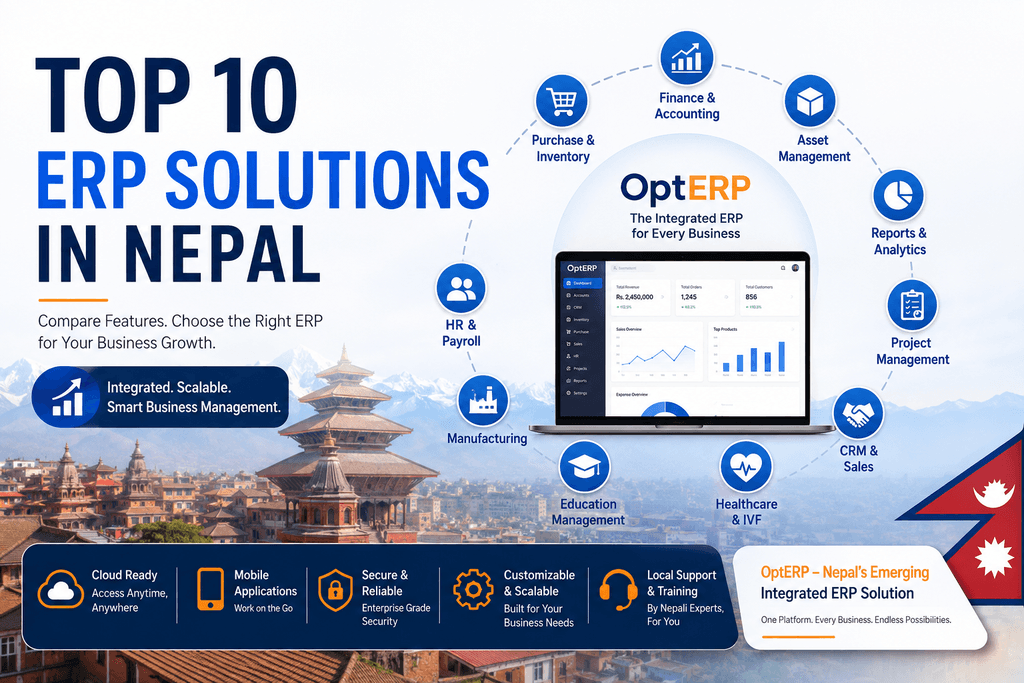
Among Nepal's newer generation of ERP platforms, OptERP is positioned as an integrated business management solution designed to address the operational requirements of Nepali organizations.
Rather than focusing exclusively on accounting or a single industry, OptERP brings multiple business functions together within one platform.
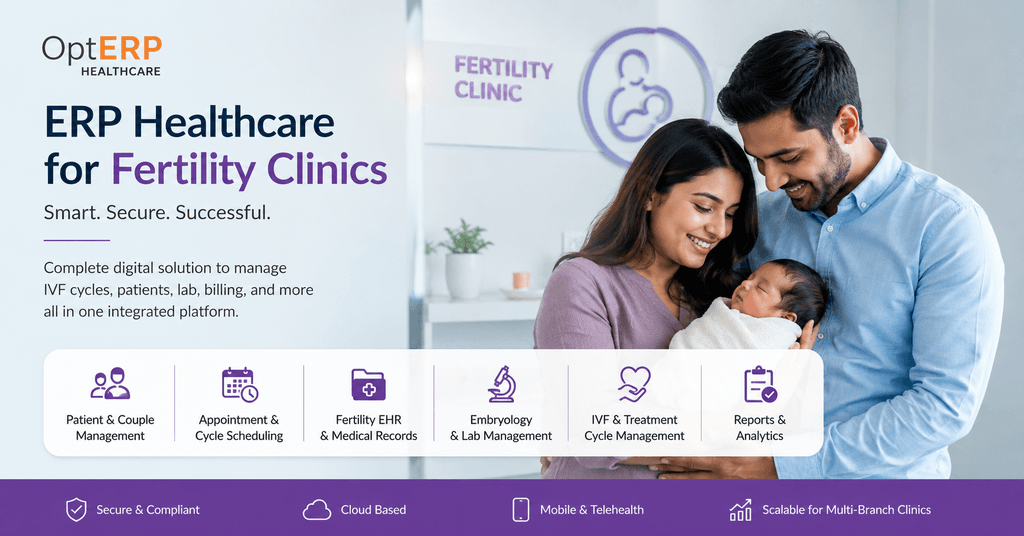
Its approach combines core ERP capabilities with specialized solutions for industries such as healthcare, fertility care, manufacturing, education, trading, logistics, and professional services.
Key Features:
▸ Finance & Accounting
▸ Inventory & Warehouse Management
▸ Procurement
▸ Sales & CRM
▸ Human Resource Management
▸ Payroll
▸ Manufacturing
▸ Healthcare Information System
▸ Fertility & IVF Management
▸ Education Management
▸ Asset Management
▸ Project Management
▸ Customer Portal
▸ Mobile Applications
▸ Advanced Analytics & Dashboards
Industry Solutions
OptERP provides solutions for multiple sectors, including:Healthcare & Hospitals
▸ Fertility Clinics
▸ Manufacturing
▸ Trading & Distribution
▸ Education Institutions
▸ NGOs & Development Organizations
▸ Logistics Companies
▸ Professional Service Firms
▸ SMEs
▸ Large Enterprises
Why Consider OptERP?
Businesses looking for a locally oriented ERP platform may consider OptERP when they require integrated business processes, industry-specific workflows, customization, API integrations, mobile accessibility, and local implementation support.
Its multi-industry approach also makes it suitable for organizations that expect their ERP requirements to expand as the business grows.
2. SAP Business One
SAP Business One is an ERP solution developed by SAP for small and midsize businesses and subsidiaries of larger enterprises.
It provides functionality across financial management, sales, purchasing, inventory, customer management, reporting, and business operations.
Best for:
✔ Medium-sized businesses
✔ Manufacturing companies
✔ Distribution businesses
✔ Wholesale organizations
✔ Growing enterprises
Strengths:
▸ Established global ERP ecosystem
▸ Strong financial management
▸ Business intelligence and reporting
▸ Extensive integration capabilities
▸ Enterprise-grade architecture
SAP Business One can be a strong choice for organizations looking for an internationally established ERP platform and expecting sophisticated business processes.
However, implementation, customization, and ongoing support should be carefully evaluated based on the organization's budget and local requirements.
3. Oracle NetSuite
Oracle NetSuite is a cloud-based ERP platform designed for organizations that need centralized financial and operational management.
It is particularly relevant for businesses operating across multiple locations, subsidiaries, currencies, or countries.
Best for:
✔ Large and growing businesses
✔ Multi-location organizations
✔ International companies
✔ Organizations with complex financial requirements
Strengths:
▸ Cloud-based architecture
▸ Strong financial management
▸ Multi-entity capabilities
▸ Scalable platform
▸ Extensive business management functionality
For Nepali companies planning international expansion, NetSuite can be an option worth evaluating. However, organizations should assess implementation complexity, subscription costs, customization requirements, and local support before choosing the platform.
4. Microsoft Dynamics 365 Business Central
Microsoft Dynamics 365 Business Central is a business management solution that integrates closely with Microsoft's broader ecosystem.
Organizations already using Microsoft products can benefit from its integration with tools such as Microsoft 365, Teams, Outlook, Excel, and Power BI.
Best for:
✔ Corporate organizations
✔ Service companies
✔ Distribution businesses
✔ Growing SMEs
✔ Organizations using Microsoft technologies
Strengths:
▸ Strong Microsoft ecosystem integration
▸ Financial management
▸ Supply chain functionality
▸ Business intelligence capabilities
▸ Flexible deployment options
For businesses already invested heavily in Microsoft technologies, Business Central can provide a familiar environment while connecting ERP data with other productivity and analytics tools.
5. Odoo ERP
Odoo is a modular business management platform offering applications for accounting, CRM, sales, inventory, manufacturing, HR, projects, websites, e-commerce, and other business processes.
One of Odoo's major advantages is its modular structure. Organizations can begin with a limited number of applications and add additional functionality as their requirements grow.
Best for:
✔ SMEs
✔ Retail businesses
✔ Manufacturing companies
✔ Startups
✔ Service organizations
Strengths:
▸ Modular architecture
▸ Large application ecosystem
▸ Broad business functionality
▸ Customization possibilities
▸ User-friendly interface
Odoo can be particularly attractive to businesses that want flexibility and a wide range of applications within one ecosystem.
6. TallyPrime
TallyPrime is primarily known as accounting and business management software rather than a full-scale ERP platform like SAP or Oracle.
Nevertheless, it remains widely used by businesses that prioritize accounting, financial management, inventory, and taxation-related operations.
Best for:
✔ Small businesses
✔ Retail stores
✔ Accounting firms
✔ Trading companies
✔ SMEs
Strengths:
▸ Easy accounting management
▸ Inventory capabilities
▸ Financial reporting
▸ Relatively simple implementation
▸ Familiarity among accounting professionals
For organizations that primarily need accounting and basic inventory functionality, TallyPrime may be more practical than implementing a complex enterprise ERP.
However, businesses with advanced HR, manufacturing, CRM, healthcare, or multi-department requirements may need a more comprehensive ERP platform.
7. Marg ERP
Marg ERP is particularly focused on businesses where inventory, billing, distribution, and accounting play major roles.
It is commonly associated with sectors such as pharmaceuticals, FMCG distribution, wholesale, and retail.
Best for:
✔ Pharmaceutical distributors
✔ Wholesale businesses
✔ Retail organizations
✔ FMCG businesses
✔ Inventory-heavy businesses
Strengths:
▸ Inventory management
▸ Distribution management
▸ Billing automation
▸ Accounting functionality
▸ Business reporting
Businesses with large inventories and distribution operations may find Marg ERP useful when inventory visibility and billing are major priorities.
8. Busy Accounting Software
Busy combines accounting with inventory management, taxation, invoicing, and financial reporting.
It is generally targeted toward small and medium-sized businesses that need accounting and inventory functionality without the complexity of a large enterprise ERP implementation.
Best for:
✔ Trading businesses
✔ SMEs
✔ Retail businesses
✔ Accountants
✔ Distribution companies
Strengths:
▸ Accounting-focused
▸ Inventory support
▸ Financial reporting
▸ Business billing
▸ Suitable for smaller organizations
Busy can be considered by organizations whose primary requirements revolve around accounting, inventory, billing, and financial reporting.
9. Zoho ERP Ecosystem
Unlike traditional ERP platforms, Zoho provides a broad ecosystem of interconnected business applications.
Its products cover areas such as CRM, finance, inventory, HR, projects, analytics, customer support, and collaboration.
For some businesses, combining several Zoho applications can provide ERP-like functionality without adopting a traditional monolithic ERP system.
Best for:
✔ Startups
✔ SMEs
✔ Service companies
✔ Sales-driven organizations
✔ Businesses looking for cloud-based applications
Strengths:
▸ Cloud-first approach
▸ Wide range of applications
▸ Strong CRM capabilities
▸ Subscription-based model
▸ Easy integration between applications
Businesses should evaluate whether an integrated application ecosystem or a single centralized ERP platform better fits their operational requirements.
10. ERPNext
ERPNext is an open-source ERP platform offering modules for accounting, inventory, manufacturing, CRM, HR, projects, healthcare, education, and other business operations.
Its open-source nature gives organizations significant flexibility in terms of customization and deployment.
Best for:
✔ SMEs
✔ Manufacturing businesses
✔ Trading companies
✔ Healthcare organizations
✔ Educational institutions
Strengths:
▸ Open-source
▸ Highly customizable
▸ Broad ERP functionality
▸ Strong developer community
▸ Cloud and self-hosted deployment options
ERPNext can be attractive to organizations that want greater control over their ERP environment and have access to technical expertise for customization and maintenance.
ERP Comparison: Which Solution Is Right for Your Business?
There is no single ERP system that is ideal for every business.
A small retail company may only require accounting, inventory, and billing, while a large manufacturing organization may need production planning, procurement, supply chain management, HR, finance, and advanced reporting.
Here's a simplified comparison:
| ERP Solutions | Best Suited For | Key Advantage |
| OptERP | Nepali businesses across industries | Integrated and locally oriented |
| SAP Business One | Medium and large businesses | Enterprise capabilities |
| Oracle NetSuite | Growing/international businesses | Cloud security |
| Microsoft Dynamics 365 | Corporate & Microsoft users | Microsoft ecosystem |
| Odoo | SMEs & growing businesses | Modular flexibility |
| TallyPrime | Small businesses | Accounting simplicity |
| Marg ERP | Distribution & inventory-heavy businesses | Inventory and billing |
| Busy | SMEs & trading businesses | Accounting + inventory |
| Zoho Ecosystem | Startups & service businesses | Cloud applications |
| ERPNext | SMEs & customizable deployments | Open-source flexibility |
This table should be treated as a starting point rather than a definitive ranking. Businesses should evaluate each platform against their specific requirements before making a decision.
Why Businesses in Nepal Are Moving Toward ERP ?
Several factors are contributing to the growing interest in ERP solutions in Nepal.
1. Digital Transformation
Businesses are increasingly replacing manual records and disconnected applications with centralized digital systems.
2. Better Financial Visibility
ERP systems allow management teams to monitor revenues, expenses, receivables, payables, and other financial information more efficiently.
3. Inventory Control
For trading, manufacturing, retail, and distribution businesses, real-time inventory visibility can reduce stock shortages, excess inventory, and manual errors.
4. Improved Decision-Making
Centralized data allows management to generate reports and dashboards that support faster and more informed decisions.
5. Business Growth
As organizations grow, managing operations through spreadsheets and disconnected applications becomes increasingly difficult. ERP systems provide a structured foundation for scaling operations.
Why Businesses Are Watching OptERP ?
One of the key areas of interest around newer ERP platforms in Nepal is the ability to combine local business requirements with modern technology.
OptERP focuses on bringing finance, operations, human resources, inventory, customer management, and industry-specific workflows into an integrated platform.
Its broader approach includes solutions for sectors such as healthcare, fertility clinics, manufacturing, education, trading, logistics, NGOs, and professional services.
Features such as cloud deployment, customizable workflows, API integrations, mobile accessibility, analytics, and local implementation support can make an integrated ERP attractive to Nepali organizations evaluating digital transformation.
For businesses considering OptERP, the most important step is to evaluate how its modules, implementation approach, integrations, pricing, customization capabilities, and support services align with their specific requirements.
How to Choose the Right ERP Solution in Nepal ?
Choosing an ERP should be treated as a long-term business decision rather than simply a software purchase.
Before selecting a platform, consider the following factors.
★ Business Size
A small business may not need a complex enterprise ERP. Select a platform that fits your current requirements while allowing room for growth.
★ Industry Requirements
Healthcare, manufacturing, education, logistics, retail, and NGOs often require specialized workflows.
Make sure the ERP supports the processes that are critical to your industry.
★ Total Cost of Ownership
Don't evaluate only the initial software cost.
Consider:
- Licensing or subscription fees
- Implementation costs
- Customization
- Data migration
- Training
- Maintenance
- Support
- Infrastructure
- Future upgrades
★ Customization
Every organization has unique workflows.
An ERP should provide sufficient flexibility to adapt to your business without requiring excessive custom development.
★ Local Support
Implementation support is especially important when adopting an ERP for the first time.
Evaluate the availability of:
- Local consultants
- Technical support
- Training
- Documentation
- Implementation services
- Post-deployment support
★ Scalability
Your ERP should support future growth.
Consider whether the system can handle additional users, branches, products, transactions, departments, and business operations as your organization expands.
★ Integration
Modern businesses rarely operate with one system alone.
Check whether the ERP can integrate with:
- Banks
- Payment gateways
- Websites
- E-commerce platforms
- Government systems
- Biometric devices
- Email platforms
- Third-party applications
- Business intelligence tools
★ Cloud vs. On-Premise
Cloud ERP can reduce infrastructure requirements and provide easier remote access.
On-premise ERP may provide greater control over infrastructure and data management.
The right option depends on the organization's security, technical, budget, and operational requirements.
★ User Experience
Even a powerful ERP will fail to deliver value if employees find it difficult to use.
Request a product demonstration and allow actual users to test the system before making a final decision.
★ Data Security
Businesses should evaluate authentication, authorization, backups, audit trails, access controls, encryption, and disaster recovery capabilities before selecting an ERP.
Questions to Ask Before Buying an ERP
Before signing an ERP agreement, businesses should ask vendors:
- What modules are included?
- What is the total implementation cost?
- Is the pricing subscription-based or perpetual?
- What customization options are available?
- Can the system integrate with existing software?
- How is data backed up?
- Where is the data hosted?
- What happens if the business changes vendors?
- Is data export available?
- What training is provided?
- What level of local technical support is available?
- How frequently is the software updated?
- Can the system support multiple branches?
- Can additional modules be added later?
- Can the vendor provide a live demonstration using our business workflow?
Getting clear answers to these questions can help businesses avoid unexpected costs and implementation problems.
Frequently Asked Questions (FAQs) About ERP in Nepal
Q. What is the best ERP software in Nepal?
There is no single ERP that is best for every organization. The right solution depends on factors such as business size, industry, budget, required modules, customization, integrations, and support requirements.
Q. How much does ERP software cost in Nepal?
ERP costs vary significantly depending on the number of users, modules, customization, implementation requirements, hosting model, and support package. Businesses should compare the total cost of ownership rather than looking only at the software license or subscription price.
Q. Is ERP suitable for small businesses in Nepal?
Yes. Small businesses can benefit from ERP systems, particularly when they need integrated accounting, inventory, sales, procurement, HR, or reporting. However, smaller organizations should avoid paying for unnecessary enterprise-level functionality.
Q. Is cloud ERP better than on-premise ERP?
Neither option is universally better. Cloud ERP can provide easier accessibility and reduce infrastructure management, while on-premise systems can provide greater control over the organization's environment.
Q. What should Nepali businesses consider when choosing an ERP?
Nepali businesses should consider local business requirements, taxation and accounting workflows, industry-specific functionality, integrations, implementation support, customization, security, scalability, and the vendor's long-term support capability.
Final Thoughts
Nepal's ERP market is continuing to evolve as businesses increasingly adopt digital technologies to improve efficiency and competitiveness.
Established global platforms such as SAP Business One, Oracle NetSuite, Microsoft Dynamics 365, Odoo, and ERPNext provide a range of capabilities for organizations with different requirements. Accounting and business management platforms such as TallyPrime, Marg ERP, and Busy can also remain practical choices for smaller or more specialized businesses.
Among these emerging solutions, OptERP stands out as a modern, integrated ERP platform designed to meet the operational needs of businesses across multiple industries. With its comprehensive modules, industry-specific solutions, cloud capabilities, and focus on digital transformation, OptERP is well-positioned to become one of Nepal's leading ERP platforms in the coming years.
Ultimately, the best ERP is not necessarily the one with the longest feature list. It is the platform that fits your organization's business processes, budget, industry requirements, employees, technology environment, and long-term growth strategy.
Before making a final decision, businesses should compare multiple vendors, request demonstrations, calculate the total cost of ownership, evaluate implementation and support, and test the system against real business workflows.
For organizations beginning their digital transformation journey in 2026, evaluating both established global ERP platforms and emerging Nepal-focused solutions can provide a clearer path toward selecting the right technology for sustainable growth.