Enterprise Resource Planning (ERP) systems have become essential for businesses that want to connect finance, sales, inventory, procurement, HR, manufacturing, and reporting in one system. In Nepal, however, choosing an ERP involves more than comparing feature lists. Local tax requirements, implementation support, connectivity, industry requirements, customization, data security, and total cost of ownership can all determine whether an ERP investment succeeds.
Why ERP Selection Matters for Nepali Businesses?
ERP adoption is no longer limited to large corporations.
Nepali businesses across manufacturing, trading, retail, healthcare, education, hospitality, distribution, professional services, and other sectors are increasingly moving away from disconnected spreadsheets and standalone applications toward integrated business systems.
At the same time, Nepal's broader digital transformation is accelerating. In February 2026, the World Bank approved US$50 million for Nepal's Digital Transformation Project, which includes digital public infrastructure, cybersecurity, data governance, electronic signatures, and digitization of public services. The project also aims to encourage private-sector investment in digital infrastructure.
This wider shift makes ERP increasingly relevant.
But choosing an ERP is not simply a question of:
“Which software has the most features?”
The better question is:
Which ERP can support our current operations, comply with our requirements, integrate with our existing systems, and continue to make sense as our business grows?
That is the focus of this guide.
What is an ERP System?
Enterprise Resource Planning (ERP) is software that connects multiple business functions through a shared system and database.
Instead of maintaining separate systems for accounting, inventory, sales, purchasing, HR, and manufacturing, an ERP can connect those processes.
A simplified business flow looks like:
Sales → Inventory → Procurement → Finance → Reporting
For a manufacturing company, the flow could become:
Sales Order → Production Planning → Raw Materials → Manufacturing → Quality Control → Finished Goods → Sales → Accounting
For a hospital:
Patient Registration → Appointment → Clinical Records → Pharmacy/Lab → Billing → Reporting
The exact modules depend on the ERP and industry.
Why ERP is Particularly Important in Nepal?
Nepali businesses have several considerations that can make ERP selection different from selecting software in a generic international market.
1. Tax and regulatory requirements
Businesses need accounting and reporting processes that fit Nepal's tax and regulatory environment.
An ERP should therefore be evaluated for:
• VAT handling
• PAN-related workflows
• Tax calculations
• Tax reporting
• Invoice formats
• Audit trails
• Accounting reports
• Integration requirements where applicable
Importantly, “supports accounting” does not automatically mean “fully compliant with every current Nepal tax requirement.”
Businesses should verify the exact compliance capabilities with the ERP vendor and their accounting/tax professionals before implementation.
2. Nepal-specific localization
Localization can include:
• Nepali language support
• Local date formats
• Bikram Sambat-related workflows
• Nepal-specific accounting requirements
• Local invoice formats
• Tax configurations
• Local reports
• Payment and banking integrations
However, localization should always be tested rather than assumed.
A vendor saying “Nepal supported” is not enough.
Ask for a demonstration using your actual business documents and workflows.
3. Internet and deployment requirements
Cloud ERP has become increasingly attractive because employees can access business systems from different locations.
However, businesses should still evaluate:
• Internet reliability
• Backup connectivity
• Offline requirements
• Local network infrastructure
• Cloud hosting location
• Data backup
• Disaster recovery
• Security controls
A business operating from Kathmandu with reliable connectivity may have different requirements from a manufacturing plant, branch office, or warehouse operating in a location with unstable connectivity.
4. Local implementation and support
ERP is not simply software that you install and forget.
Implementation normally involves:
Requirement Analysis → Configuration → Data Migration → Training → Testing → Go-Live → Support
Therefore, the implementation partner can be almost as important as the software itself.
A technically powerful ERP can still fail if:
• Requirements are misunderstood
• Data migration is poorly planned
• Employees are not trained
• Customizations are excessive
• Support is slow
• Management does not enforce adoption
The Most Important ERP Selection Criteria in Nepal
Before comparing vendors, create a weighted evaluation framework.
| Criterion | What to Evaluate | Importance |
| Tax & compliance | VAT, tax workflows, reports and applicable integrations | Very High |
| Industry fit | Features relevant to your sector | Very High |
| Implementation | Vendor's implementation methodology | Very High |
| Local support | Nepal-based or accessible support | High |
| Scalability | Users, branches, companies and transaction growth | High |
| Integration | APIs, banking, POS, websites and other systems | High |
| Security | Roles, permissions, backups and audit trails | Very High |
| Reporting | Dashboards and business intelligence | High |
| Deployment | Cloud, on-premise or hybrid options | High |
| Customization | Ability to adapt without excessive complexity | High |
| Total Cost | Software + implementation + support + customization | Very High |
| User experience | Ease of learning and daily operation | High |
ERP Selection Should Start With Business Processes
One of the biggest ERP-selection mistakes is starting with software.
Instead, start with your business.
For example, a distributor might document:
Purchase → Goods Receipt → Warehouse → Sales Order → Delivery → Invoice → Payment
A manufacturer might document:
Purchase → Raw Materials → QC → BOM → Work Order → Production → Finished Goods → Dispatch
A healthcare organization might document:
Registration → Appointment → Clinical Service → Lab/Pharmacy → Billing → Reporting
Then ask:
Which ERP handles this process with the least unnecessary complexity?
This produces a much more useful comparison than simply counting features.
Popular ERP Options for Nepali Businesses
There is no universal winner. When selecting an ERP provider in Nepal, businesses should evaluate implementation experience, local support, customization capabilities, training, integrations and post-implementation services.
The market can broadly be divided into:
- Nepal-focused/local ERP platforms
- Open-source ERP platforms
- International modular ERP platforms
- Enterprise-grade global ERP suites
Each category has different strengths.
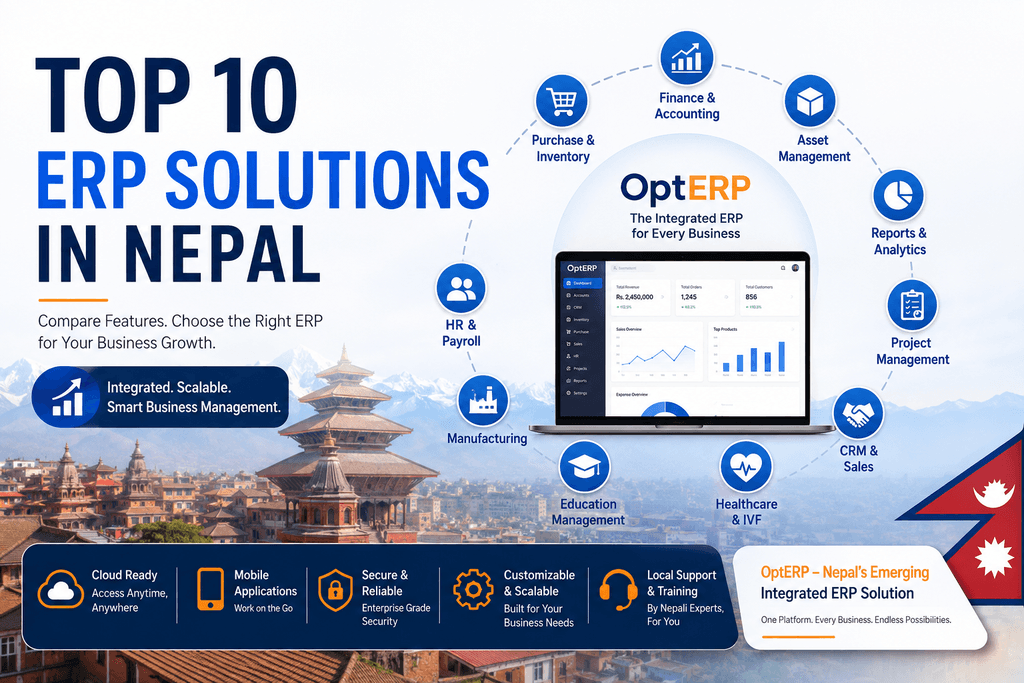
Also get knowledge on: Top 10 ERP Solutions in Nepal
1. OptERP
OptERP – Integrated ERP Solution
OptERP is positioned as a Nepal-focused ERP platform offering business management capabilities across areas such as accounting, inventory, HR, sales, procurement, healthcare, and other operations.
Its official website currently describes its SaaS offering as an IRD-approved, cloud-based ERP tailored for Nepalese businesses, with accounting, inventory, HR, sales, and procurement capabilities.
Potential strengths for Nepali businesses:
• Nepal-focused implementation
• Local tax/compliance orientation
• Cloud-based deployment
• Accounting and financial management
• Inventory management
• Sales and procurement
• HR capabilities
• Industry-specific solutions
• Local vendor support
Possible trade-offs:
• Businesses should still evaluate:
• Customization requirements
• Integration requirements
• Long-term scalability
• Data migration
• Service-level agreements
• Pricing structure
• Backup and disaster recovery
• Exact features included in the selected package
Best suited for:
Businesses looking for a Nepal-oriented ERP with local compliance and implementation considerations.
2. ERPNext
ERPNext is an open-source ERP platform covering areas including:
• Accounting
• Sales
• Purchasing
• Inventory
• Manufacturing
• CRM
• HR
• Projects
• Assets
• Helpdesk
• Website management
Its official documentation and product material describe it as an open-source ERP with extensive customization capabilities.
ERPNext can therefore be attractive to businesses that value:
• Open-source software
• Customization
• Developer control
• Broad functionality
• Lower software licensing barriers
• Self-hosting possibilities
Important Nepal consideration
ERPNext should not automatically be assumed to have complete native Nepal localization.
Its official regional documentation lists various country-specific configurations, but Nepal is not shown among the listed regional chart-of-accounts configurations in the current documentation.
ERPNext is flexible and can be customized, but a Nepali business should ask its implementation partner:
“Which Nepal-specific tax, reporting and compliance capabilities are included out of the box, and which require customization?”
Best suited for:
SMEs, technology-oriented businesses, manufacturers, and organizations that value flexibility and open-source customization.
3. Odoo
Odoo is a modular business platform that combines applications for:
• Accounting
• CRM
• Sales
• Inventory
• Manufacturing
• HR
• Project management
• eCommerce
• Point of Sale
• Marketing
• Website management
Odoo's architecture is particularly attractive to businesses that want to start with a few modules and expand later.
Strengths:
• Large application ecosystem
• Modular architecture
• Broad international adoption
• Extensive customization
• Strong third-party ecosystem
• Wide range of business applications
Nepal considerations
Odoo provides country-specific fiscal localization mechanisms, but its current official fiscal-localization list does not show Nepal as a standard listed localization package.
There are third-party Nepal localization modules—for example, the Odoo Apps Store contains a Nepal accounting localization module—but businesses should distinguish between official Odoo functionality and third-party localization/customization.
Best suited for:
Growing SMEs and mid-sized businesses that want a broad modular ecosystem and are comfortable working with an implementation partner.
4. SAP
SAP operates at a very different end of the ERP market.
Its current cloud ERP offering focuses on:
• Finance
• Procurement
• Supply chain
• HR
• Sales
• Analytics
• Automation
• AI
SAP describes its cloud ERP as providing real-time insights, embedded AI, and scalable enterprise capabilities.
Strengths:
• Enterprise-scale capabilities
• Mature processes
• Global operations
• Advanced analytics
• Extensive integration ecosystem
• Strong multinational support
• Advanced automation and AI
Trade-offs:
For smaller Nepali businesses, the key concern may not be functionality.
It may be complexity and total cost of ownership.
SAP can be excessive for an organization that only needs:
• Accounting
• Inventory
• Sales
• Purchasing
• Basic HR
Best suited for:
Large enterprises, multinational companies, complex groups, and organizations with sophisticated global processes.
ERP Comparison for Nepali Businesses
| ERP | Main Strength | Nepal Localization | Customization | Typical Fit | Main Trade-off |
| OptERP | Nepal-focused business management | Strong Nepal orientation | Vendor-dependent | SMEs to larger local business | Ecosystem smaller than global paltforms |
| ERPNext | Open-source flexibility | Requires careful verification/partner configuration | Very High | SMEs, technical teams, manufacturers | Localization/ implementation may require work |
| Odoo | Modular system | Often partner/customization dependent | Very High | SMEs and growing companies | Localization and customization can add cost |
| SAP | Enterprise scale | Strong global enterprise capabilities | High | Large enterprise/MNCs | Complexity and cost |
| Other local ERPs | Local requirements | Often strong | Vendor-dependent | SMEs and sector-specific business | Smaller ecosystem/scale may vary |
Important: This table is a selection framework, not a universal ranking. Actual suitability depends on the specific edition, implementation partner, configuration, industry, and requirements.
Local ERP vs Open-Source ERP vs Global ERP
Instead of asking which individual vendor is "best", businesses can first determine which ERP category makes sense.
| Factor | Local ERP | Open-Source ERP | Global ERP |
| Nepal localization | Usually strong | Depends on implemetation | Usually requires localization |
| Local support | Usually strong | Partner-dependent | Partner-dependent |
| Customization | Usually available | Very flexible | Extensive but structured |
| Initial complexity | Low-Medium | Medium | High |
| Cost | Low-Medium | Low-Medium + implementation | Medium-Very High |
| Ecosystem | Smaller | Large community | Very large |
| Global scalability | Varies | High | Very High |
| Best for | Nepal-focused | Flexible/technical organizations | Large/complex enterprises |
How Much Should an ERP Cost?
The software subscription or license is only one part of ERP cost.
A more realistic calculation is:
Total Cost of Ownership = Software + Implementation + Data Migration + Customization + Training + Integration + Support + Upgrades
For example, a business could purchase inexpensive software but spend significantly more on customization and implementation.
Conversely, an expensive ERP may produce better long-term value if it eliminates multiple disconnected systems and manual processes.
Therefore:
Do not compare ERP prices without comparing what is included.
Cloud ERP vs On-Premise ERP
Cloud ERP has become increasingly common because organizations can access systems through the internet without maintaining their own ERP servers.
SAP describes cloud ERP as software delivered over the internet, providing access to core applications across locations and allowing organizations to scale their systems.
| Factor | Cloud ERP | On-Premise ERP |
| Infrastructure | Vendor/cloud provider | Business-owned |
| Upfront hardware | Lower | Higher |
| Maintenance | Mostly provider-managed | Business-managed |
| Accessibility | High | Network-dependent |
| Updates | Usually managed by provider | Managed internally |
| Control | Shared responsibility | Greater infrastructure control |
| Internet dependency | Higher | Can operate on local network |
| Scaling | Usually easier | Requires infrastructure planning |
For many Nepali SMEs, cloud ERP can be attractive because it reduces the need to maintain dedicated ERP infrastructure.
However, businesses with strict infrastructure, connectivity, or data-control requirements may still prefer on-premise or hybrid deployment.
ERP Modules Every Nepali Business Should Evaluate
Not every company needs every ERP module.
Accounting & Finance
Look for:
• General ledger
• Accounts payable
• Accounts receivable
• Bank reconciliation
• Tax management
• Financial statements
• Cost centers
• Budgeting
Inventory
Look for:
• Multi-warehouse support
• Stock transfers
• Batch tracking
• Serial numbers
• Stock valuation
• Reorder levels
• Purchase planning
Sales
Look for:
• Quotations
• Sales orders
• Customer management
• Invoicing
• Returns
• Discounts
• Sales analytics
Procurement
Look for:
• Purchase requests
• RFQs
• Purchase orders
• Supplier management
• Goods receipts
• Purchase invoices
Human Resources
Look for:
• Employee records
• Attendance
• Leave
• Payroll
• Recruitment
• Performance
Manufacturing
For manufacturers, evaluate:
• Bill of Materials
• Production planning
• Work orders
• Material requirements planning
• Shop-floor management
• Quality control
• Production costing
ERPNext, for example, provides production planning, multi-level BOMs, stock management, work orders, job cards, MRP, and manufacturing costing.
The Importance of Integration
Modern businesses rarely operate with ERP alone.
Your ERP may need to communicate with:
• Banks
• Payment gateways
• POS systems
• E-commerce websites
• CRM platforms
• Payroll systems
• Government systems
• SMS platforms
• Warehouse systems
• Mobile applications
• Business intelligence tools
Therefore, API and integration capabilities should be part of the ERP evaluation.
Ask vendors:
“Can your ERP connect to the systems we already use?”
Security Should Be a Selection Requirement
Business data includes:
• Financial information
• Customer information
• Supplier information
• Employee records
• Payroll
• Inventory
• Sales data
• Strategic information
Therefore, ERP evaluation should include cybersecurity.
Check for:
✔ User Roles
Can users access only the information they need?
✔ Audit Trails
Can administrators determine who created, changed, or approved transactions?
✔ Backups
How frequently is data backed up?
✔ Disaster Recovery
What happens if the primary system fails?
✔ Encryption
How is sensitive data protected during transmission and storage?
✔ Authentication
Does the system support strong authentication mechanisms?
✔ Data Ownership
Who owns the business data, and how can it be exported if the company changes vendors?
ERP Implementation: The Most Overlooked Part
Buying an ERP is not the same as successfully implementing one.
A strong implementation normally follows a structured process.
Step 1: Requirement Analysis
Document current processes and pain points.
Step 2: ERP Shortlisting
Select two or three realistic candidates.
Step 3: Demonstration
Ask vendors to demonstrate your actual workflows.
Step 4: Proof of Concept
Test critical processes using realistic data.
Step 5: Data Migration
Clean and transfer:
• Customers
• Suppliers
• Products
• Opening balances
• Inventory
• Employees
• Historical information where required
Step 6: User Training
Train users according to their roles.
Step 7: Testing
Test:
• Sales
• Purchase
• Inventory
• Accounting
• Tax
• Reports
• Approvals
• Integrations
Step 8: Go-Live
Move the business to the new ERP.
Step 9: Post-Go-Live Support
Monitor issues, user adoption, performance, and reporting.
A Practical ERP Demo Checklist
Do not allow the vendor to give only a generic presentation.
Give them a scenario.
For example:
“Create a purchase order for 100 units, receive 80 units, record the remaining 20 as pending, update inventory, generate the supplier invoice, post the accounting entry, and show me the resulting reports.”
For a manufacturing company:
“Create a production order, consume raw materials, record production output, perform quality checks, and show the resulting inventory and costing.”
For a retailer:
“Create a sale, apply a discount, generate an invoice, receive payment, update inventory, and show the sales report.”
This reveals far more than a PowerPoint presentation.
Questions to Ask Every ERP Vendor
Before signing a contract, ask:
- Is the software cloud, on-premise, or both?
- What Nepal-specific tax features are included?
- Is the system currently compliant with applicable IRD requirements?
- Which features are standard and which require customization?
- How much does implementation cost?
- How much does customization cost?
- What is included in annual support?
- How often are updates released?
- Who owns the data?
- Can the data be exported?
- How frequently are backups taken?
- Where is the data hosted?
- What happens during an internet outage?
- Does the system support multiple branches?
- Does it support multiple companies?
- Can it integrate with our existing systems?
- What APIs are available?
- What is the expected implementation timeline?
- What training is included?
- Can we speak with existing customers in a similar industry?
Red Flags When Choosing an ERP
Be cautious if a vendor:
❌ Promises everything without showing it
A feature mentioned in a brochure may not work exactly the way your business needs.
❌ Cannot explain the total cost
Ask for a complete five-year cost estimate.
❌ Pushes excessive customization
Too much customization can make upgrades expensive and difficult.
❌ Has no clear data-export policy
You should understand how your data can be retrieved.
❌ Cannot demonstrate compliance
Ask for actual reports and workflows rather than verbal assurances.
❌ Does not provide implementation references
Talk to businesses with similar requirements.
❌ Focuses only on software features
Implementation, training, support, and change management are equally important.
Which ERP Is Best for Which Business?
There is no universal answer.
| Business Situation | ERP Type to Consider |
| Small Nepal-focused busines | Local/SME ERP |
| Retail business | Local ERP or modular ERP |
| Manufacturing company | ERP with strong manufacturing + inventory |
| Healthcare organization | Healthcare-focused ERP/HMS |
| Technology-oriented company | Open-source or highly customizable ERP |
| Growing multi-branch company | Scalable modular ERP |
| Large enterprise | Enterprise-grade global ERP |
| Multinational organization | SAP or comparable global ERP |
| Company requiring extensive customization | ERPNext/Odoo or flexible local platform |
| Company prioritizing Nepal-specific compliance | Nepal-focused ERP |
What About OptERP, ERPNext, Odoo and SAP?
These systems should not be treated as direct substitutes in every situation.
They occupy different positions in the ERP landscape.
✦ OptERP
Strong consideration for organizations prioritizing Nepal-focused ERP capabilities, local compliance orientation, and local implementation support. Its official platform currently presents cloud ERP and accounting solutions aimed at Nepalese businesses.
✦ ERPNext
Strong option for businesses that prioritize open-source software, customization, and broad business functionality. Its ecosystem covers accounting, manufacturing, inventory, HR, CRM, projects, and more.
✦ Odoo
Strong option for organizations wanting a large modular ecosystem and extensive customization. Nepal-specific requirements may require third-party modules or partner customization, so these should be evaluated carefully.
✦ SAP
Strong option for large, complex, multinational, or enterprise-scale organizations requiring sophisticated finance, supply chain, analytics, integration, and enterprise management capabilities.
The Future of ERP in Nepal
ERP systems are also changing.
Traditional ERP was primarily about:
Record Keeping → Accounting → Reporting
Modern ERP increasingly combines:
ERP + Cloud + Analytics + Automation + APIs + AI
AI is becoming particularly important.
Modern ERP platforms are beginning to use AI for:
• Forecasting
• Financial analysis
• Document processing
• Demand planning
• Workflow automation
• Customer support
• Business recommendations
• Anomaly detection
SAP, for example, currently positions embedded AI and automation as part of its cloud ERP strategy.
For Nepali businesses, this could eventually mean moving from:
“What happened?”
to:
“What is likely to happen, and what should we do next?”
But AI should be considered an enhancement—not the primary reason to purchase an ERP.
The foundation still needs to be:
Accurate Data + Good Processes + Reliable ERP + Strong Governance
ERP and Nepal's Digital Transformation
ERP adoption should also be viewed within Nepal's broader digital transformation.
The World Bank's 2026 Digital Transformation Project includes investments in:
• Digital public infrastructure
• Government data exchange
• Digital wallets
• Digital lockers
• Electronic signatures
• Cybersecurity
• Data governance
• Digitized public services
The project also seeks to strengthen private-sector participation in digital infrastructure.
As Nepal's digital ecosystem matures, businesses will increasingly need systems that can exchange data, integrate services, maintain audit trails, and operate securely.
That makes ERP less of an isolated accounting tool and more of a potential digital backbone for business operations.
Final Verdict: How Should Nepali Businesses Choose an ERP?
The best ERP is not necessarily:
• The cheapest ERP
• The most expensive ERP
• The ERP with the most features
• The most famous international brand
• The newest ERP
• The ERP with the most attractive dashboard
The best ERP is the one that fits the organization's actual processes and can continue supporting them as the business grows.
For Nepali businesses, the decision should therefore revolve around seven questions:
1. Does it meet our regulatory requirements?
2. Does it understand our industry?
3. Can our employees actually use it?
4. Can it integrate with our existing systems?
5. Can the vendor support us after implementation?
6. Can the system scale with our business?
7. What will the total cost be over three to five years?
If an ERP performs well against these questions, it deserves serious consideration.
Conclusion
The ERP market available to Nepali businesses is becoming increasingly diverse.
Local platforms like OptERP can offer strong Nepal-specific orientation and support. Open-source platforms can provide flexibility and customization. Global platforms can provide sophisticated capabilities for large and multinational organizations.
There is therefore no single ERP that is automatically the best choice for every Nepali business.
Instead, businesses should begin with their processes, compliance requirements, industry needs, users, growth plans, and budget.
A structured process looks like:
Identify Requirements → Shortlist Vendors → Compare → Demonstrate → Test → Calculate TCO → Check References → Implement
The most important principle is simple:
Do not choose an ERP because it has more features. Choose it because those features solve your business problems.
For a Nepali business, the right ERP should bring together compliance, operations, people, data, reporting, and decision-making into a system that can evolve with the organization.
And as Nepal's wider digital economy continues to develop, ERP systems will increasingly become more than accounting and inventory software—they can become the digital operating layer of the modern business.
Frequently Asked Questions (FAQs):
Q. What is the best ERP system for Nepali businesses?
There is no universal best ERP. Local platforms such as OptERP may be attractive for businesses prioritizing Nepal-specific requirements and local support, while ERPNext and Odoo can be attractive for organizations seeking flexibility and customization. SAP and similar enterprise platforms are more appropriate for large and complex organizations.
Q. Is ERPNext suitable for businesses in Nepal?
ERPNext can be suitable for Nepali businesses, particularly those that value open-source software and customization. However, businesses should verify Nepal-specific tax, reporting, localization, and compliance requirements with their implementation partner rather than assuming they are included by default.
Q. Is Odoo suitable for Nepal?
Odoo can be used by Nepali businesses, but Nepal-specific accounting and tax requirements should be carefully evaluated. Odoo's official fiscal-localization documentation does not currently list Nepal among its standard supported fiscal-localization packages, while third-party Nepal localization modules are available.
Q. Is SAP suitable for small businesses in Nepal?
SAP can serve smaller businesses through products such as SAP Business One, but its enterprise ecosystem can be unnecessary for organizations with simple accounting, inventory, and sales requirements. The decision should be based on complexity, budget, growth plans, and required capabilities.
Q. How much does an ERP cost in Nepal?
ERP cost varies significantly depending on the vendor, number of users, modules, deployment model, customization, integrations, implementation, training, and support. Businesses should calculate total cost of ownership rather than comparing only monthly or annual subscription prices.
Q. Should a Nepali business choose cloud ERP or on-premise ERP?
Cloud ERP is often attractive because it reduces infrastructure management and allows access from multiple locations. On-premise ERP can provide greater infrastructure control and may suit organizations with particular connectivity or data-control requirements.
Q. Does ERP automatically make a business more efficient?
No. ERP provides tools for integrating information and automating processes, but the result depends on implementation quality, data accuracy, business processes, employee adoption, training, and management practices.
Q. How long does ERP implementation take?
There is no universal timeline. A small organization using mostly standard workflows may implement an ERP relatively quickly, while a multi-branch organization with complex accounting, manufacturing, integrations, and historical-data migration can require considerably more time.
Q. What should I test during an ERP demo?
Test your real business processes rather than generic features. For example, demonstrate a purchase from quotation through payment, a sale through accounting, inventory movements, tax calculations, approvals, and the reports your management actually uses.
Q. Can ERP systems integrate with banks, websites and other software?
Many modern ERP platforms provide APIs or integrations, but the exact capabilities differ by product and implementation. Always ask the vendor to demonstrate the integrations your business actually needs.
Q. Is open-source ERP always cheaper?
Not necessarily. Open-source software can reduce licensing costs, but businesses may still incur costs for implementation, hosting, customization, security, maintenance, upgrades, training, and support.
Q. What is the biggest ERP-selection mistake businesses make?
Choosing software based on a feature list without first documenting business processes. An ERP should be evaluated against the organization's actual workflows, regulatory requirements, users, integrations, and long-term goals.
Get more knowledge on: Nepal: The Emerging Silicon Valley of South Asia, Healthcare ERP in Nepal, Nepal's Booming IT Sector