Best ERP Software in Nepal: Why the Right ERP Matters?
For Nepali businesses, choosing an Enterprise Resource Planning (ERP) system is no longer simply a technology decision. It can affect accounting, inventory, procurement, sales, human resources, manufacturing, customer management, reporting, and day-to-day decision-making.
The challenge is that businesses in Nepal have different requirements from one another. A manufacturing company may need production planning and material tracking, while a retail business may prioritize inventory, billing, and point-of-sale operations. A service company may focus more heavily on accounting, CRM, HR, projects, and reporting.
At the same time, businesses operating in Nepal need to consider local tax requirements, reporting practices, integrations, implementation support, language, deployment options, and total cost of ownership.
This makes ERP localization an important part of the selection process.
Get more knowledge on: Choosing the Right ERP System
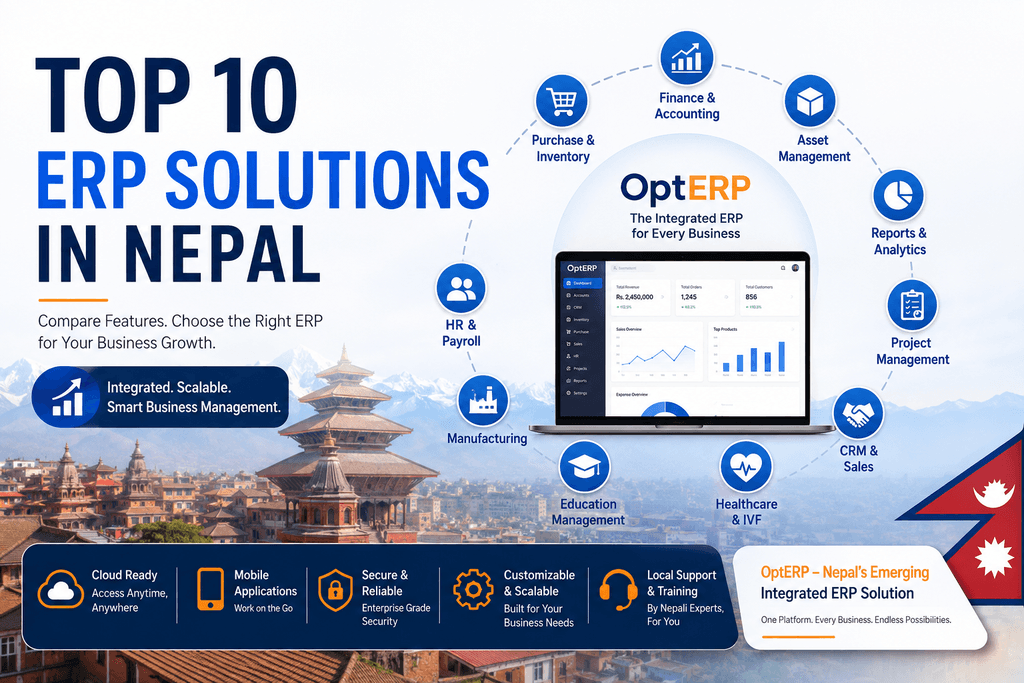
Among the ERP options available to Nepali businesses, OptERP stands out as a Nepal-focused platform that combines local compliance, customizable business workflows, integrated modules, and cloud-based deployment.
But it is not the only option.
Solutions such as ERPNext, Odoo, SAP Business One, Microsoft Dynamics 365 Business Central, and Marg ERP can also be relevant depending on the company's size, industry, budget, technical resources, and localization requirements.
While there are many ERP solutions available in Nepal, one stands out for its flexibility, localization, and hands-on support — OptERP.
What is an ERP System?
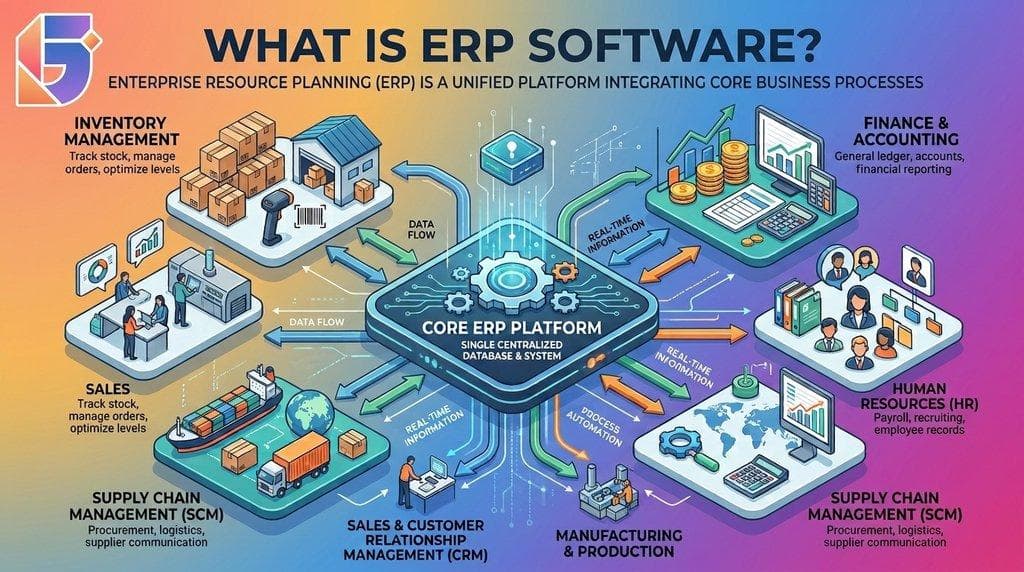
An Enterprise Resource Planning (ERP) system is software that brings multiple business functions into a centralized platform.
Instead of maintaining separate systems for accounting, inventory, sales, procurement, HR, manufacturing, and reporting, an ERP connects these processes and allows departments to work from shared business data.
A typical ERP can connect:
- Finance and accounting
- Sales and invoicing
- Purchasing and procurement
- Inventory and warehouse management
- Human resources and payroll
- Manufacturing and production
- CRM
- Supply chain management
- Project management
- Reporting and analytics
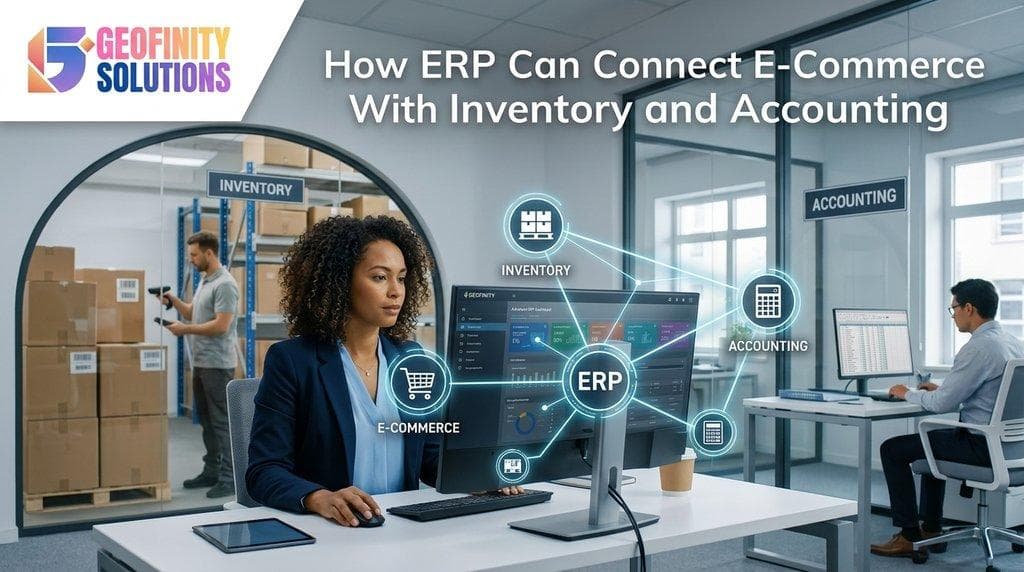
For example, when a sales order is created, an integrated ERP can potentially connect that transaction with inventory availability, procurement requirements, invoicing, receivables, and management reporting.
This reduces the need to manually move information between disconnected systems.
Why Nepali Businesses Need Localized ERP Software?
A global ERP may provide extensive functionality, but high costs and rigid frameworks mean functionality alone does not guarantee success—making an affordable ERP, organizations can scale a far smarter choice. To operate efficiently, companies require a web based ERP, which teams can access anywhere, alongside a fully integrated online ERP businesses trust to simplify daily operations.
Ultimately, choosing a custom ERP providers tailor to local tax structures, reporting standards, and bilingual workflows ensures a smooth transition and long-term business growth.
Important considerations include:
1. Nepal Tax and Compliance Requirements
Accounting and financial systems need to accommodate the regulatory environment in which a business operates.
For Nepali businesses, this means evaluating support for requirements associated with PAN, VAT, invoicing, tax reporting, and Inland Revenue Department (IRD) processes.
OptERP positions itself as an IRD-approved, cloud-based ERP solution tailored for Nepalese businesses, with accounting, inventory, HR, sales, procurement, and government-system integration capabilities.
However, businesses should always verify the exact compliance features and integrations included in the version and implementation package they are purchasing.
2. Local Business Workflows
Nepali businesses often have approval processes and operational practices that are specific to their organization.
An ERP should therefore allow companies to configure:
- Approval hierarchies
- Purchase approvals
- Sales approvals
- Expense approvals
- Stock transfers
- User permissions
- Department-level access
- Notifications
- Automated workflow triggers
3. Local Implementation and Support
ERP implementation does not end when the software is installed.
Businesses typically need:
- User training
- Data migration
- Configuration
- Troubleshooting
- Workflow customization
- Integration support
- Software updates
- Post-implementation assistance
Therefore, the quality and availability of the implementation partner can be just as important as the ERP software itself.
What Makes OptERP Different?

What Is OptERP?
OptERP is an integrated ERP platform developed with a focus on the requirements of businesses operating in Nepal.
According to its official platform information, OptERP provides modules covering finance, human resources, procurement, inventory, CRM, sales, and supply chain management. Its SaaS offering is cloud-based and is positioned as an IRD-approved solution tailored for Nepalese businesses.
Its main proposition is not simply to provide a collection of ERP modules, but to allow businesses to configure the platform around their operational requirements.
Key Features of OptERP:
1. Integrated Business Modules
Instead of managing separate applications for different departments, OptERP brings core business processes into a centralized platform.
Depending on the implementation, businesses can manage areas such as:
✔ Finance and Accounting
✔ Sales Management
✔ Purchase Management
✔ Inventory and Warehouse Management
✔ Human Resources
✔ Payroll
✔ CRM
✔ Procurement
✔ Supply Chain Management
✔ Industry-specific workflows
This integrated approach can give management a more complete view of business operations.
2. Nepal-Focused Compliance
One of OptERP's strongest differentiators is its focus on the Nepalese market.
The official OptERP platform describes its SaaS product as IRD-approved and tailored for Nepalese businesses, with tax compliance and government-system integration.
For a Nepali company evaluating ERP software, this can be an important consideration because tax and accounting requirements should be evaluated during ERP selection rather than treated as an afterthought.
3. Customizable Workflows
Not every company operates in the same way.
A manufacturing company may require:
Purchase Request → Approval → Purchase Order → Goods Receipt → Quality Check → Production
A service company might use:
Lead → Proposal → Approval → Project → Invoice → Payment
An ERP should be capable of representing these different processes.
OptERP's customization-focused approach allows businesses to configure workflows and processes according to their operational requirements.
This can be particularly useful for organizations that have outgrown basic accounting or inventory software.
4. Real-Time Reporting and Dashboards
ERP systems become considerably more valuable when operational data can be converted into useful management information.
Depending on the modules implemented, businesses can use ERP reporting to monitor:
- Sales performance
- Revenue
- Expenses
- Inventory levels
- Purchasing
- Receivables
- Payables
- Employee performance
- Production performance
- Financial indicators
Instead of waiting for departments to compile separate spreadsheets, management can work from centralized information.
5. Cloud ERP Nepal
Cloud ERP allows authorized users to access business applications without maintaining all infrastructure locally.
OptERP's official platform describes its SaaS offering as cloud-based, with secure access, automatic updates, and reduced IT infrastructure management requirements.
This can be particularly useful for businesses with:
- Multiple branches
- Distributed teams
- Remote management
- Growing operations
- Limited internal IT resources
However, businesses should still evaluate internet dependency, backups, security controls, service availability, data ownership, and recovery procedures before selecting a cloud ERP.
6. Industry-Specific Customization
A major advantage of customizable ERP software is that businesses do not necessarily have to completely change their existing processes to fit the software.
Instead, workflows can be adapted around the organization's requirements.
This can be particularly useful in sectors such as:
- Manufacturing
- Retail
- Healthcare
- Education
- Construction
- Distribution
- IT and technology
- Service businesses
OptERP also presents industry-specific ERP solutions through its platform and implementation services.
Best ERP Solutions in Nepal: 2026 Comparison
There is no single ERP that is objectively best for every Nepali business.
The right solution depends on business size, industry, technical capacity, compliance requirements, implementation budget, customization requirements, and long-term growth plans.
| ERP Solution | Main Positioning | Best Suited For | Key Strength |
|---|---|---|---|
| OptERP | Nepal-focused ERP | Nepali SMEs and growing business | Local compliance + customization |
| ERPNext | Open-source ERP | Businesses wanting flexibility and open-source technology | Broad functionality + customization |
| Odoo | Modular business platform | SMEs to larger organizations | Large application ecosystem |
| SAP Business One | Enterprise ERP for SMBs | Growing and established businesses | Mature ERP capabilities |
| Microsoft Dynamics 365 Business Central | Cloud ERP | Small and midsize organizations | Microsoft ecosystem + ERP |
| Marg ERP | Business management/billing ERP | Retail, distribution and pharma-oriented businesses | Billing + inventory capabilities |
The table is intended as a high-level starting point rather than a ranking. Actual suitability depends on the business's requirements and implementation partner.
1. OptERP
Best for: Nepali businesses looking for local compliance, customization, and integrated business management.
OptERP is positioned specifically for the Nepalese market and offers accounting, inventory, HR, sales, procurement, and other business functions through an integrated platform. Its official website describes the SaaS product as IRD-approved and tailored to Nepalese businesses.
Key advantages:
- Nepal-focused implementation
- IRD-oriented compliance
- Cloud-based SaaS option
- Accounting and financial management
- Inventory management
- HR and payroll capabilities
- Procurement
- Sales
- CRM
- Customizable workflows
- Industry-specific customization
Best suited for:
Businesses that want a combination of localization and flexibility without necessarily adopting an enterprise platform designed primarily for global markets.
2. ERPNext
Best for: Businesses that prioritize open-source software, flexibility, and broad ERP functionality.
ERPNext is an open-source ERP platform covering accounting, procurement, sales, inventory, manufacturing, HR, payroll, CRM, projects, POS, and other functions. Its official documentation also emphasizes customization and cloud readiness.
ERPNext can be particularly attractive to businesses with internal technical resources or access to experienced implementation partners.
Key advantages:
- Open-source
- Broad ERP functionality
- Accounting
- Inventory
- Manufacturing
- CRM
- HR and payroll
- Procurement
- Projects
- POS
- Customization options
For Nepalese businesses, however, localization and tax configuration should be evaluated carefully during the implementation process rather than assumed to be identical to a Nepal-focused ERP.
3. Odoo
Best for: Businesses that want a broad modular business-management ecosystem.
Odoo combines ERP functions with applications for CRM, accounting, inventory, manufacturing, point of sale, eCommerce, projects, website management, and more. Its current platform describes Odoo as a flexible, modular business platform suitable for organizations ranging from very small businesses to large companies.
Odoo offers both open-source Community software and an Enterprise edition with additional applications and services.
Key advantages:
- Large application ecosystem
- CRM
- Accounting
- Inventory
- Manufacturing
- POS
- eCommerce
- Project management
- Workflow customization
- Open-source foundation
For a Nepali business, the key evaluation point should be whether the selected edition and implementation partner provide the required Nepal-specific tax, accounting, reporting, and integration configuration.
4. SAP Business One
Best for: Small and midsize businesses that need a mature enterprise ERP platform.
SAP Business One is designed for small and midsize businesses and covers areas such as financials, purchasing, inventory, sales, CRM, reporting, and analytics. SAP states that Business One is implemented and supported through its partner network.
Its capabilities also extend into manufacturing, retail, wholesale distribution, and other industries.
Key advantages:
- Mature ERP platform
- Financial management
- Inventory
- Purchasing
- Sales
- CRM
- Analytics
- Manufacturing capabilities
- Industry-specific functionality
- Partner-based implementation
The main consideration for a Nepali company is not simply the software's capabilities but whether the implementation cost, localization, partner support, and total cost of ownership make sense for the business.
5. Microsoft Dynamics 365 Business Central
Best for: Small and midsize businesses that already rely heavily on Microsoft technologies.
Microsoft positions Business Central as an ERP platform for small and midsize businesses, covering finance, sales, service, manufacturing, projects, and operations. It also integrates with Microsoft products such as Excel, Outlook, and Teams.
Key advantages:
- Microsoft ecosystem integration
- Finance
- Sales
- Inventory and operations
- Manufacturing
- Project management
- Workflow automation
- AI capabilities
- Cloud deployment
- Power Platform integration
For Nepal-based organizations, implementation should include a clear assessment of local accounting, taxation, reporting, integrations, and partner support.
6. Marg ERP
Best for: Businesses focused on billing, inventory, retail, distribution, and pharmaceutical operations.
Marg ERP offers billing, accounting, inventory, e-invoicing, and industry-focused features, particularly for retail, pharmaceutical, and distribution businesses. Its official website also lists Nepal among its South Asian markets.
Key advantages:
- Billing
- Accounting
- Inventory
- Batch and expiry tracking
- Retail functionality
- Distribution functionality
- Pharmaceutical-focused capabilities
- Mobile applications
For Nepalese businesses, however, local tax and compliance requirements should be verified specifically before implementation.
OptERP vs Other ERP Solutions
A more useful comparison than simply asking which ERP is “best” is to ask:
Which ERP best matches my business requirements?
| Evaluation Factor | OptERP | ERPNext | Odoo | SAP Business One | Dynamic 365 Business Central |
|---|---|---|---|---|---|
| Nepal-focused positioning | Strong | Requires evaluation/configuration | Requires evaluation/configuration | Partner/configuration dependent | Partner/configuration dependent |
| Open source | No | Yes | Community edition | No | No |
| Accounting | ✅ | ✅ | ✅ | ✅ | ✅ |
| Inventory | ✅ | ✅ | ✅ | ✅ | ✅ |
| Manufacturing | ✅ | ✅ | ✅ | ✅ | ✅ |
| HR/Payroll | ✅ | ✅ | ✅ | Available | Available |
| CRM | ✅ | ✅ | ✅ | ✅ | ✅ |
| Customization | High | High | High | High | High |
| Cloud option | ✅ | ✅ | ✅ | ✅ | ✅ |
| Local compliance focus | Nepal-focused | Requires configuration | Requires configuration | Implementation dependent | Implementation dependent |
| Global ecosystem | Growing | Large open-source ecosystem | Large | Very large | Very large |
| Best fit | Nepal-focused businesses | Open-source-oriented organizations | Modular organizations | Established SMBs | Microsoft-oriented SMBs |
Important: Feature availability, localization, pricing, integrations, and implementation services can vary by edition, partner, country, and deployment model. Businesses should validate these details through a vendor demonstration and proof of concept.
📊 Compare ERP Solutions Before You Decide
Choosing the right ERP software in Nepal involves more than comparing features and prices. Evaluate local compliance, implementation requirements, customization, integrations, scalability, support, and total cost of ownership before making your decision.
👉 Request an OptERP Demo to explore how a Nepal-focused ERP can be configured around your business requirements.
Compare your requirements. Test the workflows. Make a more informed ERP decision.
Why OptERP Can Be a Strong Choice for Nepali Businesses?
OptERP's biggest potential advantage is its local-market orientation. It is a local ERP software in Nepal.
A business selecting ERP software should not evaluate the number of features alone.
It should ask:
Can this ERP handle the way my business actually operates in Nepal?
That means considering:
- Local compliance: Does the system support the accounting, invoicing, taxation, and reporting requirements the business needs?
- Customization: Can workflows be adapted to the company's approval structures and operational processes?
- Implementation: Can the vendor or implementation partner understand the organization's industry and business processes?
- Support: Can users obtain timely assistance after deployment?
- Scalability: Can the ERP support additional users, branches, products, departments, and transactions as the company grows?
- Integration: Can the ERP connect with existing business systems, payment platforms, websites, eCommerce systems, or other applications?
These factors can make a locally focused platform attractive to businesses that do not want to spend heavily customizing a global ERP around Nepal-specific requirements.
ERP Selection Checklist for Nepali Businesses
Before choosing an ERP, companies should evaluate more than the software demonstration.
Use this checklist:
| Area | Questions to Ask |
|---|---|
| Accounting | Does it support our accounting and reporting requirements? |
| Tax | How does it handle VAT, PAN, invoicing, and required tax processes? |
| Inventory | Can it manage warehouses, batches, serial numbers, and stock transfers? |
| Manufacturing | Does it support BOM, production planning, costing, and work orders? |
| HR | Does it cover attendance, payroll, recruitment, and employee management? |
| CRM | Can sales teams manage leads, opportunities, and customer history? |
| Workflow | Can approval processes be customized? |
| Reporting | Are dashboards and management reports available in real time? |
| Integration | Can it connect with existing software and third-party services? |
| Deployment | Is cloud, on-premise, or hybrid deployment available? |
| Security | How are authentication, permissions, backups, and data security handled? |
| Support | Who provides implementation and post-deployment support? |
| Scalability | Can the system grow with the company? |
| Cost | What is the complete five-year cost, not just the initial price? |
| Migration | How will existing accounting and business data be migrated? |
Don't Choose an ERP Based on Features Alone
One of the biggest ERP-selection mistakes is choosing the software with the longest feature list.
More features do not necessarily mean a better implementation.
For example:
Business A may need:
- Accounting
- Inventory
- Sales
- Purchase
- 20 users
while Business B may need:
- Manufacturing
- Multi-warehouse inventory
- Production planning
- Quality control
- Advanced procurement
- Payroll
- Multiple branches
- Complex approval workflows
The two businesses should not necessarily purchase the same ERP.
The better approach is to identify the business processes that need improvement first, then evaluate ERP platforms against those requirements.
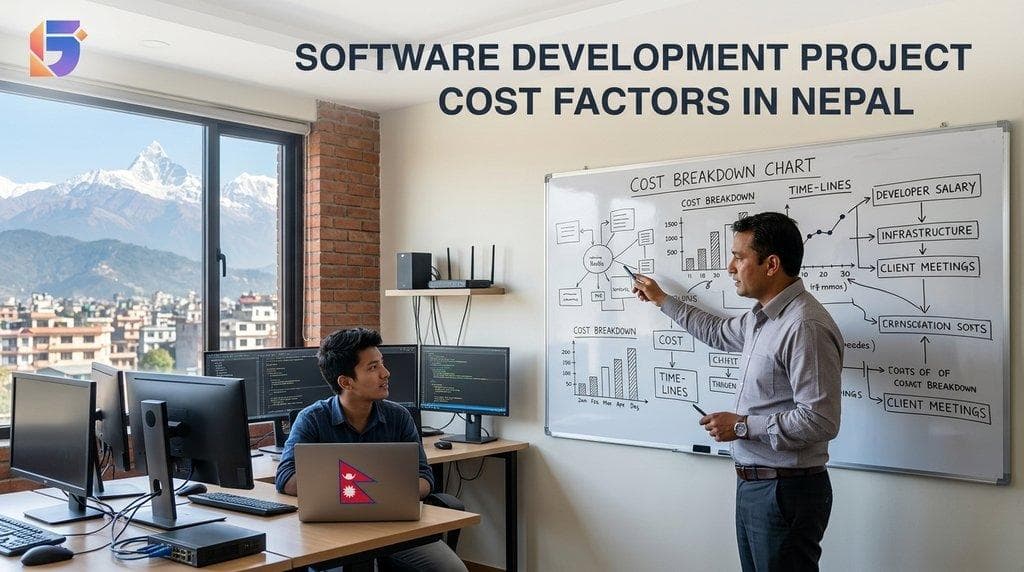
Total Cost of Ownership Matters
ERP pricing should not be evaluated only by asking:
“How much does the software cost?”
Businesses should calculate the Total Cost of Ownership (TCO).
This can include:
- Software subscription or licensing
- Implementation
- Customization
- Data migration
- Training
- Hardware
- Hosting
- Integrations
- Support
- Upgrades
- Additional users
- Future modules
A system that appears inexpensive at the beginning can become costly if every customization requires additional consulting.
Similarly, a higher-priced platform may be worthwhile if it significantly reduces manual work and supports business growth.
ERP Implementation in Nepal: What Businesses Should Expect?
ERP implementation should be treated as a business transformation project rather than simply installing software.
A typical implementation may involve:
1. Requirement Analysis
The implementation team studies current business processes.
2. Process Mapping
Existing workflows are documented and compared with the ERP's capabilities.
3. Configuration
Modules, permissions, tax settings, workflows, reports, and other settings are configured.
4. Data Migration
Existing customer, supplier, inventory, accounting, and employee information is prepared and migrated.
5. User Training
Employees learn how to perform their daily activities in the new system.
6. Testing
Real business scenarios should be tested before going live.
7. Go-Live
The ERP becomes the operational system.
8. Post-Implementation Support
The business continues to receive support, fixes, optimization, and training.
Why ERP Adoption is Becoming More Important in Nepal?
Nepal's broader digital transformation is accelerating.
In February 2026, the World Bank approved $50 million in financing for Nepal's Digital Transformation Project, aimed at strengthening digital public infrastructure and digitizing public services. The project includes areas such as secure government data exchange, digital services, digital credentials, cybersecurity, and data governance.
The World Bank has also identified digital services as an important opportunity for Nepal's future economic growth, while highlighting the need for better infrastructure, skills, regulation, and business competitiveness.
This broader movement toward digital operations makes business systems such as ERP increasingly relevant.
For companies, digital transformation is not only about moving from paper to software.
It is about creating connected, measurable, and data-driven operations.
The Future of ERP in Nepal
ERP systems in Nepal are likely to become increasingly connected with:
- Artificial intelligence
- Business intelligence
- Cloud computing
- Digital payments
- E-invoicing
- Mobile applications
- E-commerce
- Automation
- API integrations
- Data analytics
- Industry-specific applications
The next generation of ERP will increasingly move beyond simply recording transactions.
It will help businesses answer questions such as:
- Which products are selling fastest?
- Which inventory is approaching reorder levels?
- Which customers generate the highest value?
- Where are operational costs increasing?
- Which suppliers perform best?
- Which branches are most profitable?
- Where are production bottlenecks occurring?
- Which business processes can be automated?
This shift from recording information to generating business intelligence will be an important part of ERP adoption.
Frequently Asked Questions (FAQ's):
Q. Which is the best ERP solution in Nepal?
There is no single ERP that is best for every business. OptERP can be a strong option for businesses that prioritize Nepal-focused compliance, customization, and local implementation. ERPNext, Odoo, SAP Business One, Microsoft Dynamics 365 Business Central, and Marg ERP may be suitable for different business sizes and requirements.
Q. Is OptERP suitable for small businesses in Nepal?
OptERP can be suitable for small and growing businesses that need integrated accounting, inventory, sales, HR, procurement, and other business functions. The appropriate configuration depends on the company's size and operational requirements.
Q. Is OptERP IRD compliant?
OptERP's official website describes its SaaS product as IRD-approved and tailored for Nepalese businesses, including tax compliance and government-system integration. Businesses should confirm the exact compliance features included in their selected implementation.
Q. Is ERPNext available in Nepal?
Yes. ERPNext is open-source and can be implemented in Nepal. However, businesses should evaluate the local implementation partner and configure Nepal-specific tax, accounting, reporting, and integration requirements appropriately. ERPNext provides a broad range of accounting, inventory, manufacturing, HR, CRM, and other modules.
Q. Is Odoo suitable for Nepali businesses?
Odoo can be suitable for Nepali businesses because of its broad modular architecture and large application ecosystem. However, businesses should verify the specific Nepal localization, tax configuration, integrations, and implementation support required for their operations.
Q. Is SAP Business One suitable for SMEs?
Yes. SAP Business One is specifically designed for small and midsize businesses and provides financials, purchasing, inventory, sales, CRM, reporting, analytics, and industry-specific functionality.
Q. What should I check before buying an ERP in Nepal?
Businesses should evaluate local tax compliance, accounting, inventory, workflows, integrations, customization, implementation support, security, scalability, data migration, training, and total cost of ownership.
Q. Should a business choose cloud or on-premise ERP?
It depends on the organization's infrastructure, connectivity, security requirements, IT resources, budget, and business model. Cloud ERP can reduce infrastructure management, while on-premise deployment may provide organizations with greater direct control over their infrastructure.
Q. How much does ERP software cost in Nepal?
ERP costs vary significantly depending on the number of users, modules, customization, implementation, integrations, deployment model, support, and vendor. Instead of comparing only license or subscription prices, businesses should compare the total cost of ownership.
Q. How much does ERP software cost in Nepal?
The cost of ERP software in Nepal can range from around NPR 20,000 per year for basic small-business solutions to several lakhs or more for customized ERP implementations. The actual price depends on the number of users, modules, customization, hosting, data migration, implementation, training, and support requirements. Some Nepal-based ERP providers currently publish plans starting around NPR 15,000–20,000 per year, while larger or customized ERP projects can cost significantly more.
Q. What is the average ERP software price in Nepal for small and medium businesses?
For small and medium-sized businesses in Nepal, ERP pricing can commonly fall in the range of NPR 20,000 to NPR 300,000, depending on the software, number of users, modules, and implementation requirements. Basic cloud ERP may have a lower upfront cost, while businesses requiring accounting, inventory, HR, CRM, manufacturing, multiple branches, customization, or integrations may have higher total costs. These are indicative market ranges rather than fixed industry prices.
Q. What factors determine the cost of ERP software in Nepal?
The ERP software cost in Nepal depends on several factors, including the number of users, required modules, cloud or on-premise deployment, customization, data migration, integrations, training, implementation, technical support, and ongoing maintenance. A basic accounting and inventory ERP will generally have different costs from a fully customized ERP covering finance, HR, manufacturing, CRM, supply chain, and multiple branches.
Q. Does OptERP provide industry-specific ERP software in Nepal?
Yes. OptERP can be configured for different industries and business workflows. Geofinity provides specialized solutions covering areas such as healthcare, fertility clinics, manufacturing, education, trading, distribution, and service businesses. This allows organizations to evaluate ERP functionality according to their industry-specific processes rather than relying only on generic accounting or inventory software.
Q. What should businesses consider when choosing cloud-based ERP software in Nepal?
Businesses should evaluate more than the monthly or annual ERP subscription price. Important factors include data security, backups, internet dependency, system availability, user access, integrations, scalability, implementation support, customization, and total cost of ownership. A cloud-based ERP can reduce the need for local infrastructure, but businesses should still verify how their data is hosted, protected, backed up, and recovered.
Final Thoughts: Choosing the Right ERP for Nepal
The best ERP solution in Nepal is not necessarily the platform with the most features.
It is the one that best fits the organization's:
- Business processes
- Industry
- Compliance requirements
- Budget
- Technical capabilities
- Growth plans
- Integration requirements
- Support expectations
OptERP has a strong proposition for Nepali businesses because it combines ERP functionality with a specific focus on Nepal's business environment. Its official platform highlights local tax compliance, cloud-based deployment, accounting, inventory, HR, sales, procurement, and customization.
At the same time, businesses should compare it objectively with alternatives such as ERPNext, Odoo, SAP Business One, Microsoft Dynamics 365 Business Central, and Marg ERP.
The smartest approach is to shortlist two or three platforms, map them against actual business requirements, request demonstrations, test critical workflows, calculate the full cost of ownership, and verify local compliance before making a final decision.
For businesses that want a Nepal-focused, customizable ERP platform with integrated business management capabilities, OptERP deserves a place on that shortlist.
Ready to explore OptERP? Request a demo and evaluate how the platform can be configured around your business requirements.
Click here to explore: OptERP