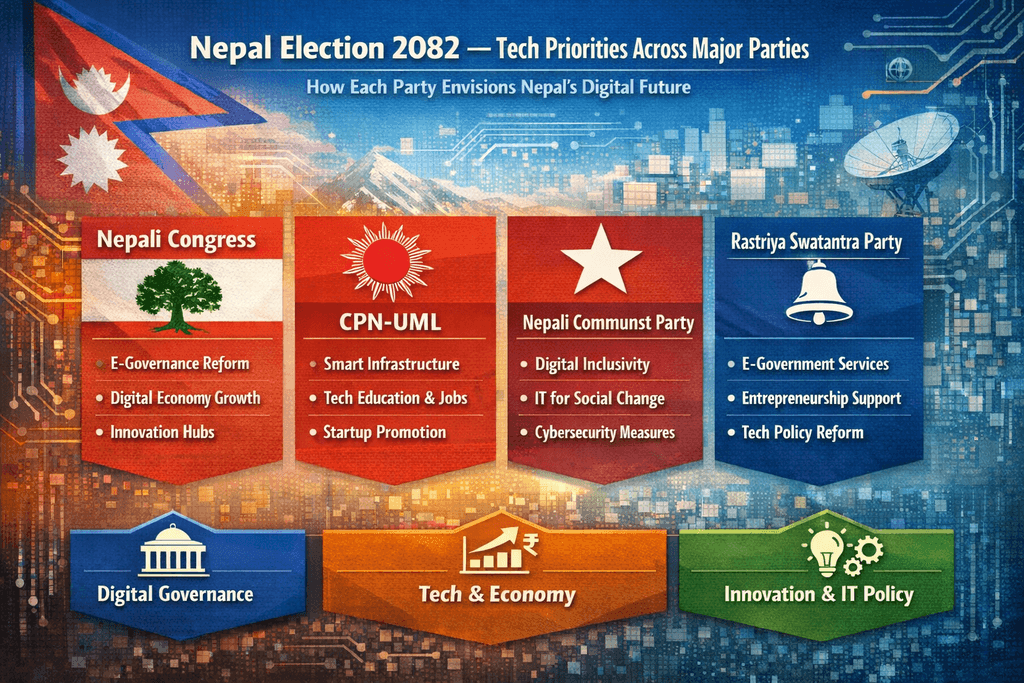
Technology, Digital Governance & the Future of Nepal's Digital Economy
Nepal's Election 2082 (BS), held on 5 March 2026 (Falgun 21, 2082 BS), placed governance, economic growth, employment, accountability, and digital transformation among the issues shaping political debate.
Technology was particularly important because Nepal's future economic opportunities increasingly depend on digital governance, IT exports, artificial intelligence, fintech, connectivity, digital skills, cybersecurity, and technology-enabled employment.
Different political parties approached these issues from different directions. Some emphasized digital government and public-service reform, while others focused more strongly on IT exports, digital employment, technical education, connectivity, or technology-enabled economic growth.
This article provides an analytical comparison of the major parties' technology-related priorities for Nepal Election 2082, based on their published commitments and publicly available policy documents.
Note: This article analyzes the parties' stated priorities during the 2082 BS election. It does not imply that every proposal was implemented after the election.
Nepal Election 2082: Why Technology Matters
Nepal's technology sector is no longer limited to software companies and telecommunications.
Technology increasingly affects:
• Government services
• Banking and financial services
• Education
• Healthcare
• Agriculture
• Tourism
• Manufacturing
• Employment
• International trade
• Public administration
• Cybersecurity
• Artificial intelligence
The political debate around technology therefore represents something larger than an IT policy discussion.
It is increasingly a discussion about:
How Nepal can use technology to improve governance, create jobs, increase productivity and compete globally.
Nepal's Digital Economy Before Election 2082
Nepal entered the 2082 election with a growing digital ecosystem.
Digital payments, mobile banking, internet access, online government services, software development, freelancing, and technology startups have all increased the importance of digital infrastructure.
The next stage of development is moving from digital adoption to digital competitiveness.
Nepal's Digital Transformation Challenge
| Existing Strength | Remaining Challenge |
| Growing internet access | Affordable and reliable high-speed connectivity |
| Increasing digital payments | Greater cross-border payment access |
| Growing IT workforce | Advanced AI and emerging-tech skills |
| Online government services | Interoperable digital government |
| Digital setups | Easier access to capital |
| Freelancing | Stronger digital-export infrastructure |
| National digital identity | Broader service integration |
| AI experimentation | Responsible AI governance |
| Digital businesses | Stronger data protection |
| Technology adoption | Strong cybersecurity |
Tech Priorities: Party‑by‑Party Overview

1. Nepali Congress (NC)
Core Technology Focus
Institutional digitization, Digital Nepal implementation, IT education, economic digitization and governance reform.
The Nepali Congress positioned technology within a broader framework of governance, economic modernization and a knowledge-based economy.
Its 2082 election commitments included themes around digitizing approval processes, improving the business environment, and developing IT and knowledge-based economic opportunities.
Key Technology Priorities:
• Expansion of Digital Nepal and digital public services
• Greater use of technology for government services
• Digitization of administrative and approval processes
• Development of IT and knowledge-based industries
• Technology-focused skills development
• Digital infrastructure and connectivity
• Greater use of technology in economic development
The party's manifesto specifically places IT, electric transportation and agricultural technology within a public-private skills-development agenda.
Technology Opportunity
The strongest potential impact of this approach would be connecting:
Digital Government + IT Skills + Private Sector + Knowledge Economy

2. Rastriya Swatantra Party (RSP)
Core Technology Focus
Digital-first government, digital economy, remote work, IT exports and technology-enabled governance.
RSP placed technology more directly at the center of its economic and governance agenda.
Its election commitments included legal recognition for remote work, digital jobs and cross-border service exports, as well as measures aimed at attracting digital nomads through appropriate visas, residency options and shared workspaces.
Key Technology Priorities:
• Paperless government
• Digital-first public service delivery
• Integrated government databases
• Remote work recognition
• Digital jobs
• Cross-border digital service exports
• Digital-nomad attraction
• Stronger data infrastructure
• Data security
• Technology-driven economic growth
Why RSP's Approach Stands Out ?
RSP's technology vision connects digital governance directly with employment and exports.
Instead of treating technology only as a government modernization tool, the approach positions technology as an economic engine.
The proposed chain is:
Digital Infrastructure → Digital Jobs → Global Services → Foreign Income → Economic Growth

3. CPN (Unified Marxist–Leninist / UML)
Core Technology Focus
ICT-based public-service reform, connectivity, digital education and technology-enabled economic growth.
The CPN-UML's official 2082 manifesto was published under the theme “Prosperous Nepal, Happy Nepalis.”
Key Technology Priorities:
• Online delivery of public services
• Digital government systems
• Affordable communication infrastructure
• Expanded internet access
• Digital education
• Technology-enabled economic development
• IT-sector employment
• Digital infrastructure expansion
The party's broader employment agenda also emphasized substantial IT-sector job creation, making technology part of its employment strategy.
Technology Opportunity
UML's approach can be summarized as:
Connectivity + Digital Public Services + Skills + IT Employment
The major challenge would be ensuring that digital infrastructure translates into productive employment and internationally competitive technology businesses.

4. Nepal Communist Party (Socialist / Maoist Centre / NCP)
Core Technology Focus
Science and technology development, digital transformation, ICT infrastructure and technology-enabled public services.
The Nepal Communist Party's election platform emphasized broader economic and social transformation, including technology and digital development.
Key Technology Priorities:
• Long-term ICT development
• Digitalization of government services
• Technology in healthcare
• Technology in education
• Technology in infrastructure
• Science and technology investment
• Technology-oriented industrial development
• Digital monitoring systems
• Digital literacy
• Technology hubs and knowledge infrastructure
The party's official materials also contain dedicated science-and-technology resources and publications addressing ICT and digital literacy.
Technology Opportunity
The NCP approach places technology within a broader state-led development and production strategy.
The potential model is:
Science + Technology + Industry + Infrastructure

5. Ujyalo Nepal Party (emerging/tech‑aware)
Core Technology Focus
Digital administration, transparent governance, innovation and technology-enabled public services.
Ujyalo Nepal's official 2082 election commitment document explicitly highlights citizen-friendly service delivery and digital and transparent administration.
Key Technology Priorities:
• Digital public administration
• Transparent government services
• Citizen-oriented digital services
• Technology and innovation
• Digital democracy
• Technology-enabled entrepreneurship
• Digital engagement with citizens
The party's official documents also identify technology, innovation and entrepreneurship among its broader priorities.
Important Context
Compared with some larger parties, Ujyalo Nepal's technology agenda was less extensively articulated in the public material available at the time of analysis.
Therefore, technology-related claims should be presented carefully rather than treating inferred priorities as fully developed technology policies.

6. Rastriya Prajatantra Party (RPP)
Core Technology Focus
Digital economy, technology-enabled development, smart cities and IT-sector incentives.
RPP published its Sankalpa Patra 2082 as part of its official election documents.
Key Technology Priorities:
• Digital Nepal implementation
• Smart cities
• Smart villages
• IT-sector development
• Software-export incentives
• Digital payments
• Communication infrastructure
• Technology-enabled economic growth
Technology Opportunity
RPP's technology agenda is particularly relevant to the digital-export economy, where software and IT-enabled services can generate international revenue.

7. Shram Sanskriti Party (SSP)
Core Technology Focus
Technical education, engineering and workforce development.
Compared with parties that published more detailed digital-government or technology-export agendas, SSP's technology emphasis was more strongly connected to education and technical skills.
Key Technology Priorities:
• Technical education
• Engineering education
• Vocational skills
• Workforce development
• Technology-related education
The party's broader election platform placed significant emphasis on restructuring education and developing a stronger culture of work.
Technology Opportunity
The underlying idea is important:
A technology economy cannot grow without a technology-skilled workforce.
Nepal's long-term digital competitiveness therefore depends not only on software companies and infrastructure but also on education.
Comparison Table: Tech Priorities Across Parties
| Party | 🏛️ Digital Governance & e‑Gov | 💻 IT Economy & Exports | 🤖 AI / Innovation | 📡 Connectivity / Broadband | 📊 Data Security / Digital IDs |
| NC | ✔️ Strong | ✔️ Skills & knowledge economy | ⚙️ Emerging | ✔️ Support | ⚙️ Governance focus |
| RSP | ✔️ Strong | ✔️ Strong digital-export focus | ✔️ Technology-driven | ✔️ Strong | ✔️ Strong |
| CPN‑UML | ✔️ Strong | ✔️ IT employment | ⚙️ Developing | ✔️ Strong | ✔️ Support |
| NCP / Maoist | ✔️ Strong | ✔️ Technology/industry | ✔️ Science & technology | ✔️ Support | ✔️ Strong |
| Ujyalo Nepal | ✔️ Digital administration | ⚙️ Entrepreneurship | ⚙️ Innovation | ⚙️ Support | ✔️ Digital administration |
| RPP | ✔️ Digital Nepal | ✔️ IT/software exports | ⚙️ Limited | ✔️ Support | ⚙️ Digital payments |
| SSP | ⚙️ Limited | ⚙️ Skills-focused | ⚙️ Indirect | ⚙️ Education-focused | ⚙️ Limited |
Legend:
✔️ = Explicit/strong priority
⚙️ = Mentioned, supporting or developing priority
What Do the Parties Agree On?
Despite ideological and political differences, several technology themes appear repeatedly.
1. Digital Government
Most major parties recognize the need to move government services online.
The broader direction is:
Paper-based Government → Digital Government → Integrated Digital Government
2. IT Jobs and Digital Employment
Technology is increasingly viewed as a potential source of domestic employment.
This is particularly important as Nepal faces continued pressure from youth migration and foreign employment.
RSP explicitly included remote work and digital jobs, while UML's platform included a major IT-sector employment target.
3. Connectivity
Internet access is no longer simply a communications issue.
It is economic infrastructure.
Reliable connectivity enables:
• Remote work
• Online education
• Digital banking
• E-commerce
• Telemedicine
• Government services
• Software development
• Digital tourism
4. Digital Skills
Technology policies cannot succeed without skilled people.
Across different party approaches, education, technical skills and IT-sector employment emerge as important themes.
Nepal therefore needs to move from:
Basic Digital Literacy → Technical Skills → Advanced Technology Skills → Global Digital Competitiveness
5. Data and Digital Infrastructure
Data is becoming increasingly important for:
• AI
• Healthcare
• Finance
• Government
• Research
• Business intelligence
• Public policy
This makes data protection, cybersecurity and interoperability increasingly important components of Nepal's digital future.
Where the Parties Differ ?
The biggest differences are not necessarily whether technology matters.
They are about how technology should be used.
| Policy Direction | Stronger Emphasis |
| Digital-first government | RSP |
| IT exports & digital jobs | RSP / RPP |
| Institutional digitization | NC |
| Connectivity & public infrastructure | UML |
| State-led science & technology | NCP |
| Digital administration & innovation | Ujyalo Nepal |
| Technical education | SSP |
| Smart cities | RPP |
This suggests that Nepal's technology debate is evolving from:
“Should Nepal digitize?”
to:
“What kind of digital economy should Nepal build?”
Technology Priorities That Should Go Beyond Elections
Political manifestos provide direction, but technology policy needs continuity.
A national digital strategy should ideally survive changes in government.
Five Areas Requiring Long-Term Continuity
➜ Digital public infrastructure
➜ Cybersecurity
➜ Data protection
➜ Digital skills
➜ IT and digital-service exports
These areas should not be reinvented every election cycle.
What Nepal's Next Digital Government Should Look Like
A future-ready government could connect:
Digital Identity
↓
Citizen Authentication
↓
Government Service Portal
↓
Interoperable Ministries
↓
Digital Payments
↓
Digital Documents
↓
Government Data Infrastructure
↓
Analytics & AI
Instead of citizens repeatedly submitting the same information to different government offices, authorized systems should be able to securely exchange verified information.
Watch out: National Digital Identity in Nepal
Get more knowledge here: Digital Government in Nepal
From IT Sector to Digital Economy
Nepal's technology strategy should also move beyond simply creating more software developers.
The bigger objective should be creating a complete digital economy.
The Digital Economy Ecosystem
| Layer | Examples |
| Infrastructure | Internet, cloud, data centers |
| Skills | Developers, AI engineers, cybersecurity professionals |
| Finance | Digital payments, fintech, venture capital |
| Businesses | SaaS, software, IT services |
| Government | Digital public services |
| Innovation | AI, robotics, fintech |
| Exports | Software and digital services |
| Regulation | Data protection, cybersecurity, AI governance |
This creates a much broader opportunity than the traditional definition of Nepal's IT sector.
AI: The Missing Piece in Many Political Discussions
Artificial intelligence is likely to become one of the most important technologies affecting Nepal over the coming decade.
Potential applications include:
• AI-assisted government services
• Agriculture forecasting
• Healthcare support
• Education technology
• Fraud detection
• Financial services
• Tourism personalization
• Nepali-language AI
• Disaster management
Nepal has already moved toward formal AI policy through the National Artificial Intelligence Policy 2082.
The next challenge is turning policy into:
Research → Startups → Products → Exports → Economic Value
Cybersecurity Should Become a National Priority
As Nepal becomes more digital, cyber risk also increases.
A digital economy requires trust.
That means Nepal needs stronger capabilities around:
• Cybersecurity
• Data protection
• Critical infrastructure protection
• Incident response
• Digital fraud prevention
• Government system security
• Cloud security
• Cyber awareness
Digital transformation without cybersecurity can create new vulnerabilities.
The Biggest Question: Can Nepal Execute?
The biggest challenge may not be creating technology policies.
It may be implementation.
Nepal has already produced numerous digital strategies, policies and initiatives.
The next question is whether those commitments can become measurable outcomes.
From Manifesto to Results
Election Promise
↓
Policy
↓
Law
↓
Budget
↓
Institution
↓
Implementation
↓
Measurable Outcome
This is where Nepal's digital transformation will ultimately be judged.
How to Measure a Government's Technology Performance
Instead of measuring success through the number of applications launched, Nepal should measure actual outcomes.
| Area | Possible KPI |
| Digital government | % of services completed fully online |
| Digital identity | % of eligible citizens using digital authentication |
| IT exports | Annual growth in digital-service exports |
| Employment | New technology jobs created |
| Startups | Technology startups established |
| AI | AI companies/research projects |
| Connectivity | Broadband quality and affordability |
| Cybersecurity | Incident response time |
| Digital payments | Growth in digital transactions |
| Education | Advanced-tech graduates |
| FDI | Technology-sector investment |
| Remote work | Digital-service workers/exporters |
This changes the question from:
“Did the government launch a digital platform?”
to:
“Did the platform actually improve people's lives?”
Post-Election Context: What Happened in Election 2082?
Because this article was originally published around the election period, it is useful to distinguish pre-election promises from the actual election result.
Nepal's Election Commission reports that the House of Representatives election was completed on 21 Falgun 2082, corresponding to 5 March 2026. The final FPTP results recorded 125 seats for Rastriya Swatantra Party, 18 for Nepali Congress, 9 for CPN-UML, 8 for the Nepali Communist Party, 3 for Shram Sanskriti Party, 1 for Rastriya Prajatantra Party, and 1 independent.
For the proportional representation component, the Election Commission allocated seats among six parties: RSP 57, Nepali Congress 20, CPN-UML 16, Nepali Communist Party 9, SSP 4 and RPP 4.
Final Parliamentary Picture
| Party | FPTP Seats | PR Seats |
| Rastriya Swatantra Party | 125 | 57 |
| Nepali Congress | 18 | 20 |
| CPN-UML | 9 | 16 |
| Nepali Communist Party | 8 | 9 |
| Shram Sanskriti Party | 3 | 4 |
| Rastriya Prajatantra Party | 1 | 4 |
| Independent | 1 | — |
The result makes the technology-policy question even more relevant: which digital priorities will move from election commitments into actual government programs?
What Should Voters and Citizens Watch Next?
The most useful way to evaluate technology promises after an election is to track implementation.
1. Digital Government
Are more government services actually becoming fully digital?
2. International Payments
Are freelancers and digital businesses getting better access to global markets?
3. IT Exports
Is Nepal increasing its software and digital-service exports?
4. Digital Jobs
Are technology policies creating jobs inside Nepal?
5. AI
Is Nepal moving from AI discussions toward actual research, products and responsible deployment?
6. Cybersecurity
Are government and critical infrastructure becoming more resilient?
7. Digital Education
Are universities and schools producing skills that the global technology market needs?
8. Data Protection
Are citizens gaining stronger protection over their personal information?
These are more meaningful indicators than simply counting policy announcements.
The Bigger Opportunity for Nepal
The 2082 election demonstrates that technology has become increasingly integrated into Nepal's political and economic conversation.
But Nepal's opportunity extends beyond government digitization.
The country could potentially build a digital economy around:
✔ Global IT Services: Software development, outsourcing and digital agencies.
✔ Remote Work: Nepali professionals working for international companies while remaining in Nepal.
✔ AI: AI products, research and Nepali-language technologies.
✔ Fintech: Digital payments, financial inclusion and financial technology.
✔ Digital Government: Technology-enabled public services.
✔ SaaS: Nepalese companies developing software products for international markets.
✔ Technology Tourism: Attracting remote professionals, entrepreneurs and technology communities.
Frequently Asked Questions (FAQs)
Q. What was Nepal Election 2082?
Nepal Election 2082 refers to the 2026 House of Representatives election held on 5 March 2026 (21 Falgun 2082 BS). The Election Commission subsequently published the final results.
Q. Which political party had the strongest technology-focused agenda?
RSP had one of the more explicit technology-oriented agendas, particularly around digital government, remote work, digital jobs and cross-border digital services. Other parties also included significant technology, education, connectivity or digital-governance commitments.
Q. What were the major technology priorities in Nepal Election 2082?
Major themes included:
• Digital government
• IT jobs
• Digital exports
• Connectivity
• Technical education
• Data infrastructure
• Digital payments
• AI and innovation
• Cybersecurity
• Digital public services
Q. Why is digital governance important for Nepal?
Digital governance can reduce paperwork, improve service accessibility, reduce administrative friction and allow government agencies to exchange information more efficiently.
Q. Which parties emphasized IT jobs?
IT employment and digital economic opportunities featured particularly strongly in RSP and UML-related commitments, while other parties also included technology, skills and employment within broader economic plans.
Q. Did political parties propose AI policies?
AI and innovation appeared to varying degrees across party platforms. However, AI policy should also be considered alongside Nepal's national-level National Artificial Intelligence Policy 2082.
Q. What is Nepal's biggest technology challenge?
One of the biggest challenges is implementation. Policies need to translate into legislation, budgets, infrastructure, institutions and measurable outcomes.
Q. Can Nepal become a global IT hub?
Nepal has potential to grow as a digital-services and IT-export destination, but doing so requires improvements in international payments, infrastructure, skills, cybersecurity, data protection, investment policy and regulatory predictability.
Q. How can Nepal create more technology jobs?
Nepal can combine advanced technical education with startup support, IT exports, remote work, digital infrastructure, investment and industry-academic collaboration.
Q. Why are international payments important to Nepal's technology sector?
Software companies, freelancers, SaaS businesses and digital-service providers need efficient ways to participate in international commerce. Better payment infrastructure can therefore support digital exports.
Q. What should Nepal prioritize after Election 2082?
A practical technology agenda could prioritize:
- Digital government
- International digital payments
- Data protection
- Cybersecurity
- Digital skills
- IT exports
- AI innovation
- Startup investment
Q. Should technology policy change after every election?
Ideally, core digital infrastructure, cybersecurity, data governance, digital identity and technology education should have long-term continuity beyond individual governments.
Conclusion: The Tech Landscape of Nepal’s 2082 Election
Across Nepal's political spectrum, technology is no longer optional.
The 2082 election demonstrated that digital transformation has become connected to some of the country's biggest challenges:
• Economic growth
• Youth employment
• Government efficiency
• Public-service delivery
• Global competitiveness
• Education
• Financial inclusion
The parties differed in emphasis.
➞ NC focused on institutional digitization and a knowledge-based economy.
➞ RSP placed strong emphasis on digital-first government, remote work and digital exports.
➞ CPN-UML connected technology with connectivity, public services and IT employment.
➞ NCP approached technology through broader science, infrastructure and development priorities.
➞ Ujyalo Nepal emphasized digital and transparent administration alongside innovation.
➞ RPP highlighted digital economy, smart-city concepts and IT-related incentives.
➞ SSP placed stronger emphasis on technical education and skills.
But the most important question is no longer what political parties promised during the election.
It is:
What will actually be implemented?
Nepal's digital future will not be determined by manifestos alone.
It will be determined by whether the country can transform:
Policies → Laws → Infrastructure → Skills → Businesses → Jobs → Exports
The opportunity is enormous.
Nepal can become a stronger digital-services economy, technology-enabled society and regional innovation ecosystem—but only if technology policy is backed by consistent execution.
The future of Nepal's digital economy will depend not only on who governs, but on how effectively technology is turned into measurable economic and social outcomes.