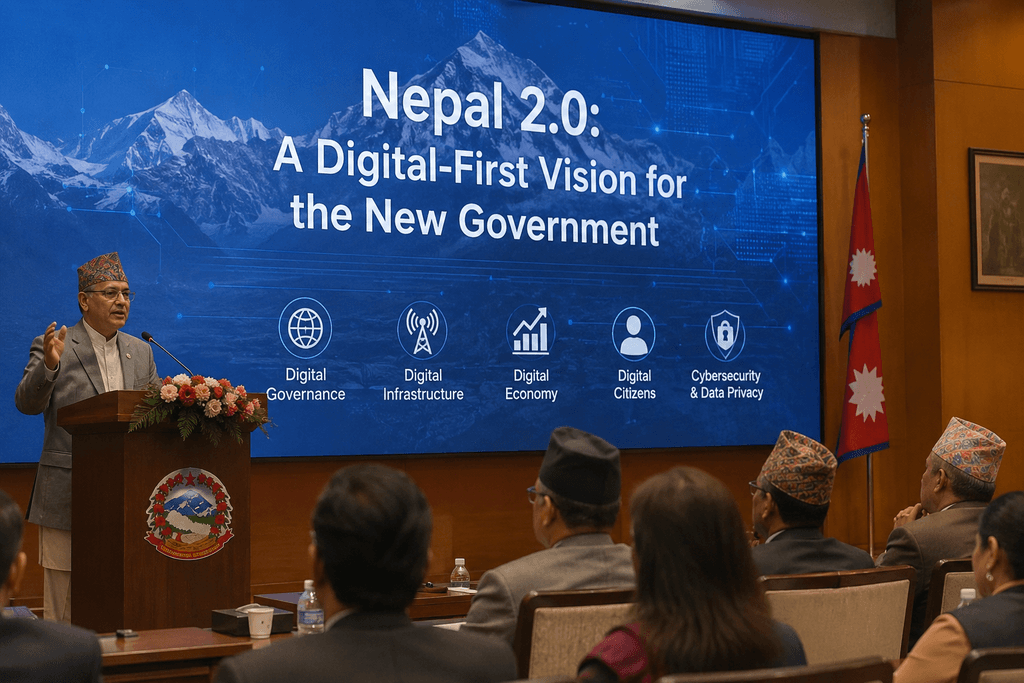
Nepal 2.0: A Digital-First Vision for the New Government
Nepal is now ready to move beyond the label of a “developing country” , not through traditional methods, but through a technological leapfrog.
Expectations from the new government should not be limited to roads, bridges, and buildings. The time has come to invest in data, digital infrastructure, and decentralization.
The Shift We Need: Analog Bureaucracy → Digital Governance
Nepal’s problem is not a lack of resources; it is the inefficiency of its systems.
We need to move from a paperwork-driven bureaucracy to a technology-enabled, citizen-centric government.
Imagine a Nepal where:
▸ Citizen services are fully online, accessible 24/7, with no unnecessary physical queues.
▸ Government data is secure, interoperable, transparent, and available in real time where appropriate.
▸ Policy decisions are evidence and data-driven rather than politically reactive.
▸ Government systems communicate with one another, so citizens do not have to repeatedly submit the same information.
▸ Public spending and projects can be digitally tracked, improving transparency and accountability.
▸ Digital services are designed to be accessible even to citizens with limited digital literacy or connectivity.
The Case for Digital Government in Numbers
Nepal already has a substantial digital foundation to build upon. The Nepal Telecommunications Authority reported more than 42.7 million broadband subscriptions in its November 2024 management information report, including more than 25.2 million 4G subscriptions. Because subscriptions can include multiple connections per person and the penetration figure exceeds 100%, these numbers should not be interpreted as unique individual users.
Digital financial services are also becoming deeply established. Nepal Rastra Bank's 2024/25 annual report recorded approximately 26.77 million wallet users, 27.74 million mobile-banking users, and 2.22 million internet-banking users by mid-July 2025.
| Digital Indicator | Latest Reported Figure |
| Broadband subscriptions | 42.7+ million |
| 4G subscriptions | 25.2+ million |
| Wallet users | 26.76+ million |
| Mobile banking users | 27.74+ million |
| Internet banking users | 2.21+ million |
These figures show that Nepal is not starting digital transformation from zero. The opportunity is to connect existing digital adoption with interoperable public services, secure digital identity, open data, and better government systems.
Expectation: “Digital by Default” Government
Every ministry and government agency should operate as a technology-enabled public service platform, not a paperwork-driven office.
But digital transformation should not simply mean putting paper forms online. It should mean redesigning government processes to make them faster, simpler, transparent, interoperable, and citizen-centric.
Build once. Integrate everywhere. Serve citizens digitally by default.
What Does “Digital by Default” Actually Mean?
| Traditional Government | Digital-by-Default Government |
| Physical forms | Digital forms |
| Repeated document submission | Resuable verified information |
| Office visits | Online services |
| Manual verification | Digital verification |
| Department-specific databases | Interoperable systems |
| Paper-based approvals | Digital workflows |
| Manual status checking | Real-time service tracking |
| Reactive administration | Data-driven decision-making |
| Limited public visibility | Digital transparency |
The goal should not be to eliminate physical services overnight. Instead, Nepal should build digital-first services with inclusive alternatives for citizens who face connectivity, accessibility, language, or digital-literacy barriers.
5 Bold Tech Expectations from the New Government
1. National Digital Identity Ecosystem
Not just a citizenship card but a secure, interoperable digital identity that allows citizens to access public services through a single trusted identity.
The Department of National ID and Civil Registration itself describes the National Identity Card as a digital solution for identity authentication that can be connected with public services.
Expectation:
✔ One digital identity for government services.
✔ Single sign-on for public services, reducing repeated registrations and paperwork.
✔ Securely connect relevant government systems across health, taxation, education, social security, and other services.
✔ Consent-based data sharing, so citizens have greater control over how their information is accessed.
✔ Real-time verification to reduce duplicate records, identity fraud, and administrative delays.
✔ Strong privacy and cybersecurity safeguards must be built into the system from the beginning.
Result: Less paperwork, faster services, fewer opportunities for middlemen and fraud, and greater government accountability.
Digital Identity: From Card to Public-Service Infrastructure
A digital identity ecosystem should go beyond simply issuing an identity number or physical card.
| Layer | Purpose |
| Digital Identity | Establish a trusted digital identity |
| Authentication | Verify that a person is who they claim to be |
| Single Sign-On | Reduce repeated registrations |
| Consent Management | Give citizens control over data access |
| Interoperability | Allow authorized systems to communicate |
| Audit Trails | Record access and transactions |
| Privacy Controls | Reduce misuse of sensitive information |
| Service Integrations | Connect identity with public services |
The long-term objective should be “tell government once”: citizens should not repeatedly submit information that the government already holds and is legally permitted to reuse.
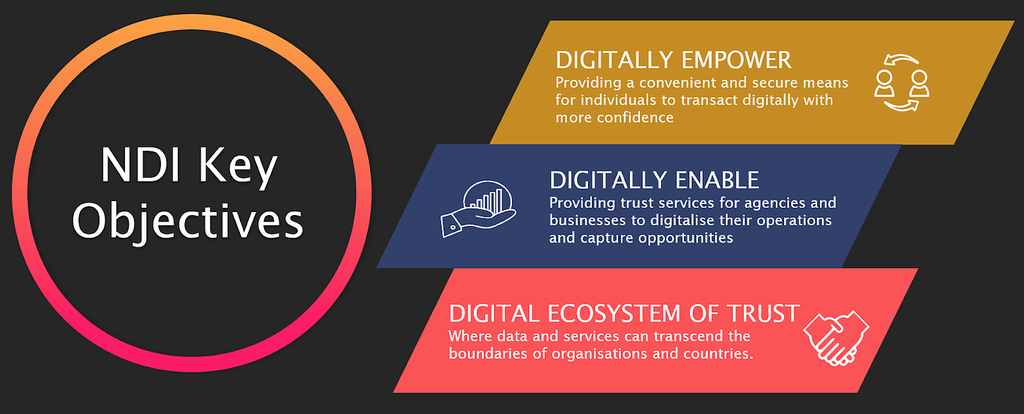
Medium: GovTech’s NDI Team
2. Open Banking + Fintech Sandbox
Nepal’s financial innovation should not be held back by regulatory uncertainty and slow approval processes. The goal should be to create a regulatory environment where new financial technologies can be tested safely, scaled quickly, and integrated with the existing financial system.
Expectation:
✔ Open APIs for banks and financial institutions to enable secure integration with fintech platforms.
✔ Regulatory sandbox where startups can test innovative financial products under controlled supervision.
✔ Faster digital payment infrastructure that enables seamless, low-cost transactions.
✔ Clear regulations for digital lending, embedded finance, fintech, and emerging financial technologies.
✔ Strong consumer protection, cybersecurity, and data-privacy standards alongside innovation.
✔ Easier integration between banks, digital wallets, payment platforms, and investment services.
Result: Turn Nepal’s digital financial ecosystem from a payment network into a pathway for saving, investing, and productive capital formation.
Nepal’s Digital Payment Momentum
Nepal’s financial system already shows significant digital adoption. According to Nepal Rastra Bank’s 2024/25 Annual Report, wallet users increased from approximately 23.46 million to 26.77 million between mid-July 2024 and mid-July 2025, while mobile-banking users increased to approximately 27.74 million.
| Indicator | Mid-July 2024 | Mid-July 2025 | Growth |
| Wallet Users | 23.46M | 26.77M | 14.09% |
| Mobile Banking Users | 24.65M | 27.74M | 12.55% |
| Internet Banking Users | 1.92M | 2.22M | 15.63% |
| connectIPS Users | 1.28M | 1.44M | 12.89% |
The next opportunity is therefore not simply more digital payments. It is building a financial ecosystem where digital infrastructure supports saving, investment, business creation, financial inclusion, and productive capital formation.

3. Remote Work Nation Strategy
Nepal may be geographically small, but digital work makes economic participation borderless. Instead of treating remote work simply as a lifestyle trend, Nepal can turn it into a strategy for attracting foreign income, retaining skilled talent, and spreading economic activity beyond Kathmandu.
Expectation:
✔ Introduce a clear Digital Nomad Visa / Remote Worker Residence Permit with a simple, predictable application process.
✔ Create competitive tax rules and incentives for qualified remote workers and foreign-income earners.
✔ Build rural and regional co-working hubs with reliable high-speed internet, electricity, and essential digital infrastructure.
✔ Expand nationwide high-speed broadband and 5G connectivity so remote work is not limited to Kathmandu.
✔ Create pathways for Nepali freelancers and remote workers to earn foreign currency and export digital services.
✔ Encourage international companies to hire and collaborate with Nepali talent remotely.
✔ Develop digital-work hubs in cities and tourism destinations beyond Kathmandu to distribute economic activity.
Progress:
➤ The government has already moved toward making remote work and the digital economy part of its broader economic agenda. Its 2026–27 policy programme includes plans for a legal framework that would allow Nepalis to work remotely from Nepal for foreign employers.
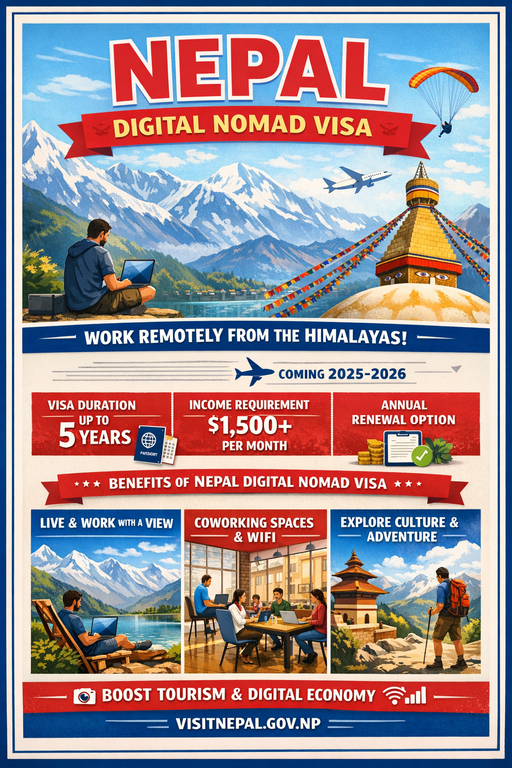
➤ A proposed digital-nomad framework has also included features such as a five-year multiple-entry visa, a $1,500+ monthly income threshold or qualifying bank balance, health-insurance requirements, residential approval, and the ability to open Nepali bank accounts. These should be treated as proposed framework details rather than assumed final operating rules until the relevant regulations are formally implemented.
Result: Brain Drain → Brain Retention → Brain Gain
Foreign jobs don't have to mean foreign locations.
Remote Work Opportunity
| Area | Potential Economic Impact |
| Nepali freelancers | Increase foreign-income earnings |
| Remote employees | Retain skilled workers in Nepal |
| International companies | Access Nepali talent |
| Regional cities | Distribute economic activity |
| Tourism destinations | Attract long-stay digital workers |
| Coworking hubs | Build local digital ecosystems |
| IT services | Increase service exports |
| Tax formalization | Bring remote income into the formal economy |
The government's 2026–27 policy programme explicitly places digital trade, remote work, and information-technology-based service exports within its broader economic transformation agenda.
4. Open Data Economy
The government holds enormous amounts of data across healthcare, agriculture, tourism, transportation, education, demographics, and public spending. But data has little economic value when it remains fragmented, inaccessible, or trapped inside government offices.
Nepal should treat high-quality public data as digital infrastructure much like roads, electricity, and telecommunications.
Expectation:
✔ Make non-sensitive government datasets openly accessible through a centralized national data portal.
✔ Publish data in machine-readable, standardized formats with APIs not just PDFs.
✔ Open datasets across agriculture, tourism, health, education, transportation, demographics, and public expenditure.
✔ Establish clear rules for privacy, anonymization, data ownership, and responsible data use.
✔ Provide APIs for real-time or frequently updated datasets wherever practical.
✔ Encourage startups, researchers, universities, and developers to build products and services using public data.
✔ Launch government data challenges and innovation grants to solve real public problems using data.
✔ Make government datasets more interoperable so different agencies can share and use information efficiently.
Result: Don’t let government data sit in databases, turn it into infrastructure for innovation.
From Government Data to an Open Data Economy
| Data Sector | Potential Digital Uses |
| Agriculture | Crop intelligence, market information, weather tools |
| Tourism | Destination analytics and travel services |
| Healthcare | Public-health planning and research |
| Education | Resource and enrollment planning |
| Transportation | Mobility and infrastructure planning |
| Demographics | Evidence-based policy |
| Public spending | Transparency and accountability |
| Disaster data | Early-warning and response systems |
Nepal already has examples of public-sector geospatial data infrastructure. The National Geoportal provides government geospatial datasets, metadata, data downloads, and geospatial applications.
This demonstrates that the challenge is not simply collecting data. The larger opportunity is making data discoverable, standardized, interoperable, reusable, and responsibly accessible.
5. AI for Public Services
AI is no longer a luxury, it is a tool for better governance.
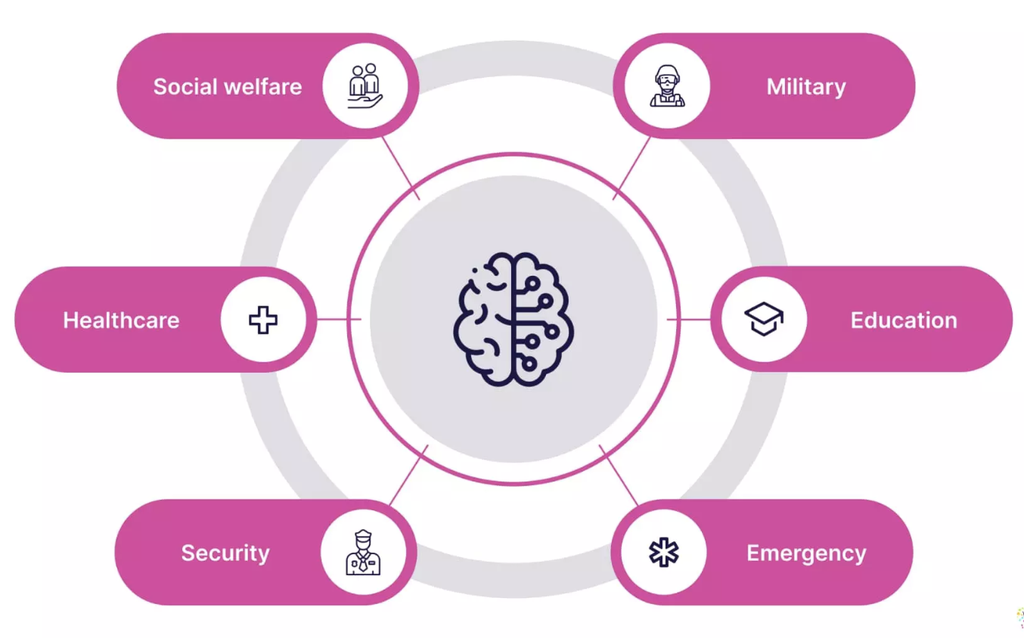
Nepal should use AI to make public services faster, more accessible, proactive, and data-driven while keeping human oversight at the center of important decisions.
Nepal now has a National Artificial Intelligence Policy, 2082, published by the Ministry of Communication and Information Technology, providing a formal policy foundation for the country's AI direction.
Expectation:
✔ AI-powered citizen assistants for 24/7 government information, service guidance, and basic queries.
✔ Predictive analytics for disaster management to improve early warning and emergency response.
✔ Smart agriculture recommendations based on weather, soil, crop, and market data.
✔ AI-assisted policy analysis to help government identify trends and make evidence-based decisions.
✔ Automated routine government processes to reduce paperwork and administrative workload.
✔ Nepali-language AI services to make digital government more accessible to citizens.
Result: Faster Services → Smarter Decisions → Better Governance
AI in Public Services: Where It Can Help
| Government Area | Potential AI Application |
| Citizen services | AI assistant and service guidance |
| Disaster management | Risk analysis and early-warning support |
| Agriculture | Crop, weather, and market insights |
| Healthcare | Administrative and analytical support |
| Taxation | Anomaly and compliance analysis |
| Transportation | Traffic and mobility analytics |
| Education | Personalized digital learning support |
| Policy | Trend analysis and scenario modeling |
| Language access | Nepali-language digital services |
AI should not mean automating every government decision. High-impact decisions involving rights, benefits, healthcare, taxation, law enforcement, or public eligibility should retain appropriate human oversight, accountability, transparency, and appeal mechanisms.
The Digital Government Stack Nepal Should Build
The five expectations above are strongest when treated as one connected digital ecosystem, rather than five independent projects.
| Layer | Digital Infrastructure |
| Identity | National Digital Identity |
| Access | Single Sign-On / Citizen Portal |
| Payments | Digital Payments / Open Banking |
| Data | Government Data Platforms |
| Interoperability | APIs and data exchange |
| Intelligence | AI and Analytics |
| Services | Digital Government Applications |
| Security | Cybersecurity & Privacy |
| Infrastructure | Cloud, Connectivity & Data Centers |
| Governance | Policies, Standards & Accountability |
The principle should be:
Identity → Authenticate → Access Data → Process Service → Pay → Track → Analyze
That is how Nepal can move from isolated digital projects toward genuine digital public infrastructure.
What Should STOP Immediately ?
❌ Paper-first bureaucracy : stop requiring physical documents when secure digital alternatives are available.
❌ Opaque, manual processes : reduce unnecessary human intervention in approvals and processes where automation can improve transparency and accountability.
❌ Short-term technology projects : stop building isolated systems without interoperability, maintenance plans, measurable outcomes, and long-term ownership.
❌ Political appointments in technical roles : critical technology positions should be filled based on competence, experience, and merit, not political affiliation or connections.
❌ Building systems that cannot talk to each other : government platforms should be designed for interoperability from day one.
❌ Digitizing inefficient processes without redesigning them : putting a paper form online does not automatically create digital government.
What Nepal Should Replace Them With?
| Stop | Replace With |
| Paper-first | Digital-first |
| Manual approvals | Digital workflows |
| Isolated databases | Interoperable platforms |
| Short-term projects | Long-term digital infrastructure |
| Political technical appointments | Merit-based technical leadership |
| PDF-only data | Machine-readable APIs |
| Reactive policy | Evidence-based policy |
| Repeated documents | Once-only data submission |
| Closed systems | Secure interoperable systems |
The Real Opportunity
Nepal does not need to become the next Silicon Valley.
It needs to become the best version of a digitally enabled Nepal leveraging its young workforce, growing digital infrastructure, geographic diversity, and ability to adopt new technologies without being tied to legacy systems.
Nepal can become:
- 🌍 A Global Remote Work & Digital Services Hub: Connecting Nepali talent with global companies while bringing foreign income into the country.
- 💳 A Fintech Innovation Lab: Creating a regulatory environment where startups can experiment, scale, and build solutions for Nepal and similar emerging markets.
- 🏛️ A Digital Governance Model for Developing Nations: Demonstrating how a developing country can use digital identity, open data, AI, and interoperable public services to deliver government more efficiently.
- 🚀 A Technology Leapfrog Economy: Skipping inefficient legacy systems and adopting modern digital infrastructure directly where practical.
The question is no longer whether Nepal can afford to go digital.
The question is whether Nepal can afford not to.
What Could Nepal 2.0 Look Like by 2030?
The objective should be measurable. “Digital transformation” should not remain a slogan.
| Area | Possible 2030 Direction |
| Government services | Majority of routine services digitally accessible |
| Digital identity | Widely usable across public services |
| Payments | Digital-first public transactions |
| Government data | Standardized and API-accessible where appropriate |
| AI | Responsible AI embedded into selected public services |
| Remote work | Formal framework supporting global digital employment |
| IT exports | Greater contribution to foreign-exchange earnings |
| Rural digitalization | Regional digital-work and service hubs |
| Transparency | More government spending and project data digitally trackable |
| Interoperability | Government systems designed to exchange information securely |
These should be viewed as strategic directions rather than guaranteed outcomes. The real measure of Nepal 2.0 should be whether technology produces faster services, better decisions, stronger accountability, and broader economic participation.
Why Interoperability Should Be Nepal's Digital Priority ?
A citizen should not have to become the data courier between government offices.
If the government already has legally usable information about a citizen, the citizen should not repeatedly carry photocopies from one office to another.
Example:
Instead of:
Citizen → Office A → Paper → Office B → Verification → Office C → More Documents
Nepal should move toward:
Citizen → Digital Identity → Consent → Secure Data Exchange → Service
This is where interoperability becomes more important than simply putting individual services online.
The Economic Opportunity Behind Digital Government
Digital government is not only about public administration.
It can create an ecosystem for:
✔ IT companies
✔ Software developers
✔ Fintech startups
✔ AI companies
✔ Cybersecurity firms
✔ Data companies
✔ Digital service providers
✔ Remote workers
✔ Research institutions
✔ Universities
✔ Entrepreneurs
Nepal's 2026–27 economic policy direction identifies information-technology-based services and exports, remote work, and digital trade as part of a broader economic transformation agenda.
The government's 2026–27 budget also announced increased investment in digital public infrastructure, a fintech marketplace under Nepal Rastra Bank supervision, additional Nagarik App integrations, and a sovereign AI compute centre.
This creates an opportunity to connect government digital infrastructure with private-sector innovation.
Digital Transformation Must Include Cybersecurity
A digital government without cybersecurity is simply a larger attack surface.
As more public services move online, Nepal will need strong investment in:
✔ Cybersecurity infrastructure
✔ Identity protection
✔ Encryption
✔ Access controls
✔ Security monitoring
✔ Incident response
✔ Data backups
✔ Disaster recovery
✔ Privacy governance
✔ Security audits
✔ Digital literacy
Nepal already has a National Cyber Security Policy, 2080, while its newer AI policy provides an additional policy foundation for responsible AI development.
The principle should be:
Security by design, privacy by design, interoperability by design.
Final Thought
Our expectation from the new government is simple:
“Don’t just build roads—build systems.”
“Don’t just spend budgets—build platforms.”
“Don’t just promise growth—enable innovation.”
Nepal’s next phase of development should not be measured only by how much physical infrastructure we build, but by how intelligently we build the systems behind it.
If Nepal puts technology, data, and innovation at the center of policymaking, the next decade could fundamentally change the country’s trajectory.
The goal is not simply to build a developed Nepal.
It is to build a Nepal capable of developing faster.
The opportunity is here. The technology exists. What we need now is the policy vision and the political will to act.
Frequently Asked Questions (FAQs) About Nepal's Digital Transformation
Q. What is digital transformation in Nepal?
Digital transformation in Nepal means using technologies such as digital identity, cloud infrastructure, interoperable databases, APIs, AI, digital payments, and online public services to redesign how government and citizens interact.
It is more than simply converting paper forms into online forms.
Q. What is digital government?
Digital government refers to the use of technology and data to deliver public services, manage government operations, improve transparency, and support evidence-based policymaking.
A strong digital government connects services rather than creating isolated online platforms.
Q. Why does Nepal need digital governance?
Digital governance can help reduce paperwork, improve service accessibility, connect government systems, support data-driven decision-making, improve transparency, and reduce administrative inefficiencies.
Q. What is Nepal's National Digital Identity?
Nepal's National Identity system is designed as a digital identity and authentication mechanism. The Department of National ID and Civil Registration describes the National Identity Card as a digital solution for identity authentication that can potentially be interconnected with public services.
Q. What is digital public infrastructure?
Digital public infrastructure refers to foundational digital systems that can support large-scale public and private services. Examples include digital identity, payment infrastructure, data exchange, authentication, and interoperable platforms.
Q. What is open banking?
Open banking allows customers, with appropriate authorization and security controls, to enable financial information or services to be accessed across institutions through standardized APIs.
For Nepal, open banking could support innovation in fintech, payments, lending, financial management, and other digital financial services.
Q. What is a fintech sandbox?
A fintech regulatory sandbox is a controlled environment where eligible companies can test innovative financial products or services under regulatory supervision before broader deployment.
Q. Is Nepal moving toward remote work policies?
Yes. Nepal's 2026–27 government policy programme includes plans for a legal framework that would allow Nepalis to work remotely from Nepal for foreign employers.
Q. Does Nepal have a Digital Nomad Visa?
A Digital Nomad Visa has been proposed as part of Nepal's efforts to attract remote workers, but proposed terms should not be confused with final operating rules unless and until the relevant regulations are formally implemented. Reports have described a proposed five-year multiple-entry framework and financial eligibility criteria.
Q. Why is remote work important for Nepal?
Remote work can create opportunities to retain skilled workers in Nepal while allowing them to earn income from international employers. It can also distribute economic activity beyond Kathmandu and support Nepal's digital-service export ambitions.
Q. What is an open data economy?
An open data economy is an environment where appropriate non-sensitive public datasets are made accessible in standardized, machine-readable formats so that businesses, researchers, universities, developers, and citizens can use them to create knowledge, services, and innovation.
Q. How can open government data benefit Nepal?
Open data can support:
- Research
- Startups
- Public accountability
- Urban planning
- Agriculture
- Tourism
- Healthcare
- Education
- Disaster management
- Transportation
- Policy development
Q. How can AI improve public services in Nepal?
AI can potentially support citizen assistants, Nepali-language services, disaster analytics, agricultural recommendations, administrative automation, policy analysis, and other applications.
Nepal's National AI Policy 2082 provides a formal policy foundation for AI development and use.
Q. Should AI make government decisions automatically?
Not necessarily. AI should support government decision-making where appropriate, but high-impact decisions should retain appropriate human oversight, accountability, transparency, and mechanisms for review.
Q. What is interoperability in digital government?
Interoperability means that different government systems can securely exchange and use information according to defined standards, permissions, and legal requirements.
It prevents citizens from having to repeatedly submit information that government systems already hold.
Q. Why is cybersecurity important for digital Nepal?
Government systems contain sensitive personal, financial, health, identity, and administrative information. Strong cybersecurity is therefore essential for maintaining trust and preventing unauthorized access, fraud, disruption, and data misuse.
Q. Can digital government reduce corruption?
Digital systems can reduce certain opportunities for corruption by improving transparency, creating audit trails, reducing unnecessary manual intervention, and making transactions easier to monitor.
However, technology alone cannot eliminate corruption. Strong institutions, enforcement, transparency, accountability, and ethical governance remain essential.
Q. How can Nepal use technology to reduce brain drain?
Nepal can support remote work, digital entrepreneurship, IT exports, international employment from within Nepal, regional technology hubs, startup ecosystems, and research opportunities.
The objective is to shift from Brain Drain → Brain Retention → Brain Gain.
Q. What should Nepal prioritize first in digital transformation?
A practical starting point would be:
➟ Digital identity
➟ Cybersecurity
➟ Interoperability standards
➟ Digital public infrastructure
➟ Citizen-facing online services
➟ Digital payments
➟ Open data
➟ Responsible AI
➟ Remote-work and digital-export policies
Q. What is Nepal 2.0?
Nepal 2.0 can be understood as a vision of a Nepal where technology, data, digital infrastructure, innovation, and modern governance become central to economic and public-sector development.
It is not simply about becoming a technology hub. It is about using technology to help Nepal develop faster, govern better, and create broader economic opportunities.
Conclusion: Building a Digital-First Nepal
Nepal has an opportunity to move beyond traditional development models by combining its growing digital infrastructure, young workforce, increasing digital-payment adoption, emerging AI policy, national identity infrastructure, and expanding IT ecosystem.
The foundation is already developing.
The next challenge is integration.
Nepal needs digital identity that connects services, data that can be responsibly reused, financial infrastructure that enables innovation, AI that supports—not blindly replaces—human decision-making, and government systems that can communicate with one another.
The country's digital transformation should therefore be measured not by the number of applications or websites created, but by whether citizens experience:
Less paperwork → Faster services → Better transparency → Smarter decisions → More innovation → Greater opportunity
The vision of Nepal 2.0 is ultimately simple:
Don't just digitize Nepal. Redesign how Nepal works.
And that requires not only technology, but policy vision, institutional capacity, cybersecurity, interoperability, investment, and the political will to execute.