Geofinity - Nepal Election 2082(BS) — Tech Priorities Across Major Parties
How each party envisions Nepal’s digital future : - governance, economy, innovation & IT policy
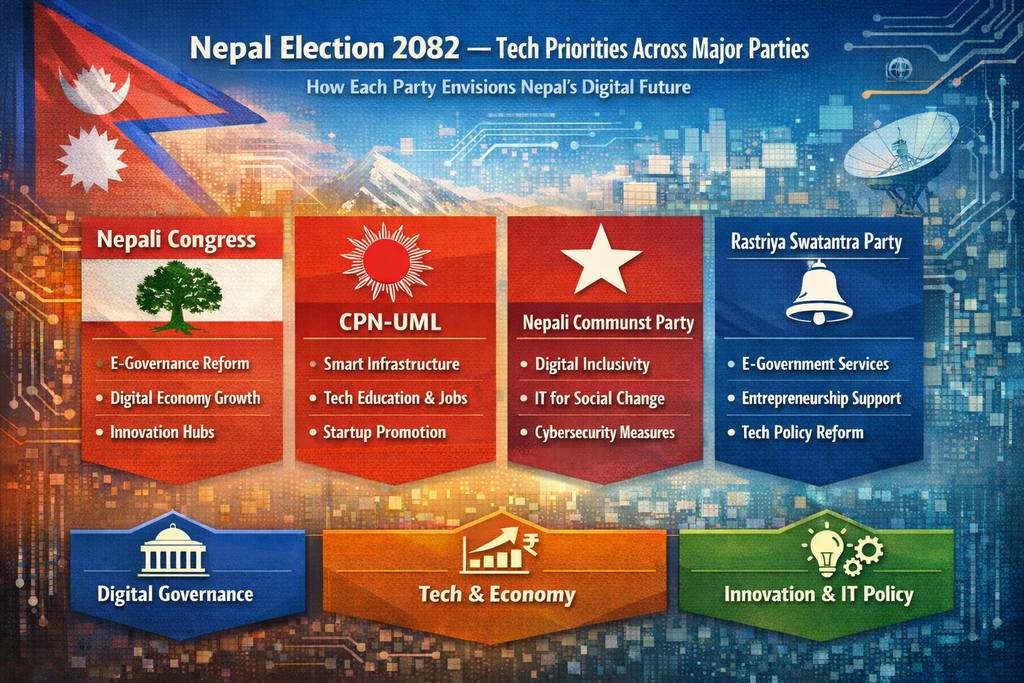
Introduction
As Nepal gears up for the Election 2082, scheduled for 5th March 2026,, technology has become a central theme in political agendas. Parties are positioning digital transformation as a cornerstone of economic growth, governance reform, job creation, and global competitiveness. Below is an analytical overview of each major political party’s technology-related priorities, from digital governance to AI, e‑services, and IT economy.
Tech Priorities: Party‑by‑Party Overview
 Nepali Congress (NC)
Core tech focus: Institutional digitization, Digital Nepal implementation, IT education & governance reform.
📌 Key priorities:
- Expansion of Digital Nepal Framework — digital public services & e‑government.
- Use of IT in transparency and corruption control.
- Expansion of online portals and Hello Sarkar e‑services.
- ICT promotion in public services and education.
 Rastriya Swatantra Party (RSP)
Core tech focus: Digital economy, e‑governance, strong data infrastructure.
📌 Key priorities:
- Paperless government and fully digital public service delivery.
- High‑speed internet access & secure national data centers.
- Clear data security laws.
- Promoting IT as a second economic pillar and expanding software/IT exports.
 CPN (Unified Marxist–Leninist / UML)
Core tech focus: ICT in public service reform & connectivity expansion.
📌 Key priorities:
- Online delivery of services (citizenship, licenses, taxes).
- Affordable & accessible communication and technology infrastructure.
- Expansion of free internet at schools and community centers.
- Implementation of modified Digital Nepal initiatives.
 Nepal Communist Party (Socialist / Maoist Centre / NCP)
Core tech focus: Broad digital transformation & science‑tech development.
📌 Key priorities:
- Long‑term ICT policy with significant budget allocation.
- Digitalizing government functions and services.
- Promoting ICT in health, education, infrastructure.
- Tech assembly industries and e‑monitoring systems.
 Ujyalo Nepal Party (emerging/tech‑aware)
Core tech focus: Tech in economic growth and smart city concepts.
📌 Key priorities (inferred from public statements and budget priorities):
- Investment in digital promotion and online outreach.
- Smart city planning & digital public engagement (digital ads, social outreach).
- (Official fully detailed tech manifesto pending release.)
 Rastriya Prajatantra Party (RPP)
Core tech focus: Digital economy & IT workforce enhancement.
📌 Key priorities:
- Digital Nepal framework adoption.
- Smart cities & smart villages across provinces.
- Zero tax on software exports to encourage IT businesses.
- Encouraging digital payments.
 Shram Sanskriti Party (SSP)
Core tech focus: Skills integration and technical education.
📌 Key priorities:
- Emphasis on technical education and engineering within vocational curricula.
- (No explicit comprehensive IT manifesto available yet, but support for tech education and digital skills implied from party platform.)
Comparison Table: Tech Priorities Across Parties
| Party | 🏛️ Digital Governance & e‑Gov | 💻 IT Economy & Exports | 🤖 AI / Innovation | 📡 Connectivity / Broadband | 📊 Data Security / Digital IDs |
| NC | ✔️ E‑Gov expansion & Hello Sarkar | ✔️ Skilled workforce | ✔️ Emerging focus | ✔️ accessible internet | ✔️ mention in manifesto |
| RSP | ✔️ Fully paperless gov | ✔️ IT exports & startup | ✔️ Tech infrastructure | ✔️ high‑speed national internet | ✔️ data laws & secure centers |
| CPN‑UML | ✔️ Online services | ✔️ ICT industry push | ⚙️ planned expansion | ✔️ free internet support | ⚙️ broad support |
| NCP / Maoist | ✔️ full digitalization | ✔️ tech hubs & knowledge parks | ✔️ AI & long‑term ICT funding | ✔️ online public services | ✔️ e‑services systems |
| Ujyalo Nepal | 🟡 tech in smart city planning | 🟡 digital outreach | 🟡 smart city concepts | 🟡 implied support | 🟡 not fully articulated |
| RPP | ✔️ Digital Nepal adoption | ✔️ software export incentives | ⚙️ limited mention | ✔️ communication access | ⚙️ digital payments |
| SSP | ⚙️ limited mention | ⚙️ tech education push | ⚙️ implied tech skills | ⚙️ educational connectivity | ⚙️ not detailed |
✔️ = Strong/explicit priority ⚙️ = Some mention/support 🟡 = inferred/limited data
Conclusion — The Tech Landscape of Nepal’s 2082 (BS) Election
Across Nepal’s political spectrum, technology is no longer optional — it’s a core part of electoral vision. While priorities differ, several shared themes emerge:
🔹 Digital governance & e‑government expansion — promised by most major parties.
🔹 IT economy & export growth — emphasized strongly by RSP and RPP.
🔹 Connectivity & digital infrastructure — a common priority across NC, UML, and Maoist variants.
🔹 AI, data protection & digital identity systems — rising in policy discussions.
As Nepal enters a digitally transformative decade, voters will weigh not just who governs, but how the state leverages technology for economic empowerment, public service, and inclusion.
asasasasasas